from the West Papua Advocacy Team (WPAT)
Reports from the Puncak Jaya region, inside the central highlands of West Papua, indicate that Indonesian security forces, principally the
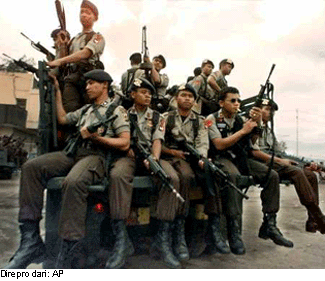
militarized police ("BRIMOB"), have launched actions against the small, armed Free Papua Movement (OPM). In May, security force spokespersons warned that if the local OPM leader, Goliat Tabuni, did not surrender by June 28, major operations would be launched to capture him and his small force. Notwithstanding that deadline, it appears that major operations are already underway. The Indonesian government announced in mid-June that additional BRIMOB personnel were being dispatched to the region.
According to reports from the field, the operations have already caused large numbers of civilians to flee to other villages or into the surrounding forests. Specifically, thousands of people are reportedly hiding in forests, notably some from the Tingginambut Distirct; other residents of Tingginambut District have fled to Kuyawagi Astir, Tiom, and Lani Districts. Civilians from the Districts of Yambi, Agandugume, and Ilaga Peak have fled to Majesty Towogi District.
These civilians, in particular those who have fled to the forests, face health and possibly life threatening conditions including lack of access to food, adequate shelter, and medical services. In the past such "sweeping operations," Indonesian security forces prevented provision of humanitarian assistance to these besieged populations.
Reports from the field also tell of security forces targeting of civilians through widespread arrests, also:
- A church in Kayogwebur district Tingginambut has been taken over as headquarters for the BRIMOB. Local people unable to worship there.
- Local people are forced to do labor tasks for Indonesian military.
- In the district of Kampong Tinggineri Tingginambut, a pregnant woman was raped by BRIMOB personnel in the first half of June.
- 12 houses and 2 churches have been burned by security forces in Gwenggu Pilia.
- In Pos Nalime Tingginambut District residents have been forced to clear their gardens and prepare landing positions for military helicopters.
- On June 11, BRIMOB conducted a residential sweep search of all houses on the road between Ilu and Mulia, detaining anyone without identification, putting them on Army trucks. (Most local people do not have ID and now afraid to leave their homes. As a result, gardens are untended and local commerce is crippled.)
Recalling previous such sweep operations -
West Papua Advocacy Team (WPAT) is concerned that those civilians who have fled their homes are in urgent need of humanitarian assistance.
The WPAT urges those concerned about these operations to contact their members of Congress and the administration to urge that the U.S. government press the Indonesian government about the urgency of meeting the humanitarian needs of the people in this region and to express concern about military and police acts against civilians.
There have been growing Papuan calls, including by the Papuan Provincial Legislative Assembly (DPRD), to pursue negotiations rather than a "security approach" as a means of resolving tensions in the region. Indonesian officials have publicly discussed a release of Papuan political prisoners.
Those concerned about the growing violence in West Papua should also urge the Congress and the administration to press the Indonesian government to reduce tensions in West Papua through humanitarian steps including:
- release Papuan prisoners of Conscience (Amnesty International has identified over 30 such prisoners);
- open a senior level, internationally monitored dialogue between the Central Government and Papuans as called for by leading Papuans officials and civic leaders.
-----