Showing posts with label US Senate. Show all posts

Thursday, February 25, 2016

ETAN Alert - Write your Senators today!

Write your Senators - email letters here.

ETAN ALERT
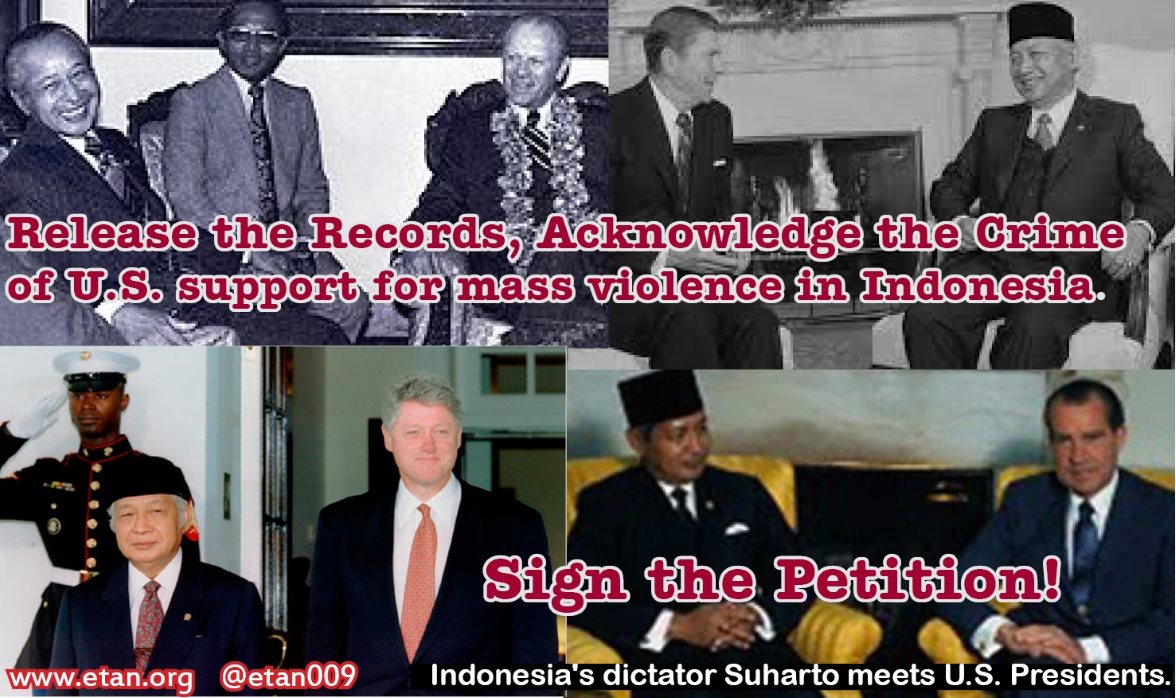
Reveal the Truth, Acknowledge the Crime

Take Action on U.S. Support for Mass Violence and Genocide in Indonesia

Take action on U.S. accountability for its role in the massacres that followed Suharto's brutal seizure of power.

Read whole alert here: http://etan.org/action/16lookofsilence.htm

1) Support S.Res. 273. Call your Senators and urge them to cosponsor Senator Tom Udall's (D-NM) resolution condemning the 1965-1966 mass murder in Indonesia and expressing concern about the lack of accountability for these crimes. 

Call the Capitol Switchboard - (202) 224-3121 - and ask for your Senators' offices. Once connected ask for a foreign policy aide. Urge the Senator to co-sponsor Senate Resolution 273 on Indonesia, summarize the resolution, and a give your reasons why you believe it is important.Stress the need for both the U.S. and Indonesia to acknowledge the past by releasing all its documents from 1965/66. By taking responsibility for its role in these crimes, the U.S. will be supporting justice, reconciliation and assist efforts in Indonesia to hold its security forces accountable and to lift ongoing restrictions on freedom of expression.

Please encourage others to call. Be sure to follow-up with an email or another call. Let us knowthe results of your calls.

S.Res. 273 urges Indonesia to consider a truth, justice, and reconciliation commission to address crimes against humanity and other human rights violations and calls on the U.S. government departments and agencies involved in developing and implementing policy towards Indonesia at the time to locate, recommend for declassification, and make available to the public all records from that time. Read more about the S.Res. 273 here: http://etan.org/news/2015/10senate.htm.

2) Sign our petition urging the U.S. government to take two immediate steps:

a) declassify and release all documents related to the U.S. role in the 1965/66 mass violence, and b) formally acknowledge the U.S. role in facilitating the 1965-66 violence and its subsequent support for the brutalities of the Suharto regime.
Thank you to all who have signed so far.

We also urge you to sign the petition by Human Rights Watch here.http://thelookofsilence.com/participate




Order the documentaries here and support ETAN
The Look of Silence.
Blu-RayDVDBlu-Ray (2 discs)DVD (2 discs)


Sunday, December 14, 2014

ETAN Supports Senate Resolution on 1965 Mass Violence in Indonesia

Read the whole media reelase here: ETAN Supports Senate Resolution on 1965 Mass Violence in Indonesia

December 11 - The East Timor and Indonesia Action Network (ETAN) today urged the U.S. Senate to act quickly and pass Sen. Tom Udall's (D-NM) resolution calling on the U.S. government to "make available to the public all classified records and documents concerning the mass killings of 1965 and 1966" in Indonesia.

The resolution, introduced on December 10, Human Rights Day, "condemns the mass murder" and "expresses great concern about the lack of accountability enjoyed by those who carried out crimes during this period."


"The peoples of the U.S. and Indonesia deserve to know the full truth about these events. The U.S. must declassify and release all files related to Suharto's U.S.-backed seizure of power and the horrific events which followed," said Chris Lundry of ETAN. 

Read the rest here: http://etan.org/news/2014/12senate.htm


Wednesday, January 23, 2013

Nine Questions for Sen. John Kerry, nominee for Secretary of State, on Indonesia, Timor-Leste and West Papua


East Timor and Indonesia Action Network and West Papua Advocacy Team

Contact: John M. Miller (ETAN), +1-917-690-4391
Ed McWilliams (WPAT), +1-575-648-2078

Human Rights and Security Assistance

Senator John Kerry (D-MA)

Background: Reform of the military and police in Indonesia has come to halt as the U.S. provides increased assistance to both. No credible effort has been made to bring to justice those responsible for the destruction of Timor-Leste in 1999 or the many human rights violations that occurred during Indonesia's 24-year-long illegal occupation. In July 2010, then Secretary of Defense Robert Gates announced the resumption of engagement with Indonesia's notorious Kopassus special forces. The U.S.-funded and trained police Detachment 88 is regularly accusedof human rights violations. The national government has done little to protect freedom of religion. Indonesian security forces often standby or actively assist in violations of religious freedom. Engaging with Indonesia's military and police has not worked to improve human rights or accountability.

Question: To what extent has U.S. training and other assistance to the Indonesian security forces, especially the Kopassus Special Forces and the "anti-terror" Detachment 88 abetted those forces' violations of human rights? What is the current relationship between the U.S. Administration and such forces as the Indonesian Special Forces and Detachment 88? Have the numerous well-founded allegations of human rights abuse and corruption targeting these institutions been thoroughly examined by the U.S. Administration? What has been the result of those examinations? Do you agree that the U.S. should stop training and selling weapons to the Indonesian military and police?
see also Congress Writes Administration on Kopassus Training

U.S. Military Assistance to Indonesia

Background
: Recent administrations have ended restrictions on military assistance to Indonesia. They argued that U.S. engagement encourages reform and progress on human rights. The opposite is true. Historically, reform in Indonesia has coincided with U.S. restrictions on security assistance. In recent years, the U.S. has re-engaged with Indonesia's notorious Kopassus special forces and is actively considering the sale of Apache attack helicopters which can be used for internal repression, including attacks on civilians in West Papua.

Question: What systems are in place to ensure that U.S.-provided weaponry and associated equipment have not been and will not be employed to violate human rights? Specifically, what guarantees are in place to ensure the Apache attack helicopters will not be employed to support Indonesian security force "sweep" operations in West Papua, where villagers have long suffered indiscriminate security force attacks? What restrictions should be placed on U.S. security assistance to Indonesia as a way to encourage reform, accountability for past human rights crimes, and ongoing respect for human rights?
Indonesia as Strategic Partner

Recent administrations have ended restrictions on military assistance to Indonesia, arguing that U.S. engagement encourages reform and progress on human rights. The opposite is true. Historically, reform in Indonesia has coincided with U.S. restrictions on security assistance.


Background: This administration has identified Indonesia as a "strategic partner" reflecting its growing regional economic, political and security importance. Despite Indonesia's impressive democratic progress, Indonesian security forces continue to be a target of strong criticism as a regular violator of human rights and as a corrupt institution that remains largely unaccountable to civilian rule. The State Department annual human rights reports have documented the broad unaccountability of the security forces under Indonesia's judicial system. The limited efforts to prosecute crimes against humanity during the Suharto dictatorships and its immediate aftermath have ended in failure. These security forces, notably, continue to conduct "sweep operations" in rural West Papua which have forced thousands of villagers to flee, destroyed homes, crops and churches, and led to the death of many. Security forces, including police, have repressed freedom of speech, harassing peaceful dissenters and employing draconian Suharto-era laws to label peaceful protesters as "treasonous." Similar repression has also been employed in the Moluccan islands.

Question: Given the strong and growing ties between the U.S. and Indonesian security forces, what should the U.S. do to influence these forces to end their violations of human rights and corruption and to subordinate themselves to civilian control?
see also Human Rights in Papua, West Papua Report (monthly) 

Justice for Timor-Leste
Background: During more than two decades of illegal occupation of Timor-Leste, Indonesian security forces committed serious crimes with impunity, taking as many as 184,000 Timorese lives and torturing, raping and displacing countless others. In 1999, after the East Timorese voted for independence, the Indonesian military and its militia proxies ransacked Timor-Leste. The magnitude of this destruction is clearly documented. Last year during a visit to Timor-Leste, UN Secretary-General Ban Ki-moon said: "All the perpetrators for the crimes against humanity and war crimes must be brought to justice." Timor-Leste's Commission on Truth, Reception and Reconciliation recommended an international tribunal should other efforts at justice fail. The government of Indonesia has proved unwilling to hold its security forces accountable.

Question: Do you support going to the UN Security Council to create an international tribunal for East Timor to make certain justice is served? What other steps should the U.S. take to support justice for these serious crimes, war crimes and crimes against humanity committed in East Timor since Indonesia invaded in 1975?
see also ETAN: 10 Years after Timor's Independence, Where Is the Justice?

Timor-Leste's Truth Commission
Background: The U.S. government has yet to respond to the report of Timor-Leste's Commission for Reception, Truth and Reconciliation (CAVR), although the president of Timor-Leste officially delivered a copy in 2003. Its recommendations include calls for an international tribunal, reparations from countries that supported the occupation, and restrictions on foreign assistance to the Indonesian military until it shows that it is a rights-respecting institution.

The U.S. government has yet to respond to the report of Timor-Leste's Commission for Reception, Truth and Reconciliation (CAVR)... Its recommendations include calls for an international tribunal.


Question: A number of Timor-Leste's Commission for Reception, Truth and Reconciliation recommendations are directed at the U.S. What do you think of the work of the CAVR and its recommendations about justice? Should the U.S. government issue a formal response to the CAVR report?
 
see also Congressmembers Urge Greater U.S. Commitment to Promote Justice for Timorese, Call for U.S. Response to CAVR Report
U.S. Aid to Timor-Leste
Background
: Timor-Leste has been independent for 10 years and remains heavily dependent on petroleum revenue. Following centuries of exploitation and occupation by external powers, its people are among the most impoverished in Asia. Current U.S. assistance to Timor-Leste is biased toward creating an unregulated economy and is increasingly emphasizing military aid. Former President Jose Ramos-Horta has argued that aid is better spent on the ground for rural development initiatives, rather than "to cover endless study missions, extremely generous consultant fees, repetitive reports and recommendations stating the obvious."

Question: Would you support assistance to Timor-Leste that is focused on improving the lot of the poorest? What should be done to strengthen non-oil sectors of its economy? Do you plan to re-evaluate the assistance the U.S. provides to Timor-Leste to make it more useful and effective? What should be the top priority of U.S. development assistance? Do you think current policy supports that emphasis? What would you change?
West Papua
Background: The Indonesian government maintains a heavy police and military presence in West Papua. The security forces regularly intimidate and threaten human rights activists, church leaders and members of indigenous communities who support greater autonomy or independence from Indonesia through peaceful means. Restrictions on international journalists, human rights advocates and diplomats hinder independent monitoring. Abuses committed in West Papua include the imprisonment of peaceful activists who raise the "Morning Star" flag, regarded as a symbol of Papuan identity and independence. Indonesian security forces opened fire on the peaceful Third Papuan National Congress in October 2011, killing at least three people. This interference with the right to peacefully assemble and express one's political views is a clear violation of international human rights. Last September, Secretary Clinton on her visit to Indonesia "deplore[d] violence of any sort in Papua" and called for "dialogue between Papuan representatives in the Indonesian Government" aimed at "resolving conflict peacefully, [and] improving governance and development."
Question: Does U.S. security assistance to Indonesia help or hinder an end to violence in West Papua? How can the U.S. best assist a peaceful resolution of the conflict there? Would you support suspension of security assistance to Indonesia until these human rights violations cease in West Papua?
see also West Papua Report (monthly); “Crimes Against Humanity: When Will Indonesia’s Military Be Held Accountable for Deliberate and Systematic Abuses in West Papua?” Hearing in House of Representatives September 22, 2010; Members of U.S. Congress Call Upon Indonesia to End Systematic Abuses in West Papua (November 18, 2011); Congressmember Faleomavaega Calls on Indonesia to Assure Safe and Humane Treatment of West Papuans in Custody and to Work for Their Release (October 21. 2011)

The U.S. government has yet to respond to the report of Timor-Leste's Commission for Reception, Truth and Reconciliation (CAVR)... Its recommendations include calls for an international tribunal.


West Papua Special Autonomy
Background: Since passage of legislation in 2001, the Indonesian government has pledged to institute "special autonomy" within West Papua. The approach, as conceived, was to grant greater autonomy to West Papua and to end decades of neglect that has led to stagnation of development and denial of basic services. For decades, West Papua has ranked at the bottom of for Indonesian provinces on indices measuring health, education and employment opportunities. The people of West Papua, through their elected and civil society leaders and through mass demonstrations, have declared "special autonomy" a failure. Nevertheless, the U.S. government continues to support this failed approach.

Question: Under your leadership, will the Department of State review "special autonomy" in the provinces of Papua and West Papua, and will you press the Indonesian government to revamp its failed approach to West Papua?
Access to West Papua
Background: The Government of Indonesia has long sought to prevent the international community from witnessing the repression of the Papuan people. It has forced the closure of the offices of the International Committee of the Red Cross and Peace Brigades International, blocked missions by Amnesty International and other international human right organizations, and regularly blocked or impeded travel to or within West Papua by diplomats, international journalists, researchers and others. A joint report by the Faith-Based Network on West Papua, Franciscans International, Papua Land of Peace and the Asian Human Rights Commission concluded that the Indonesian government is tightening restrictions on journalists and non-governmental organizations which seek to cover developments in West Papua. The U.S. Congress and several U.S. administrations have repeatedly called for an end to restrictions on travel to West Papua.

Question: What specific steps would the State Department, under your leadership, take to end restrictions on access to West Papua by journalists, humanitarian organizations and others?

Also

Wednesday, November 10, 2010

ETAN - and the peoples of East Timor and Indonesia - Will Miss Senator Feingold

When Wisconsin Sen. Russ Feingold lost his re-election bid Nov. 2, it didn’t only sadden U.S. progressives. The people of East Timor and Indonesia lost a strong ally in their struggle for democracy.

In late 1992, as Feingold was campaigning to join the U.S. Senate, East Timor suffered perhaps its most infamous massacre. The occupying Indonesian military fired on a peaceful pro-independence protest, killing more than 270 people. While the massacre received international attention -- thanks to the presence of Western journalists, including Amy Goodman and Allan Nairn -- East Timor remained an obscure issue in the United States.
But, half a world away, Feingold took notice.


Throughout his 18 years in office, Feingold remained a stalwart and effective advocate for a just U.S. foreign policy. He maintained restrictions on arms sales and military training for Indonesia.

In his first year in the Senate, Feingold, a Democrat, authored an amendment to place human rights conditions on arms sales to Indonesia. The amendment unanimously passed the Senate Foreign Relations Committee. This shocked Indonesian officials, who had for decades been able to count on the U.S. government eagerly providing military equipment while turning a blind eye to its brutal use against Timorese and Indonesian civilians.

Throughout his 18 years in office, Feingold remained a stalwart and effective advocate for a just U.S. foreign policy. He maintained restrictions on arms sales and military training for Indonesia. After a broad-based pro-democracy movement ousted Indonesian dictator Suharto in 1998, Feingold pushed the Clinton administration and Congress to ensure that political prisoners were freed, the military was reformed and civic institutions were fostered. Feingold supported East Timor’s referendum for independence in 1999, and repeatedly called for the Indonesian government and military officials responsible for serious crimes there to be held responsible. He has also raised concerns about continuing military abuses in Papua, a region with an independence movement and a history similar to East Timor.

More recently, Feingold cautioned both the Bush and Obama administrations on their rush to engage Indonesia in the “war on terror.” As the world’s most populous Muslim nation, and one where moderate forms of Islam predominate, Indonesia took on new importance for the United States following the 9/11 attacks. The United States’ relationship with Indonesia must be “aimed at fighting terrorism while supporting that country’s recent democratization,” Feingold wrote after visiting Indonesia in 2006.

You might think that President Obama, who visited Indonesia the week after the U.S. midterm elections, would agree. After all, Obama spent part of his childhood there and lamented, in his memoir “The Audacity of Hope,” that the U.S. negatively affected Indonesia by encouraging “tyranny, corruption and environmental degradation when it served our interests.”

Sadly, the U.S. hasn’t followed Feingold’s advice. Last summer, the Obama administration announced that the United States would work with Kopassus, the Indonesian military’s notorious special forces. Kopassus troops routinely engaged in torture, rape and murder in East Timor, “disappeared” Indonesian student activists, and killed a prominent Papuan leader, among other atrocities. Providing U.S. training to Kopassus “would undermine the goal of creating a professional military … that upholds human rights norms,” warned Feingold when the Bush administration considered engaging Kopassus.

For all his leadership on Southeast Asia issues, Feingold didn’t become a media darling, fill his campaign coffers or otherwise win broad acclaim. He helped the people of East Timor and Indonesia simply because it was the right thing to do. That’s what makes him a remarkable public servant and a wonderful human being.
We in the U.S. -- and our sisters and brothers around the world -- will sorely miss him.

Diane Farsetta is the coordinator of the Madison chapter of the East Timor Action Network. She is a former Field Organizer for national ETAN.