Showing posts with label Vanuatu. Show all posts

Wednesday, April 8, 2015

It's back! April 2015 West Papua Report

West Papua Report  April 2015


CONTENTS

This edition's Perspective is an interview with Octo Mote, General Secretary of the United Liberation Movement for West Papua, on the prospects for MSG membership.

In UPDATE (covering February and March) the West Papua Advocacy Team announces that it has awarded its 2015 "John Rumbiak Human Rights Defenders Award" to the people and government of Vanuatu. Security forces in Yahukimo District have fired on civilians who were raising funds for humanitarian relief in cyclone-ravaged Vanuatu, killing one and wounding four. Indonesia's Foreign Minister was dispatched to three Pacific island states to try to dampen growing support for West Papua's application to join the Melanesian Spearhead Group. Archbishop Tutu urged the United Nations to investigate the fraudulent "Act of Free Choice" through which Indonesia forcibly annexed West Papua. Rights groups have called for Indonesia to address outstanding human rights cases in West Papua. Four youths were beaten by security forces in Jayapura. Plans by Freeport to construct a smelter in Papua have not involved the Kamoro on whose land the smelter will be located. The Kamoro have long suffered from the effects of Freeport's mining operations.


In CHRONICLE, we note upcoming demonstrations in London and New York; an in-depth analysis of Jakarta's security approach to West Papua; an argument that human rights violations fuel Melanesian support for West Papuans, and a look at ongoing media restrictions.

Thursday, January 8, 2015

West Papua Report for January 2105

Read the latest issue of the West Papua Report! 

CONTENTS

This edition's Perspective is part two of Made Supriatma's overview of Indonesian security force deployments in West Papua. This looks at the police and intelligence agencies. In the UPDATE: A report on the brutal killing of five Papuan civilians and wounding of many more by security personnel in the Paniai area in early December. Papuan leaders gathered in Vanuatu launched a new coalition to apply for membership in the Melanesian Spearhead Group. President Widodo pledged during a Christmas visit to West Papua to launch a joint investigation of the killings in Paniai. His administration also promised to "listen" to Papuans and to direct more resources to West Papua to develop railroad infrastructure. A minister contends that money flowing from the Freeport mine will finance development plans.  December saw more violence in the vicinity of the mine. The discovery of gold in protected forests in West Papua does not necessarily auger well for Papuans. In Chronicle, Yan Christian Warinussy, Executive-Director of the LP3BH, opposes plans to create a new military command in West Papua.

Jokowi vists Papua in December 2014.


Wednesday, October 8, 2014

West Papua Report October 2014: Widodo challenged, access, indigenous land rights, Scotland, Fiji, MIFEE, Vanuatu

West Papua Report October 2014 is now out. Read the full report here


CONTENTS

This month's PERSPECTIVE by WPAT's Edmund McWilliams looks at the challenges facing incoming President Joko Widodo, including those posed by West Papua.

This edition's UPDATE groups urge police to provide security to West Papua human rights defenders and reviews growing Indonesian and international calls for an end to repression in West Papua with particular focus on demands for an end to restrictions on access by journalists and others to West Papua. The surge in concern is prompted in large measure by the continued detention of two French journalists whose has been the focus of numerous appeals for their prompt release (see September 2014 West Papua Report). A local Papuan official drew attention to the release ofgreenhouse gases associate with the MIFEE project. A West Papuan conference hosted by Vanuatu has been postponed to December. Attacks on Indonesian security forces in the Papuan highlands continued in September. Indonesia's national Human Rights Commission is holding a series of hearings on the land rights of indigenous peoples, including in West Papua, The U.S. military has begun training for Indonesian military personnel with the AH-64 Apache helicopters which will enhance TNI capacity to conduct "sweep" operations in West Papua.

CHRONICLE notes an analysis by Al Jazeera America of the targeting of journalists in West Papua. Fijian NGO urges government to support West Papua, The September referendum which afforded Scotland a vote on their political status prompted several analyses that highlighted the continuing denial of the right to self-determination in West Papua.


Sign ETAN's Petition to U.S. Government


Sunday, August 10, 2014

latest West Papua Report for August 2014

Read here: http://etan.org/issues/wpapua/2014/1408wpap.htm

CONTENTS

This month's PERSPECTIVE takes the form of West Papua Advocacy Team's (WPAT) open letter to President-elect Joko "Jokowi" Widodo urging him to address fundamental problems in West Papua.
Human Rights are not optional for West PapuaUPDATE notes that Widodo won substantial majorities in West Papua, but that many Papuans boycotted the election. A prominent Papuan activist fled West Papua to Australia following attempts to abduct her. The Asian Human Rights Commission called the President-elect's attention to outstanding human rights problems in West Papua and elsewhere. Leaders of the "Federal State of West Papua" were released after serving nearly three years in prison for their roles in the Third Papuan People's Congress. Planning is under way for a meeting of Papuan groups in Vanuatu. President-elect Widodo has criticized a deal with Freeport McMoRan signed by outgoing president Yudhoyono. West Papuan students staged coordinated protests in Java over the denial of Papuan rights, including the right to self-determination.Recent shootings have raised concerns over a possible "sweeping operation" as a retaliatory "collective punishment" response. The new Army Chief of Staff has a record of provocative statements which point to an intent to defame and persecute rights advocates.

CHRONICLE highlights a motion by the Green Party's Catherine Delahunty in the New Zealand Parliament concerning the absence of media freedom in West Papua. A new documentary reveals repression in West Papua. Amnesty International urged Widodo to address human rights abuses and security force impunity. A new article focuses on institutional racism in West Papua. Groups write urging Indonesia to implement the UN's Universal Periodic Review recommendations concerning West Papua.


Link to this issue: http://etan.org/issues/wpapua/2014/1408wpap.htm 
Back issues of West Papua Report


NZ Green MP Catherine Delahunty and Maire Leadbeater (West Papua Action Auckland)
 receive 
the John Rumbiak Human Rights Defenders Award,given annually
by the West Papua Advocacy Team. Photo by 
AWPA.


Wednesday, May 7, 2014

The May 2014 West Papua Report is now out!

Read it here

CONTENTS

This edition's PERSPECTIVE by Dr. Budi Hernawan examines Vanuatu's efforts to place West Papua on the international human rights agenda. 

In UPDATE, Indonesia was questioned by the UN Committee on Economic, Social and Cultural Rights. The Indonesian military want to purchase additional U.S. assault helicopters. New violence creates tension on the PNG border near Vanimo; more arrests and torture of peaceful Papuan student protesters; the anniversary of transfer of West Papua to UN control in 1963; the establishment of a new Free West Papua office in Perth, and the sentencing of the former Merauke District chief for graft.

In CHRONICLE: A photo project by Rohn Radheya draws attention to West Papuans struggle for respect of their political and other human rights. David Robie questions why South Pacific nations have not supported Vanuatu's efforts to draw international attention to Indonesia's human rights violations in West Papua. Craig Harris highlights Papuans criticism of mining giant Freeport McMoRan at a U.S. environmental conference. Oil palm plantations in West Papua and elsewhere face growing scrutiny.

Photo by Rohan Radheya.

Thursday, April 3, 2014

West Papua Report April 2014: Remembering Edward Masters, Mangrove forests, MIFEE, Unity, Vanuatu, human rights

Now out! West Papua Report April 2014 Read here; http://etan.org/issues/wpapua/2014/1404wpap.htm

CONTENTS
This edition of the West Papua Report marks ten years of monthly publication. It leads with a PERSPECTIVE that takes a detailed look at the career of Edward E. Masters, former U.S. Ambassador to Indonesia and founder of the U.S. Indonesia Society. UPDATE completes the analysis of the most recent U.S. Department of State's annual human rights report. Also, development threatens vital mangrove forests in West Papua. A conference in West Papua underscored the need for unity among Papuans. Hunted activist Buchtar Tabuni has appealed for international protection. The U.S. plans to ship the Indonesian military additional F-16s jet fights later this year. We also note reports of the continuing failure of the Indonesian government to provide minimal health care for Papuans. In CHRONICLE, we highlight a report detailing the human costs of the agribusiness MIFEE project. Vanuatu Prime Minister Moana Carcasses Kalosil brought his call for respect for Papuan rights to the UN Human Rights Council. Budi Hernawan analyzes the prospects for the resolution called for in the speech. Members of the European Parliament are urging the EU to support human rights and peace in West Papua.  The East Timor and Indonesia Action Network (ETAN) has published a backgrounder examining the problematical records of some of the possible candidates for Indonesia's president or vice president.

Mangrove forest in West Papua.

Friday, March 7, 2014

Prime Minister of Vanuatu, speaks on West Papua at UN Human Rights Council


Moana Carcasses Kalosil, Prime Minister of Vanuatu at at March 4, 2014 High-Level Segment
 - 5t
h Meeting, 25th Regular Session of UN Human Rights Council 

Moana Carcasses Kalosil, Prime Minister of Vanuatu, speaks on West Papua at UN Human Rights Council 

UN live video of Prime Ministrer Carcasses’ speech

Text of speech


 The Republic of Vanuatu is very pleased to be addressing this meeting today. I have come here to join the leaders of the world to discuss and raise concerns on different human rights challenges affecting millions of innocent citizens across the entire globe, from the island countries and in countries across continents.

    Mr President, the focus of my statement here today will be on two important but very highly critical issues to the entire population of my country. First I want to focus on the rights of our indigenous people to practise their cultural and spiritual rituals in the two of our islands in the Tafea Province, South of Vanuatu. And Secondly, I will bring to the forefront or our debate some of the issues regarding human rights abuses in West Papua that have been very disturbing to the community of democracies around the world.


    Mr President, my country’s struggle to achieve political independence in 1980 was marked with incidences of social protests and emergence of some political movements within our country. We were Melanesians being governed by Britain and France in our own mother land. Prior to 1980, we were stateless in our country and we were neither French of British citizens.


    And for almost four decades, we were exposed to foreign rule. So we had to struggle to construct our identity as free people to live in dignity. Independence was our objective. And this was a compelling thrive that motivated our leaders to achieve nothing less than political independence.


    We did not fight for independence because we were economically and financially ready. We did not fight for independence because our colonial masters were killing our people. No. We fought for our political independence because it is our God given right to be free. Freedom was our inalienable right. It is a human right. And Vanuatu was proclaimed independent on 30 July 1980.


    Thirty three years after our independence I am delighted to say that France has begun to demonstrate its willingness for our indigenous people to visit two of our very sacred islands, Umaepnune (Mathew) and Leka (Hunter) in the southern part of our country to fulfil their cultural and spiritual obligations.


    Rituals and ceremonies have continued to be held on other islands of the Tafea province annually despite the blockage previously imposed by the French authority for our tribesmen to travel to the sacred islands Umaepnune and Leka islands to fulfil their cultural and spiritual duties.


    Mr President, I want to now focus my attention on the chronic human rights challenges that has affected the indigenous Melanesian peoples of West Papua since 1969. And I do this with great respect and humility. My country is here in this meeting to amplify the concerns for human rights in West Papua. We are very concerned indeed about the manner in which the international community has neglected the voices of the Papuan people, whose human rights have been trampled upon and severely suppressed since 1969.


    Mr President, you are presiding over the noblest organ of the United Nations – the Human Rights Council. But what do we do when rights of the Melanesian people of West Papua are challenged with military interventions and presence?


    Since the controversial Act of Free Choice in 1969, the Melanesian People of West Papua have been subject to ongoing human rights violations committed by the Indonesian security services. The world has witnessed the litany of tortures, murders, exploitation, rapes, military raids, arbitrary arrests and dividing of civil society through intelligence operations.


    The Indonesian National Commission on Human Rights (KOMNAS HAM) concluded that these acts constitute crimes against humanity under Indonesian Law No. 26/2000 (KOMNAS HAM 2001,2004).


    In this climate of fear and repression of political dissent, and blatant negligence by the international community including the UN and the powerful developed countries since 1969, we find this forgotten race still dare to dream for equality and justice. Yet the democratic nations have kept silent.


    Mr President, as a Melanesian citizen, I have come here to call for immediate action. Injustice in West Papua is a threat to the principle of justice everywhere in the world. I do not sleep well at night when I know that in 2010 Yawan Wayeni, known as a separatist was videotaped by the security forces as he was lying in a pool of his own blood with his intestines seeping from a gaping wound in his abdomen.


    It concerns me that in October 2010 Telenga Gire and Anggen Pugu Kiwo were tied by the military and were severely tortured. It concerns me when I see the video footage of a group of Papuan men bounded and being kicked in the head by uniformed soldiers who are meant to protect them.


    I am worried because between October of 2011 and March 2013, 25 Papuans were murdered and nothing has been done to bring perpetrators to justice. And it embarrasses me, as a Melanesian, to note that roughly 10 percent of the indigenous Melanesian population have been killed by the Indonesian Security forces since 1963. While I acknowledge the 15 years of reformation that has taken place, I am also worried that Melanesians will soon become a minority in their own motherland of Papua.


    Mr President, in a world so now closely connected with innovative technology, there should be no excuses about lack of information on human rights violations that have plagued the Papuan people for more than 45 years. Search the internet and research papers by academic institutions and international NGOs and you will find raw facts portraying the brutal abuse of the rights of the Melanesian people in Papua.


    But why are we not discussing it in this council? Why are we turning a blind eye to them and closing our ears to the lone voices of the Papuan people, many of whom have shed innocent blood because they want justice and freedom.


    Will this august council hear their cries and now go forward to protect their human rights and put right all wrong of the past?


    I have listened attentively to the voice of a former civil servant Mr Filep Karma and student Yusak Pakage who were sentenced to 15 and 10 years in prison and speaking from behind bars, calling on our countries in the Pacific to speak out against the injustice against them. These are the children of the warriors who have stood firm to fight during the Second World War in the Pacific and who helped bring peace and security in our part of the world.


    It is now our duty to bring peace to their tribal villages and communities by affording them their basic human rights that most of us here take for granted.

    I am very encouraged that the matter has now reached the European Union Committee on Human Rights and we look forward for some actions to improve the human rights conditions of our brothers and sisters in Papua.


    I further call on the governments of the developed countries, including the African nations and the island countries of the Caribbean and the Pacific, to condemn the issue of human rights violations.


    I want to echo the words of Martin Luther King, Jr., who said in his speech in 1963 that, “nothing in the world is more dangerous than sincere ignorance and conscientious stupidity.”


    We, the democratic nations, must not ignore the cries of the Papuan people.


    Mr President, the concerns we are raising here is more than a question of keeping 70 percent of the wealth from oil and gas in West Papua, it is the question of political status. The concerns we are raising here, is more than the question of economic status were 80 percent of wealth from forestry, fisheries and general mining are kept in Papua.


    It is a question of the respect of the human rights and existence of the Melanesian people. Our concern is not to see how much they have been fed by a golden spoon, but to see the measure of respect for freedom accorded to the Papuans as equal citizens. And to what degree the civil society are given the right to express concerns about the quality of governance in their motherland.


    For this should be a measure of a vibrant democracy.


    Mr President, access must be allowed for the UN human rights monitor, international journalists and international human rights NGOs to visit West


    It is clear from many historical records that the Melanesian people of West Papua were the scapegoat of Cold War politics and were sacrificed to gratify the appetite for the natural resources which this country possess.


    Mr President, if the UN Representative, Mr Ortiz Sanz, had described the West Papuan issue as a cancer growing “on the side of the and that his job was to remove it”, it is very clear today from what we have seen that this cancer was never removed but simply concealed.


    One day, this cancer will be diagnosed. We must not be afraid if the UN had made some mistakes in the past. We must admit our mistakes and correct them.


    Mr President, as I close, my government believes that human rights challenges of Papua must be brought back to the agenda of the United Nations. I call on the Human rights Council to consider adopting a resolution to establish a country mandate on the situation of human rights in West Papua. The mandate should include investigation of the alleged human rights violation in West Papua and provide recommendations on a peaceful political solution in West Papua.


    This will help to assist in supporting H.E. President Yudhoyono’s pledge to hold dialogue with Papua.


    Thank you once again for the opportunity to express my views in this forum.


    Long God Yumi Stanap. I God we Stand. Thank you.


    Many are martyrs that have been persecuted and brutally murdered because the carry the unspoken voices of the millions now living in fear in the valleys and lofty mountains of Papua. They are demanding recognition and equality and a respect for their human rights and to live in peace.


    Papua.


Wednesday, December 4, 2013

West Papua Report December 2013 - Religious Transformation, crackdown, Freeport, autonomy, Vanuatu speaks out andmore

Latest West Papua Report is now available here


CONTENTS

In this edition's "Perspective," Dr. Charles Farhadian describes the transformation of the religious landscape of West Papua, in particular the role of the Indonesian government in the shift of the region from predominantly Christian to predominantly Muslim.

This month's "Update" leads with the police crackdown on West Papuan demonstrators which left at least one Papuan dead, many injured and many under arrest. WPAT sources in Papua New Guinea report that Papuan rights supporters foiled efforts by national police to arrest Port Moresby Governor Powes Parkop for flying the Papuan Morning Star Flag on December 1. Two reports look at the mining giant Freeport McMoRan, including its "greenwashing" activities. Moana Carassas, Prime Minister of Vanuatu, raised the plight of the people of West Papua at the Commonwealth Heads of Government meeting in Sri Lanka. A prominent Indonesian journalist called for greater transparency by the Indonesian government in dealing with West Papua.  A regional journal reports on West Papuan activists in carrying their message to the nations of the Pacific.

In "Chronicle," we note condemnation of recent police violence in West Papua by Amnesty International and the West Papua Advocacy Team. The impact of the recent "Freedom Flotilla" is considered in a comprehensive essay. West Papuan voices are largely absent in the ongoing reconsideration of special autonomy for West Papua.  An OpEd by ETAN board member Andrew de Sousa looks at the role of the "School of the Americas" in training military officials who have notorious human rights records. A regional conference examined policing practices.


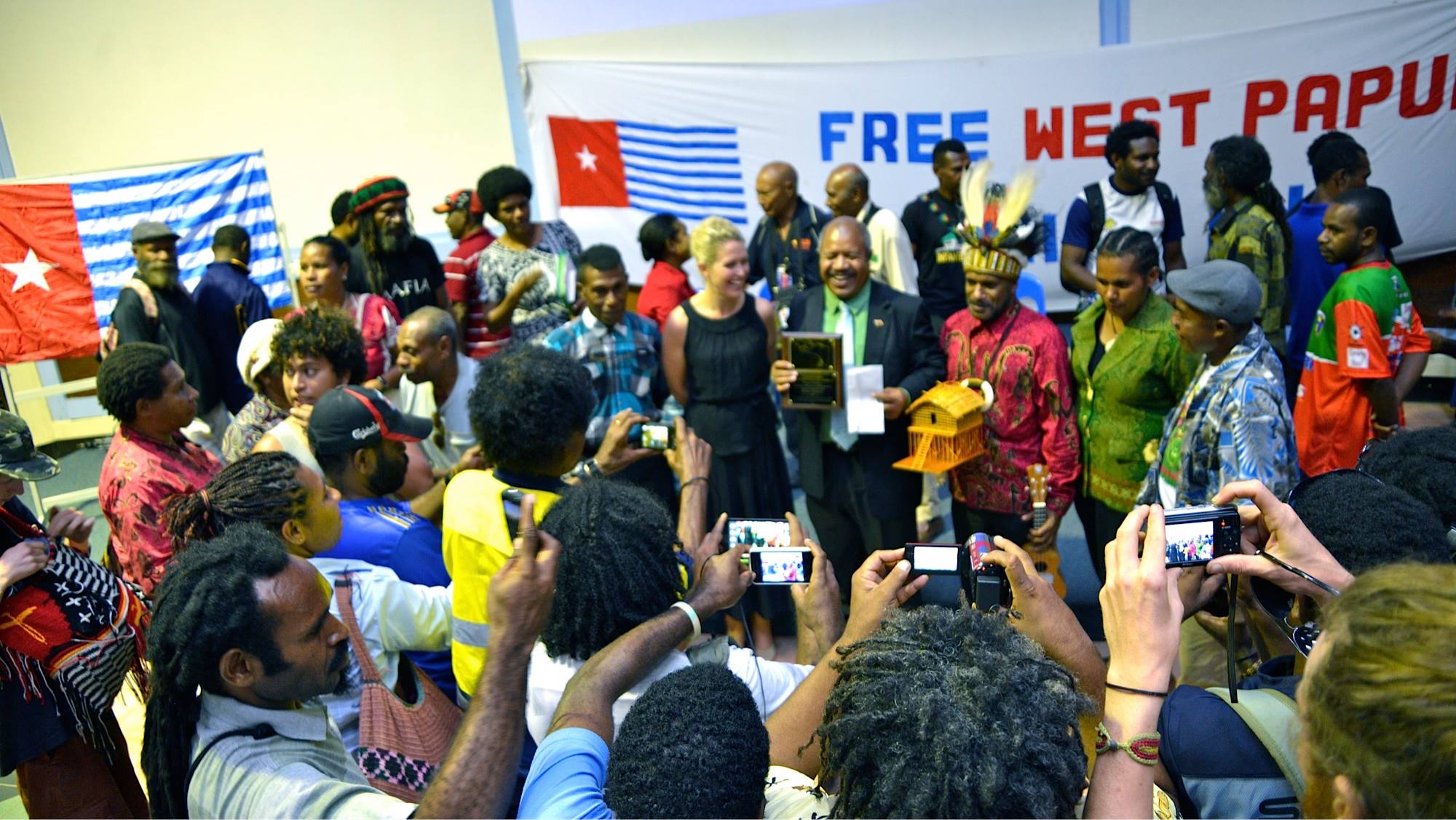
Powes Parkop, Governor of Port Moresby, Papua New Guinea's capital region, was presented with the John Rumbiak Human Rights Defenders Award" for 2013. Parkop (center, holding plaque), with Jennifer Robinson and Benny and Maria Wenda in Port Moresby.


Support ETAN