This blog supplements ETAN's website (etan.org) and listservs. It includes news and comment on justice, human rights, democracy, security, foreign affairs, U.S policy, the environment, and other issues related to the two countries. ETAN supports justice, accountability, human rights and democracy and is non-partisan.
This edition's Perspective discusses the implications for West Papua for the Indonesian military's continuing effort to re-involve itself in civilian affairs.
Update summarizes the grave problems of toxic smoke from massive fires set by palm oil plantation developers and others across the Indonesian archipelago. For the first time, fires are taking place on a large scale in West Papua. Transmigration continues to undermine West Papuans. The lack of Papuan involvement in the controversial plan to extend Freeport's mining concession in West Papua is raising concerns. The Indonesian government'sMelanesian gambit meets resistance.
Chronicle announces two important new reports and calls attention to the special problems posed by military repression for Papuan women, We link to Democracy Now! coverage by of President Widodo's visit to the U.S. The Indonesian Perss Council derends press freedom in West Papua. Maire Leadbetter sees hope for West Papua.
Want to receive issues of the West Papua Report via email: send us a note.
Cartoonist's depiction of Indonesian government restrictions on media freedom and rights monitoring in Papua. Copyright 2015 Toni Malakian for Human Rights Watch.
If we didn't know any better, we would say President Widodo was avoiding us! He cancelled the two events on his preliminary schedule that we had planned to bring our messages of support for human rights and justice in Indonesia and West Papua. Stay tuned for future activities.-- John M. Miller for ETAN. Join ETAN, Sign up today! Protest Freeport and Indonesia's Theft of West Papuan Resources
Please note; The Washington, DC demonstration is cancelled. President Jokowi's planned meeting with Freeport will not take place. The California demonstration is still on! Sign up for ETAN's email lists
Wednesday, October 28, 2015, 09:00 - noon Where: Computer History Museum 1401 N. Shoreline Blvd, Mountain View, CA 94043
Contact : Peter Phwan, ETAN/ICANet, San Francisco (415) 812-2414 Muhamad Amin, www.jokowitodo.org, San Francisco (415) 412-6372 John M. Miller, East Timor and Indonesia Action Network (ETAN), 917-690-4391 john@etan.org Facebook page Indonesia's President Joko "Jokowi" Widodo will shortly visit the United States to meet with President Obama. On October 28, President Jokowi is set to give a speech at Computer History Museum in Silicon Valley. This forum will be all about business. Jokowi was elected with the promise that his administration would different. He has yet to fulfill this promise. Positive initiatives by President Jokowi have been undermined by his own officials and many important issues, such as justice and accountability for past human rights crimes, have not been seriously addressed. More information here
Monday, October 26, 2015, 8:45 - 9:45 am Willard Hotel Contact John M. Miller, East Timor and Indonesia Action Network (ETAN), 917-690-4391, john@etan.org On Monday, Oct. 26, Indonesia's President Joko "Jokowi" Widodo will meet with officials of the Freeport McMoRan mining company. Freeport, which runs what at among the world's largest copper and gold mine in West Papua. The mine is Indonesia's largest revenue generator. Monday's meeting is part of negotiations about the renewal of Freeport's license, including a new split of the mine's revenue. Revenue that rightfully belongs to the West Papuan people. More information here
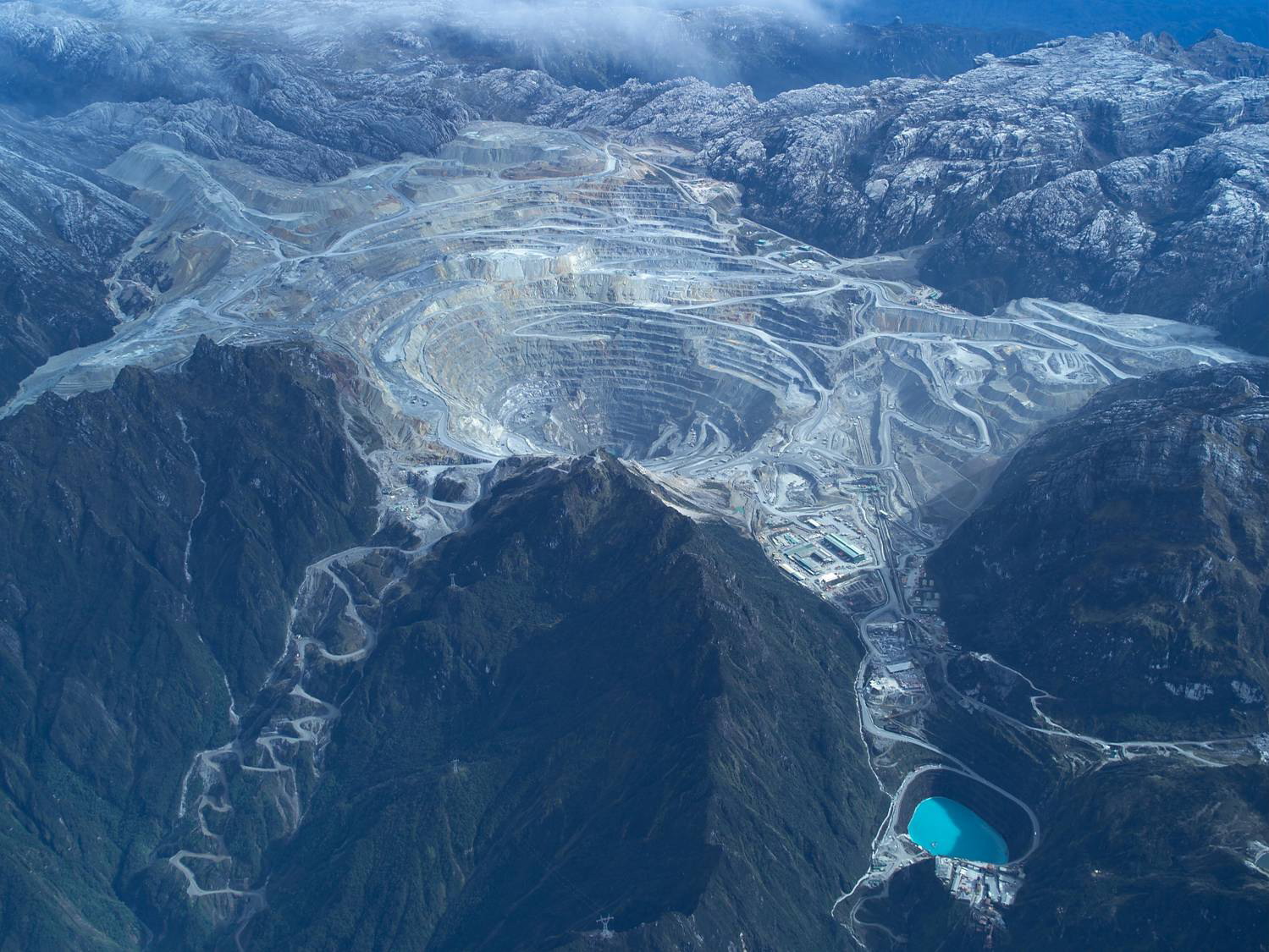
Freeport's Grasberg mine in West Papua. Credit: Panos Pictures/Rob Huibers
Now out - April 2015 West Papua Report Read report here
CONTENTS
This edition's PERSPECTIVEprovides a detailed overview of the Tolikara incident in which security force fired on a demonstration by Christian Papuans killed one and injured 11 others. The demonstrators then attacked a Muslim community, burning kiosks and a mosque. Years of government "transmigration" policies and neglect of Papuans have left West Papua a powder keg. Despite this, the local Tolikara community has come together to resolve tensions.In UPDATE: Pressure is growing on the Indonesian government to credibly investigate the December 14, 2014 murder of four West Papuans by security forces. The National Human Rights Commission (Komnas Ham) "Ad Hoc Investigation" has made little headway and competing security force investigations appear aimed at pressuring victim families to abandon efforts to force accountability. Negotiations between the Indonesian government and mining giant Freeport McMoRan have led to a six month extension of its license. Talks to renew its contract have not yet gotten underway and are essential if Freeport operations are to continue past 2021. There are growing calls to reduce security forces in West Papua. In CHRONICLE: Demographic trends in West Papua which have seen the reduction of Papuans to the status of a minority in their own land. Renowned human rights campaigner Carmel Budiardjo calls into question the United Kingdom's cooperation with the Indonesian government. AWest Papua "embassy" was temporarily set up in Darwin. The Pacific Islands Forum was urged to put West Papua on its agenda.
This edition's Perspective is an interview with Octo Mote, General Secretary of the United Liberation Movement for West Papua, on the prospects for MSG membership.
In UPDATE (covering February and March) the West Papua Advocacy Team announces that it has awarded its 2015 "John Rumbiak Human Rights Defenders Award" to the people and government of Vanuatu. Security forces in Yahukimo District have fired on civilians who were raising funds for humanitarian relief in cyclone-ravaged Vanuatu, killing one and wounding four. Indonesia's Foreign Minister was dispatched to three Pacific island states to try to dampen growing support for West Papua's application to join the Melanesian Spearhead Group. Archbishop Tutu urged the United Nations to investigate the fraudulent "Act of Free Choice" through which Indonesia forcibly annexed West Papua. Rights groups have called for Indonesia to address outstanding human rights cases in West Papua. Four youths were beaten by security forces in Jayapura. Plans by Freeport to construct a smelter in Papua have not involved the Kamoro on whose land the smelter will be located. The Kamoro have long suffered from the effects of Freeport's mining operations.
In CHRONICLE, we note upcoming demonstrations in London and New York; an in-depth analysis of Jakarta's security approach to West Papua; an argument that human rights violations fuel Melanesian support for West Papuans, and a look at ongoing media restrictions.
This month's PERSPECTIVE takes the form of West Papua Advocacy Team's (WPAT) open letter to President-elect Joko "Jokowi" Widodo urging him to address fundamental problems in West Papua. UPDATE notes that Widodo won substantial majorities in West Papua, but that many Papuans boycotted the election. A prominent Papuan activist fled West Papua to Australia following attempts to abduct her. The Asian Human Rights Commission called the President-elect's attention to outstanding human rights problems in West Papua and elsewhere. Leaders of the "Federal State of West Papua" were released after serving nearly three years in prison for their roles in the Third Papuan People's Congress. Planning is under way for a meeting of Papuan groups in Vanuatu. President-elect Widodo has criticized a deal with Freeport McMoRan signed by outgoing president Yudhoyono. West Papuan students staged coordinated protests in Java over the denial of Papuan rights, including the right to self-determination.Recent shootings have raised concerns over a possible "sweeping operation" as a retaliatory "collective punishment" response. The new Army Chief of Staff has a record of provocative statements which point to an intent to defame and persecute rights advocates.
NZ Green MP Catherine Delahunty and Maire Leadbeater (West Papua Action Auckland) receive the John Rumbiak Human Rights Defenders Award,given annually by the West Papua Advocacy Team. Photo by AWPA.
'Thank you cards" from Indonesia found buried deep in the archives, well in the back of a file cabinet. Click on each to read and for more information and background.
West Papua Report April 2013
Challenges in West Papua, New Roads, Military Impunity, Freeport, New Governor, MSG
CONTENTS: This edition of the West Papua Report offers the PERSPECTIVE of a longtime observer of West Papua who recently traveled to the Central Highlands, who reports the growing militarization of the region and the negative impact of that military build up on human rights and in stoking rising communal tensions. In UPDATE we note that the Indonesian military will shortly begin a massive road project which will likely service military rather than Papuan interests. New contract negotiations between the central government and the Freeport-McMoRan mining operation are proceeding absent West Papuan participation and without regard for their interests. The new Governor of Papua province appears not to understand problems of development and security facing the region. Papuans have again called for an end to the presence of the notorious "Special Forces" (Kopassus) in their homeland. Indonesian and international calls for an end to the impunity accorded Indonesian military leaders and personnel for human rights abuses are growing. That impunity gives license to continuing abuse and criminal activity by the military. WPNCL pressed it case to have West Papua join the Melanesia Support Group at a meeting with Fiji Prime Minister Banimarama. CHRONICLE highlights two first-hand accounts of the Wamena area and a review of Eben Kirksey's Freedom in Entangled Worlds: West Papua and the Architecture of Global Power.
There is perhaps no more remote struggle for human dignity and fundamental rights, including the right to self-determination, than that of the West Papuan people who for millennia have made their homes on what since 1963 been the Indonesian-controlled Western half of the island of New Guinea. The absence of significant international awareness of the Papuan struggle reflects in part its off-the-beaten path location. But the international community's general ignorance of the decades-long suffering of the Papuan people under Indonesian occupation largely derives from its successful efforts to hide its inhumane actions there. For decades Indonesia has imposed harsh restrictions on travel to West Papua by international journalists and human rights investigators. Indonesia closed the office of the International Committee of the Red Cross in 2009 and is currently blocking a previously agreed visit by the UN's Special Rapporteur on freedom of expression. Indonesian governments for nearly 50 years have cleverly employed diplomatic leverage to keep the plight of the Papuans off the international agenda.
This is why Eben Kirksey's new book Freedom in Entangled Worlds: West Papua and the Architecture of Global Power is so important. Kirksey, a Professor at University of New South Wales in Sydney, skillfully employs his extensive travel within the area -- trips made despite Indonesian efforts to restrict his activities -- and his fluency in Bahasa Indonesian and working knowledge of several Papuan languages to present a richly detailed analysis based on innovative anthropological approaches.
Kirksey explores the Papuan people's struggle for self-determination using a multiplicity of approaches. He looks carefully at Papuans collaboration with Indonesian state institutions, under conditions of military occupation and extreme power asymmetry. Not surprisingly, collaboration has often led to cooptation of the nearly powerless Papuans. Kirksey argues, however, that such collaboration, if imbued with "imagination embracing sweeping transformations on future horizons. Imaginative dreams [can] bring surprising prospects into view.... Clever engagement can bring specific goals within reach, even when collaborators do not share the same interests." He adds, "It is possible to maneuver for rights and justice in compromised situations."
The disillusionment in West Papua was more severe as security forces launched targeted assassinations and "sweeping operations" that devastated the lives of ordinary Papuans, especially in rural areas.
Inevitably, powerful interests turn on their nearly powerless collaborators, abandoning commitments, and even murdering individuals who have outlived their usefulness. Moreover, years of collaboration, absent a clear and articulated vision of the future only undermines local leadership. Kirksey cites widely respected Papuan theologian and cultural anthropologist Dr. Benny Giay who condemns churches, the Indonesian government, and foreign corporations for fostering the notion that "the Messiah or others animated by a messianic spirit will usher in a better future." Giay told Kirksey, "West Papuans have been left in the waiting room, waiting for outsiders to bring peace, happiness and justice."
Even the lightly-armed Papuan resistance inevitably has fallen into relationships with Indonesian power brokers, notably including the security forces. The Indonesian military has long employed the purported threat of the armed resistance to extort both the central government and foreign corporations for funds to expand its presence in West Papua. This presence has facilitated extensive legal and illegal military (and national police) businesses that exploit West Papua's vast mineral, timber and other resources. Kirksey details how the military's interests used a purported security threat to intimidate then Vice President Megawati Sukarnoputri during her visit to the region after which she and then President Gus Dur pursued antagonistic policies toward West Papua.
Perhaps the signature betrayal of the Papuan people was the failure of reformasi, the brief period of reform that swept across Indonesia after the overthrow of three-decade dictatorship of Suharto. However, Kirksey writes that it soon became clear that the "human rights abuses, corruption, nepotism, poor labor conditions and a host of other injustices" would continue at the direction of a reconstituted elite built around the Indonesian military. The disillusionment in West Papua was more severe as security forces launched targeted assassinations and "sweeping operations" that devastated the lives of ordinary Papuans, especially in rural areas.
Within a year of his taking office the military had abandoned President Gus Dur, the only Indonesian president to show sympathy for the West Papuans, in favor of the much more pliable and anti-Papuan Vice President Megawati. The government's betrayal of West Papua took concrete form in 2001 with "Special Autonomy" which purported to grant Papuans greater political autonomy and a share of the massive wealth extracted from their land. But the new revenues were instead absorbed by Indonesian-run administrative expansion and schemes aimed at ethnically cleansing Papua by introducing migrants from elsewhere in the archipelago.
The United States government, as Kirksey details, also betrayed the West Papuans (and America's commitment to justice) by siding with the Indonesian military in a complex 2002 case in which two American and an Indonesian teachers were murdered near the massive Freeport-McMoran copper and gold mining operation. Evidence developed by Kirksey and local human rights researchers (and surprisingly in the initial Indonesian police investigation) pointed strongly to a direct hand of Indonesian security forces in the killings. The U.S. FBI, after long delays imposed by Indonesian authorities, pursued an investigation that ignored the politically-inconvenient evidence of an Indonesian military role and settled on a theory that scapegoated the small Papuan armed resistance. This betrayal echoed the fundamental U.S. betrayal of the "New York Agreement," through which the U.S. government and the UN forced a turnover of Papua to rule by Jakarta in 1962.
There is a myth that Westerners will come to save the people of West Papua. We must throw out this myth.
Kirksey quotes Giay on the betrayal of the West (especially the U.S.): "There is a myth that Westerners will come to save the people of West Papua. We must throw out this myth. ... Look at America that sees itself as the teacher of democracy and human rights in the world -- still in remote areas [the U.S. firm] Freeport McMoran cultivates intimate relations with state security forces that are destroying the West Papuan people."
But Kirksey argues compellingly that on some occasions Papuans have successfully exploited the space separating the interests of their much more powerful corporate and government collaborators to advance Papuan goals. In 2000, Papuans drew on financial support from corporations to stage a massive congress which for a time appeared to bring unity and purpose to the Papuan struggle.
Ultimately, Kirksey expresses cautious hope: The emerging generation in West Papua has been "more careful in its coalition building," and it is "wrapping their freedom dreams around the architecture of the modern world system," he writes.
Kirksey's highly-analytical, richly-detailed account of the international, Indonesian and local power realities that underly the current Papuan People's struggle is groundbreaking. No sound understanding of that struggle is possible without this analysis.
Edmund McWilliams is a retired U.S. Foreign Service Officer who served as the Political Counselor at the U.S. Embassy in Jakarta 1996-1999. He received the American Foreign Service Association’s Christian Herter Award for creative dissent by a senior foreign service official. He is a member of the West Papua Advocacy Team and a consultant with the East Timor and Indonesia Action Network (ETAN).
Speech by ETAN's Chris Lundry at December 14, 2012 Freeport Protest
My name is Chris Lundry, and I am a
research prof at ASU. I work in Indonesia, Timor Leste and Southeast
Asia. I have been a member of the East Timor and Indonesia ActionNetwork since 1994. I have worked in and written about the situation
in West Papua, which is what I want to talk about today. I am not
surprised, however, that we have representatives from all over
Arizona here to protest conditions at Freeport in place such as
Bisbee. Freeport has a diabolical history in Indonesia, and
apparently it doesn’t much care for workers here in Arizona either.
I would like to take a few minutes to speak about Freeport’s
despicable behavior in Indonesia.
Freeport came to Indonesia to exploit
gold and copper discovered in the remote region of West Papua, and
signed a contract in 1967 with the brutal Major General Suharto, who
had come to office two years prior after a coup d’etat in which
hundreds of thousands of people were killed, suspected of being
leftists or communists, and tens of thousands more were imprisoned
without trial. It was the height of the Cold War, the US was
embroiled in Vietnam, and we were pleased that we had a new ally in
Southeast Asia. So we overlooked the mass murder and extrajudicial
executions, and Suharto became our guy in the region.
The region of West Papua, where
Freeport operates the world’s largest open pit gold mine and second
largest open pit copper mine, had been embroiled in political
intrigue of its own. Promised independence by the Dutch before
Indonesia won its revolution, West Papua was instead taken over by
Indonesia in 1962; the Dutch fled, and the UN signed off on the
takeover. West Papuans played almost no role in the negotiations
between the Dutch, the Indonesians, and the UN over the fate of the
territory. US President Kennedy said at the time that it would be
better to appease mammoth Indonesia than worry about the fate of
700,000 living in the “Stone Age.” The Indonesians persecuted,
tortured and killed West Papuans who dared to aspire to independence,
and began flooding the region with people from other islands in
Indonesia to water down the population. Freeport signed its contract
in 1967 and dictated the terms of the agreement; Suharto skimmed 10
percent of Indonesia’s take. The West Papuan people, once again,
were not consulted but were rather pushed off their own land. The
Amungme Tribe, who lived where the mine was developed, opposed the
economic and environmental violence that had been wreaked upon them.
The mountain was their spiritual mother, and Freeport had come in,
cut off her head, dug into her heart, and poisoned her blood; the
river that runs from the mountain to the sea is now a dead zone due
to the poisons emitted by Freeport.
A sham referendum was held in 1969 –
still at the height of the Cold War, and the US and the West
supported it, and the UN signed off on it. 1200 West Papuans, many at
gunpoint, were forced to agree to integration. West Papuans were
denied a one person – one vote referendum as they demanded, and
those who spoke out were tortured or murdered. Once again, the voice
of the West Papuans was silenced.
Freeport operates in the region with
impunity. It has been implicated in murder and torture, and pays the
Indonesian police and military to act as a private militia on its
behalf in order to guarantee profits before people. Anyone who
opposes Freeport’s policies risks imprisonment, torture, or
disappearance. The Indonesians go along with it, because Freeport is
the largest foreign contributor to the Indonesian tax base.
Despite recent moves toward
democratization in Indonesia, the region of West Papua remains an
Indonesian colony. Papuans are exploited in every way imaginable.
People from other regions of Indonesia own the businesses, make the
money, and govern the territory. Justifications for this are usually
housed in racism: Papuans are stupid, Papuans are lazy. My experience
tells me otherwise: Papuans are exploited, outgunned, and subjected
to fear, intimidation and violence.
Let me emphatically state that I do not
claim to speak on behalf of the West Papuan people. Rather, I support
the right of the West Papuan people to speak for themselves, and to
be able to live lives free of exploitation and violence. Freeport
McMoran continues to be an obstacle to that goal. 45% of the
company’s profits come from Indonesia, and yet its workers are paid
$2-$3 a day, among the lowest wages in the world for mine workers. In
case you’re wondering, Freeport made 4.5 billion dollars in profits
last year. Last Year, Richard Adkerson, the CEO of Freeport, broke
Arizona’s executive pay record and took home 82 million dollars,
according to the Arizona Republic.
Last Year the United Steelworkers, in
solidarity with workers in West Papua, submitted a formal complaintto the US Department of Justice, urging them to investigate
Freeport’s violations of the foreign Corrupt Practices Act for the
bribery of Indonesian security forces. Freeport has blood on its
hands and can well afford to pay its workers better. Instead it
chooses to use violence, corruption and intimidation to increase
profits. And now we’re seeing Freeport’s exploitation up close in
Bisbee. Shame on Freeport! Workers’ rights are human rights! As an
American and an Arizonan, I stand in solidarity with the oppressed
people of Papua, and oppressed workers everywhere. No blood for
copper, no blood for gold!
ETAN joined other human rights and environmental groups at protest outside the headquarters of Freeport McMoRan in Phoenix, AZ. Freeport runs one of the largest mines in the world in West Papua. Other groups participating included Sierra Club, IWW and Occupy Phoenix. Thanks to Crazy-Man Docs for the video.
Note: With this edition, West Papua Report has changed format: The Report leads with "Perspective," an opinion piece; followed by an "Update," a summary of some developments during the covered period; and a "Chronicle" which lists of statements, new resources, appeals and action alerts related to West Papua. Anyone interested in contributing a Perspective or responding to one should write to edmc@msn.com. The opinions expressed in Perspectives are the author's and not necessarily those of WPAT or ETAN.
Statement for Phoenix Occupy Freeport DemonstrationFriday, February 3, 2012
The East Timor and Indonesian Action Network (ETAN), in conjunction with the Industrial Workers of the World and Occupy Phoenix will be protesting the Freeport-McMoRan Corporation at their headquarters in Phoenix, Arizona, on Friday, February 3, from 4-6 p.m. We are acting in solidarity with the people of West Papua to bring attention to Freeport's egregious human, labor, and environmental rights problems.
We believe that Freeport-McMoRan must be held accountable for its atrocious record. We also believe that Freeport should listen to its West Papuan workers' demands for better working conditions and pay, and should be required to clean up the grave environmental damage it has caused in West Papua. While Freeport is not responsible for all of the political turmoil in West Papua, we are convinced that its actions are making the situation worse. Token payments to West Papuans and increased royalties to the central government are not substitutes for genuine control by Papuans over their resources.
A few months ago, WIN Magazine published Food vs. Forests, Profits vs. People, by Octo Mote and John M. Miller. The article examines Jarkata's plans for the massive Merauke Integrated Food and Energy Estate (MIFEE) near the Papua New Guinea border. MIFEE's impact will be devastating for people's and environment of the region.
ETAN joined others in two recent statements on events in West Papua.
With Tapol and the West Papua Advocacy Team (WPAT), ETAN condemned the assault on the close of the peaceful Third Papuan Congress. The groups demanded the release of those arrested. The release - Indonesian crackdown on Papuan Congress sparks outrage - also included comments from Lord Avebury, Vice Chair of the UK Parliamentary Human Rights Group and U.S. Congressmember Eni Faleomavaega (D-AS). Tapol's Carmel Budiardjo said "The daily discrimination and violations experienced by Papuans are bad enough, but an attack of this nature on a democratic congress is an absolute outrage. ETAN is quoted as saying “The right to gather and speak out is a fundamental freedom, it doesn’t just disappear because the government doesn't like what is being said.”
Events are still unfolding with new information that at least six were killed in the Indonesian security force attack.
"the escalating violence in the area of [Phoenix, Arizona]-based Freeport McMoran's massive gold and cooper mining operation located in the Timika-Tembagapura area of West Papua. Workers have been on strike since September 15 seeking higher wages on par with those that Freeport pays workers at its mines elsewhere. Freeport's response has been to stonewall, reject worker demands, and hire scab workers."
The groups said the U.S. government
should publicly emphasize its commitment to respect for worker rights in the context of the ongoing labor dispute. It should urge Freeport to negotiate in good faith with its workers. It is urgent that the U.S. government press the Indonesian government to forego the use of violence in addressing the current tensions in the area of the mining operation. The U.S. government also should investigate Freeport operations, especially actions taken by security forces at Freeport's behest to date. Finally, it is high time that the U.S. Congress undertake, including through committee hearings, a review of Freeport operations which have for decades undermined respect for the United States in Indonesia and West Papua.
What does a mining company need to do to get a top score for “corporate social responsibility”?
To judge by the recent “100 Best Corporate Citizens List”, all it takes to finesse a long and controversial record of human rights abuses is to come up with a piece of high-minded rhetoric, then carry on as usual.
Freeport's Grasberg mine, West Papua.
Human rights advocates and those who have studied the record of Freeport McMoran in West Papua were startled to learn that Corporate Responsibility Magazine had named Freeport as the 24th-best corporate citizen in America (click for the full list). More startling still, the company scored well based mainly on a sixth-place ranking in the human rights category.
How is this possible? Well, the survey’s methodology seems to pay no heed to human rights performance. Only human rights rhetoric matters.And in that, Freeport excels. A strong written policy on human rights declares: “Freeport-McMoRan does not tolerate human rights transgressions.” It points to rights risks in West Papua, Peru, and the Democratic Republic of Congo, and adds that PT Freeport Indonesia policy is to “notify the direct commanders of the perpetrators” in cases where human rights allegations are made against Indonesian security forces. Since reputable human rights groups suggest that the top ranks of the security forces are implicated in widespread human rights violations in West Papua, this is hardly striking at the root of the problem.
As local people have pointed out, and researchers have confirmed, Freeport’s performance is a far cry from the written policies. The main trouble is intimate ties to Indonesian security forces.
Violence around the mine is used by security forces to target and scapegoat local people. In 2005, the New York Times revealed that Freeport paid the security forces more than $10 million in 2001 and 2002. Payments are now made “in-kind” rather than in cash. The local Amugme people have long protested Freeport seizure of their lands. Pictures of Freeport’s Grasberg mine from space (left) show the scale and environmental impact in the mountains that are home to the Amungme.
And lest all of this be hailed as “old news,” the Amungme filed a lawsuit last year saying Freeport had taken their lands illegally. Meanwhile, the Indonesian army’s presence around Freeport, and the company’s close ties to Indonesian security forces, were reinforced this year. The continuing alliance between FreeportIndonesia and the Indonesian security forces is likely to exacerbate, rather than improve, the human rights situation.
None of these reports are taken in to account in the “100 Best Corporate Citizens List.” All the human rights indicators measure “human rights disclosure” and the sole source, according to the methodology details, comes from “Company public disclosures” – a corporation’s own information about itself.
The methodology, in other words, measures promises, not performance. There are parallels to the debate over whether companies accused of operating sweatshops overseas can be trusted to police themselves, or should accept independent monitoring. Thus the list cites the voluntary “Sullivan principles” first created under the Reagan administration and welcomed by companies resisting demands to divest from apartheid South Africa. And Freeport boasts of adherence to the Voluntary Principles on Security and Human Rights, launched by the British and American governments in 2000.
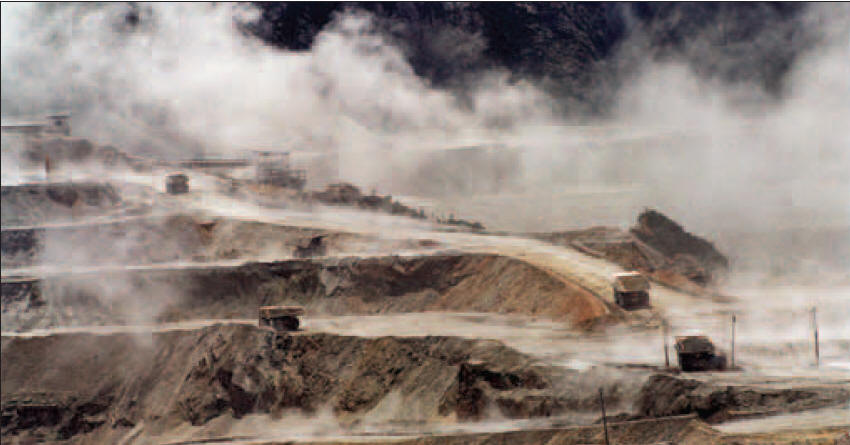
Indonesian soldiers and police escort a convey of trucks along a road
to the mine
operated by US firm Freeport McMoRan (AFP
The key word here is “voluntary.” As with the mining industry globally and with businesses jumping on the corporate social responsibility (CSR) bandwagon more generally, companies are happy to promise good performance, as long as no one will be looking over their shoulders.
So perhaps it’s no surprise to learn that Corporate Responsibility Magazine is in fact published on behalf of the Corporate Responsibility Officers Association, a body made up of many of the companies being judged, and steered by such firms as Domtar and KPMG. Freeport is listed as a “recent member” of the CROA. It’s advanced in the listings – it was ranked 83rd in 2010.
The problem here isn’t just the “corporate social responsibility” methodology, but the entire concept of “CSR”. It can all too often be used by companies to buy their way out of “corporate social irresponsibility.”
Freeport is no champion of the best values of corporate citizenship: For human rights activists, it’s long been a poster child for corporate irresponsibility. A list of good corporate citizens with Freeport winning laurels demonstrates more than flaws in the study. As George Monbiot has written of climate change credits, the lists offer corporations a new form of medieval European Catholic “indulgences,” forgiveness for any form of offence. Jeff Ballinger recently pointed out on this blog that companies like Nike are wrapping themselves in the CSR garment to burnish their corporate images, despite continuing disregard for many labour rights. Freeport, too, is now having itself measured for a fine CSR wardrobe.
----
David Webster is an assistant professor of International Studies at the University of Regina in Saskatchewan, Canada. He is a former coordinator with the East Timor Alert Network/Canada.
Indonesia's Special Forces (Kopassus) and U.S.-backed Detachment 88 troops joined in an assault on peaceful demonstrators in Manokwari. It is unclear if any of those initial detained remain in custody. The Jakarta Post reports chronic malnutrition among Amungme and Kamoro children who live in the shadow of the massive Freeport McMoran copper and gold mine. A prominent leader of PDI-P has called for creation of truth and reconciliation commissions for Aceh and West Papua. Pressure appears to be building for a military response to dissent in West Papua, including the targeting of NGOs. Leading human rights organizations and churches have called for an end to mistreatment of political prisoners in West Papua and an investigation of security force killing of activists. Indonesian intelligence and special forces are attempting to create a false front organization in Biak to replace a legitimate one established by the local people.
Summary: Famine continues to kill villagers in a broad swath of the Papuan hinterland. The Government response to the crisis has been to deny that famine is occurring and to provide inadequate assistance to address what it contends is only an outbreak of disease. Respected academics have launched a public discussion of the impact of Indonesia's four-plus decades of control in West Papua and whether its policies there constitute genocide. Papuans continue to call for an internationally mediated, senior-level dialogue with Jakarta about West Papua's past and its future. Demonstrators have urged the release of Papuans arrested for peaceful political dissent. Meanwhile, other activists have been arrested or are facing arrest. An international firm, collaborating with an Indonesian company, has announced plans to transform a vast area of forest near Merauke into wood chips. A South Korean daily has published an account of West Papua's annexation by Indonesia which it describes as a "betrayal" of the Papuans by the international community. Additional evidence has surfaced of the human cost of the Indonesian military's continuing "sweep" operations in the Papuan hinterlands. Confusion reigns in Indonesia's response to months of attacks targeting the operations of PT Freeport and its personnel.