Showing posts with label corporate social responsibility. Show all posts

Sunday, August 7, 2011

Empty promises whitewash Freeport's rights, responsibility record

Special for ETAN 
by David Webster

What does a mining company need to do to get a top score for “corporate social responsibility”?

To judge by the recent “100 Best Corporate Citizens List”, all it takes to finesse a long and controversial record of human rights abuses is to come up with a piece of high-minded rhetoric, then carry on as usual.
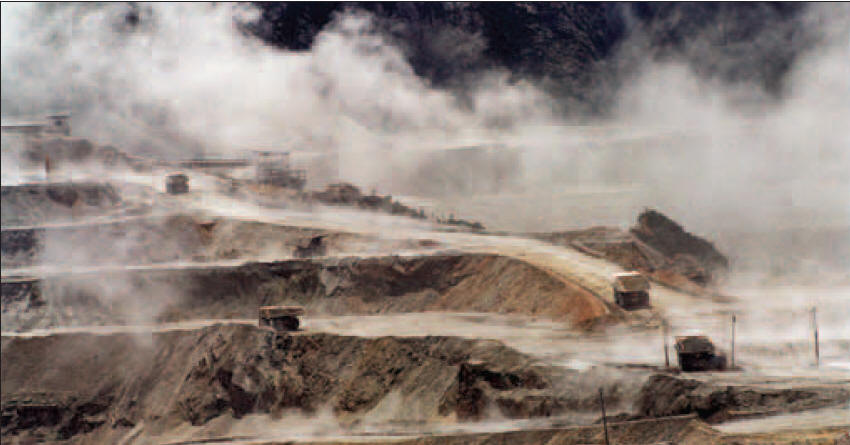
Freeport's Grasberg mine, West Papua.
Human rights advocates and those who have studied the record of Freeport McMoran in West Papua were startled to learn that Corporate Responsibility Magazine had named Freeport as the 24th-best corporate citizen in America (click for the full list). More startling still, the company scored well based mainly on a sixth-place ranking in the human rights category.

How is this possible? Well, the survey’s methodology seems to pay no heed to human rights performance. Only human rights rhetoric matters. And in that, Freeport excels. A strong written policy on human rights declares: “Freeport-McMoRan does not tolerate human rights transgressions.” It points to rights risks in West Papua, Peru, and the Democratic Republic of Congo, and adds that PT Freeport Indonesia policy is to “notify the direct commanders of the perpetrators” in cases where human rights allegations are made against Indonesian security forces. Since reputable human rights groups suggest that the top ranks of the security forces are implicated in widespread human rights violations in West Papua, this is hardly striking at the root of the problem.

As local people have pointed out, and researchers have confirmed, Freeport’s performance is a far cry from the written policies. The main trouble is intimate ties to Indonesian security forces.

Security forces may be implicated in the murder of American citizens near the Freeport mine, as Eben Kirksey and Andreas Harsono have reported.

Violence around the mine is used by security forces to target and scapegoat local people. In 2005, the New York Times revealed that Freeport paid the security forces more than $10 million in 2001 and 2002. Payments are now made “in-kind” rather than in cash. The local Amugme people have long protested Freeport seizure of their lands. Pictures of Freeport’s Grasberg mine from space (left) show the scale and environmental impact in the mountains that are home to the Amungme.

And lest all of this be hailed as “old news,” the Amungme filed a lawsuit last year saying Freeport had taken their lands illegally. Meanwhile, the Indonesian army’s presence around Freeport, and the company’s close ties to Indonesian security forces, were reinforced this year. The continuing alliance between Freeport Indonesia and the Indonesian security forces is likely to exacerbate, rather than improve, the human rights situation.

None of these reports are taken in to account in the “100 Best Corporate Citizens List.” All the human rights indicators measure “human rights disclosure” and the sole source, according to the methodology details, comes from “Company public disclosures” – a corporation’s own information about itself.

The methodology, in other words, measures promises, not performance. There are parallels to the debate over whether companies accused of operating sweatshops overseas can be trusted to police themselves, or should accept independent monitoring. Thus the list cites the voluntary “Sullivan principles” first created under the Reagan administration and welcomed by companies resisting demands to divest from apartheid South Africa. And Freeport boasts of adherence to the Voluntary Principles on Security and Human Rights, launched by the British and American governments in 2000.


Indonesian soldiers and police escort a convey of trucks along a road 
to the mine 


operated by US firm Freeport McMoRan (AFP
The key word here is “voluntary.” As with the mining industry globally and with businesses jumping on the corporate social responsibility (CSR) bandwagon more generally, companies are happy to promise good performance, as long as no one will be looking over their shoulders.

So perhaps it’s no surprise to learn that Corporate Responsibility Magazine is in fact published on behalf of the Corporate Responsibility Officers Association, a body made up of many of the companies being judged, and steered by such firms as Domtar and KPMG. Freeport is listed as a “recent member” of the CROA. It’s advanced in the listings – it was ranked 83rd in 2010.

The problem here isn’t just the “corporate social responsibility” methodology, but the entire concept of “CSR”. It can all too often be used by companies to buy their way out of “corporate social irresponsibility.”

Freeport is no champion of the best values of corporate citizenship: For human rights activists, it’s long been a poster child for corporate irresponsibility. A list of good corporate citizens with Freeport winning laurels demonstrates more than flaws in the study. As George Monbiot has written of climate change credits, the lists offer corporations a new form of medieval European Catholic “indulgences,” forgiveness for any form of offence. Jeff Ballinger recently pointed out on this blog that companies like Nike are wrapping themselves in the CSR garment to burnish their corporate images, despite continuing disregard for many labour rights. Freeport, too, is now having itself measured for a fine CSR wardrobe.

----

David Webster is an assistant professor of International Studies at the University of Regina in Saskatchewan, Canada. He is a former coordinator with the East Timor Alert Network/Canada. 

see also

West Papua Report (monthly)

ETAN/WPAT: Statement on the operations of the Freeport McMoran Mine in West Papua, to the U.S. Senate hearing on Extracting Natural Resources: Corporate Responsibility and the Rule of Law

Tuesday, July 26, 2011

Say it ain't so, Mo! - Nike in Indonesia

Guest blog by Jeff Ballinger


Jeff Ballinger, global worker rights researcher/activist
Twitter: @press4change


My apologies for references to baseball, the U.S.A.'s "national pastime", but the exasperation expressed by the quote, "Can't anyone here play this game?" perfectly captures my reaction to the news last week that a Bangladesh factory run by Grameen (Nobel-laureate, Muhammad Yunus) was closed after attacks by rioting garment workers. [Given the toxic political atmosphere in Bangladesh and current bad relations between the  government & Grameen, there could be some behind-the-scenes (political or freelance-extortion) provocateurism.]

The foregoing is noted with more sadness than surprise, as it comes on the heels of a searing
Associated Press report ten days ago, about how Converse/Nike shoes are made in Sukabumi, West Java. ("Nike says nearly two-thirds of the factories that make Converse products fail to meet standards for contract manufacturers...")

Converse shoes are displayed at a store in Jakarta, Indonesia. Irwin Fedriansyah | The Associated Press

I have been
warning (whining?) -- and here -- about Nike's deployment of "codes of conduct", Corporate Social Responsibility (CSR) and business self-regulation schemes for more than a decade; here's the evidence that this noxious media manipulation has, for the most part, succeeded:  Almost all the comments about this AP story were either expressing surprise ("We thought that Nike had fixed that.") or, that this type of "gotcha" story was inevitable when a big brand sources from nearly a thousand factories. In other words, the Sukabumi story is a one-off (and what a great challenge it is to police the supply chain).  In fact, this story could have been written 15 -- or five -- years ago, and it could have described almost any Nike-producing factory in China, Vietnam, Malaysia, Thailand, etc.  The default position of virtually all garment production is something akin to what Frederick Douglass wrote in the 1850s: "Find out just what any people will quietly submit to and you have found out the exact measure of injustice and wrong which will be imposed upon them."


You may be thinking, "Oh, it is the 'race to the bottom,' then?"  Not so fast. Folks who remember the years-long strike wave in Indonesia during the early- to mid-90s will recall that the minimum wage rocketed from 86 cents to $2.46 per day.  Instead of running off to Sri Lanka or Bangladesh, Nike-supplier factories increased investment and the Nike contract-workforce went from 22,000 to 110,000.  It was still a very good deal in Indonesia at triple the price for labor!  [The 'Underground Economist' of the Financial Times cites a brilliant study by Berkeley economist on these latter two points...]

In this AP photo taken May 26, 2011, workers leave a factory that make Converse shoes, in Gunung Putri, West Java, Indonesia. Workers making Converse sneakers in Indonesia said supervisors throw shoes at them, slap them in the face and call them dogs and pigs.
The Douglass principle still held up, however; these brutal contractors would not pay a penny over what was required and - as Nike continued to assemble a team of phony "responsibility" operatives - the Korean and Taiwanese bosses devised new ways to cheat workers.  Tens of thousands were denied severance pay ($32 million in Indonesia alone, I calculate) in the early- to mid-2000s and work became more "precarious" with short-term contracts and outsourcing. Nike's feckless "responsibility" team (now numbering over 210!) could do little more than lament the fact (see transcript beginning @10:54) that Nike HQ is powerless.  By the way, the video clip that I have is devastating: Nike's CSR vice-president giving a condescending lecture on poverty-level wage to young CNBC reporter. [Any help I can get in uploading this to Youtube would be most appreciated!] Reminds me of the lesson I received on Wage Elasticity from a World Bank staffer in the parking lot of the American Club in Jakarta (1990). I could not tell him what I thought of this slavery/servitude justification because he was the only poker player in our group more inept than myself...


But, hold on a minute - don't tell the U.S. anti-sweatshop students' movement or some determined group of Vietnamese expats that you cannot force Nike to directly deal with contractors' depredations! The Vietnamese forced Nike to broker a million-dollar settlement... students' story - pls see below. 


[Fragment from what I wrote for the War Resisters League's WIN magazine some months ago]: 

How did university students achieve a string of victories for Latin American workers? United Students Against Sweatshops (USAS) has assisted more than 4,000 college-logo garment workers in Honduras and the Dominican Republic by deploying grassroots pressure tactics and carefully crafted appeals to university administrators. Even in the midst of a global economic downturn, diligent research combined with determined activism on the part of the wronged workers forced Russell Athletic to reopen a factory that was closed to thwart unionization. It produced an agreement between Nike and the CGT union of Honduras to pay restitution to 2,100 workers illegally denied severance benefits when two suppliers for the shoe giant closed abruptly last year. In addition, the students' persistence in seeking ethical alternatives has led the largest brand selling to bookstores, Knights Apparel, to pay more than triple the Dominican Republic's minimum wage to hundreds of workers. Merchandise from the Alta Gracia factory is already on 140 campuses. 
The research to monitor compliance with "codes of conduct" for factories was carried out by the Worker Rights Consortium (WRC; launched by the USAS in 1999) and funded by 123 universities, based on a percentage of university-licensed apparel sales. While the codes include language about "freedom of association" and collective bargaining -- specific trade union protections -- the Russell case was the first in nearly a decade of activism that delivered meaningful redress when the Jerzees de Honduras plant was shuttered as collective bargaining talks were under way. For 14 months starting in early 2008, USAS teams in North America and Great Britain convinced administrators at 110 schools to stop purchasing from Russell Athletic. College bookstores are the company's largest revenue source. In late 2009, the Jerzees de Honduras factory was reopened and Russell has pledged not to oppose unionization at seven other factories it owns and operates nearby.
In essence, these two inspiring stories are like the early days of the East Timor Action Network, when no one would believe that an activist group with almost no budget could win against the Pentagon, lobbyists of arms-makers, and diffident politicians. Our current struggle for justice in West Papua is facing the usual challenges, complicated by "conventional wisdom."  What do I mean by this?  See what PBS/Newshour reporter, Ray Suarez said about Indonesia just last week: "Indonesia hasn’t managed to do is root out the legendary levels of corruption that discourages foreign investment." Now, how could he say this immediately after saying, "...solid years of back to back to back high levels of economic growth"?  How can you say, on the one hand, that corruption inhibits growth, while the evidence of double-digit growth has been the reality for Asia's most corrupt countries for two decades?  Any ideas on how to fight this pervasive misperception?