Wednesday, August 17, 2011

Timorese students support West Papua. Three arrested in Dili.

Friday UPDATE: The three arrested have reportedly been released and are due in court early next week.

-----
A friend in Dili tells ETAN that police recently broke up a demonstration in support of West Papua. As we get more information, we will post updates on ETAN's blog here.

Police arrest Juvntina Correia Ximenes.
The morning of August 17, more than 30 Timorese students called for the right of West Papuan to self-determination and condemned human right violation by the Indonesian military and police against Papuans. The demonstration took place in front of Indonesia Embassy in Farol, Dili, on the 66th anniversary of Indonesia's independence proclamation.

Timor-Leste Police (PNTL) arrested three of the protesters -- Juventina Correia Ximenes, Domingos de Andrade and Letornino da Silva. All are currently studying at Timor-Lorosae National University, UNTL.

One of demonstrator, Nolasco Mendes, said that the PNTL treated the activists brutally. Police reportedly arrested the activist after the Indonesia Embassy asked the PNTL to stop the demonstration.

According to a Timornewsline report the pro-Papua protesters were members of the Students Solidarity Council (Dewan Solidaritas Mahasiswa Timor-Leste) which previously fought for Timor-Leste's independence.

Timor-Leste has a strict law on demonstrations which among other things requires four days notice and bans them within 100 yards of a government or diplomatic building.

Police vehicle removes students supporting West Papua from in front of Indonesian embassy in Dili.

Sunday, August 7, 2011

Empty promises whitewash Freeport's rights, responsibility record

Special for ETAN 
by David Webster

What does a mining company need to do to get a top score for “corporate social responsibility”?

To judge by the recent “100 Best Corporate Citizens List”, all it takes to finesse a long and controversial record of human rights abuses is to come up with a piece of high-minded rhetoric, then carry on as usual.
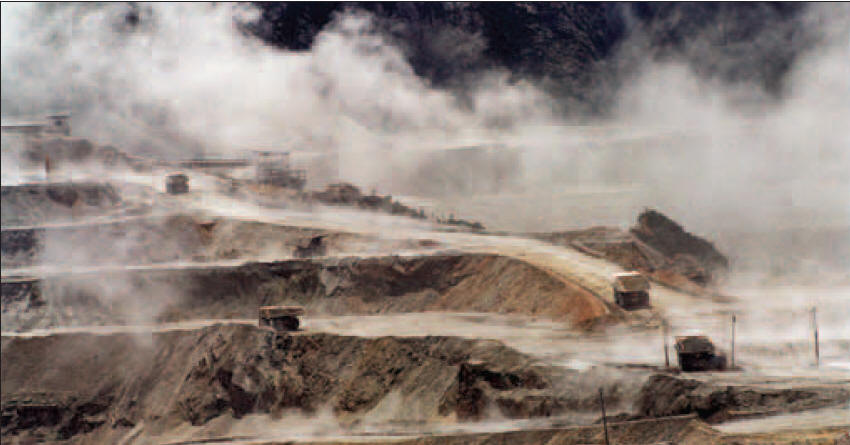
Freeport's Grasberg mine, West Papua.
Human rights advocates and those who have studied the record of Freeport McMoran in West Papua were startled to learn that Corporate Responsibility Magazine had named Freeport as the 24th-best corporate citizen in America (click for the full list). More startling still, the company scored well based mainly on a sixth-place ranking in the human rights category.

How is this possible? Well, the survey’s methodology seems to pay no heed to human rights performance. Only human rights rhetoric matters. And in that, Freeport excels. A strong written policy on human rights declares: “Freeport-McMoRan does not tolerate human rights transgressions.” It points to rights risks in West Papua, Peru, and the Democratic Republic of Congo, and adds that PT Freeport Indonesia policy is to “notify the direct commanders of the perpetrators” in cases where human rights allegations are made against Indonesian security forces. Since reputable human rights groups suggest that the top ranks of the security forces are implicated in widespread human rights violations in West Papua, this is hardly striking at the root of the problem.

As local people have pointed out, and researchers have confirmed, Freeport’s performance is a far cry from the written policies. The main trouble is intimate ties to Indonesian security forces.

Security forces may be implicated in the murder of American citizens near the Freeport mine, as Eben Kirksey and Andreas Harsono have reported.

Violence around the mine is used by security forces to target and scapegoat local people. In 2005, the New York Times revealed that Freeport paid the security forces more than $10 million in 2001 and 2002. Payments are now made “in-kind” rather than in cash. The local Amugme people have long protested Freeport seizure of their lands. Pictures of Freeport’s Grasberg mine from space (left) show the scale and environmental impact in the mountains that are home to the Amungme.

And lest all of this be hailed as “old news,” the Amungme filed a lawsuit last year saying Freeport had taken their lands illegally. Meanwhile, the Indonesian army’s presence around Freeport, and the company’s close ties to Indonesian security forces, were reinforced this year. The continuing alliance between Freeport Indonesia and the Indonesian security forces is likely to exacerbate, rather than improve, the human rights situation.

None of these reports are taken in to account in the “100 Best Corporate Citizens List.” All the human rights indicators measure “human rights disclosure” and the sole source, according to the methodology details, comes from “Company public disclosures” – a corporation’s own information about itself.

The methodology, in other words, measures promises, not performance. There are parallels to the debate over whether companies accused of operating sweatshops overseas can be trusted to police themselves, or should accept independent monitoring. Thus the list cites the voluntary “Sullivan principles” first created under the Reagan administration and welcomed by companies resisting demands to divest from apartheid South Africa. And Freeport boasts of adherence to the Voluntary Principles on Security and Human Rights, launched by the British and American governments in 2000.


Indonesian soldiers and police escort a convey of trucks along a road 
to the mine 


operated by US firm Freeport McMoRan (AFP
The key word here is “voluntary.” As with the mining industry globally and with businesses jumping on the corporate social responsibility (CSR) bandwagon more generally, companies are happy to promise good performance, as long as no one will be looking over their shoulders.

So perhaps it’s no surprise to learn that Corporate Responsibility Magazine is in fact published on behalf of the Corporate Responsibility Officers Association, a body made up of many of the companies being judged, and steered by such firms as Domtar and KPMG. Freeport is listed as a “recent member” of the CROA. It’s advanced in the listings – it was ranked 83rd in 2010.

The problem here isn’t just the “corporate social responsibility” methodology, but the entire concept of “CSR”. It can all too often be used by companies to buy their way out of “corporate social irresponsibility.”

Freeport is no champion of the best values of corporate citizenship: For human rights activists, it’s long been a poster child for corporate irresponsibility. A list of good corporate citizens with Freeport winning laurels demonstrates more than flaws in the study. As George Monbiot has written of climate change credits, the lists offer corporations a new form of medieval European Catholic “indulgences,” forgiveness for any form of offence. Jeff Ballinger recently pointed out on this blog that companies like Nike are wrapping themselves in the CSR garment to burnish their corporate images, despite continuing disregard for many labour rights. Freeport, too, is now having itself measured for a fine CSR wardrobe.

----

David Webster is an assistant professor of International Studies at the University of Regina in Saskatchewan, Canada. He is a former coordinator with the East Timor Alert Network/Canada. 

see also

West Papua Report (monthly)

ETAN/WPAT: Statement on the operations of the Freeport McMoran Mine in West Papua, to the U.S. Senate hearing on Extracting Natural Resources: Corporate Responsibility and the Rule of Law

Friday, August 5, 2011

West Papua Report August 2011

[Don't forget: Call Congress to sign the House letter on Papuan prisoner Filep Karma - Deadline is August 12.]


West Papua Report for August 2011 is now out. Read in full here.

Summary 

Thousands of Papuans peacefully took to the streets August 2 to support calls for a referendum on West Papua's political future. The demonstrations proceeded despite the presence of armed security forces intended to block the demonstrations and the presence of Jakarta-backed militia provocateurs. Violence erupted near Jayapura and in Puncak District on the eve of the demonstrations. Over 50 international organizations publicly called for the Indonesian government to respond positively to appeals by Papuan NGOs and churches for justice, an end to human rights violations in West Papua, and protection of human rights advocates and journalists. WPAT called on Secretary Clinton to raise with Indonesian officials the ongoing military sweep operations in Puncak Jaya, West Papua. These operations have had devastating affects on innocent Papuan civilians. Secretary Clinton called for dialogue to settle disputes over West Papua. Her repetition of US Government support for "special autonomy" made clear that the Obama administration is deaf to the voice of Papuans who have rejected "special autonomy" repeatedly. Efforts by Indonesian security forces to cover-up the human cost of their military sweep operations in Puncak Jaya have failed. Komnas Ham has proposed a dialogue about violence in Puncak Jaya. A peace conference which convened in West Papua has explored the possibility of advancing dialogue with the Indonesian government. Renowned international academics, lawyers and Papuan activists will convene in Oxford to discuss the continuing denial of the right of self-determination to Papuans. The military commander in West Papua has apologized to the Papuan Kingmi church over intimidating language he employed against the church. 

Thursday, August 4, 2011

Call Congress concerning Papuan prisoner Filep Karma

Representative Joe Pitts and Jim Moran are circulating a letter to President Susilo Bambang Yudhoyono of Indonesia concerning the case of political prisoner Filep Karma, a prominent Papuan advocate of self-determination. Karma has been serving a 15-year sentence for raising the Papuan Morning Star flag at a peaceful political rally in 2004. Karma is designated a Prisoner of Conscience by Amnesty International for his nonviolent advocacy.

This bi-partisan initiative is currently circulating in the House of Representative. Please call your Representative this week and urge him or her to sign the letter.

Call the Capitol Switchboard (202) 224-3121. Ask for your congressperson's foreign policy aide. Ask that your representative sign on to Representative Joseph Pitt's and Jim Moran's letter to Indonesia's President concerning the case of prisoner of conscience Filep Karma. Urge them to support human rights and the rule of law  in Indonesia. Offer to e-mail them a copy of the letter. Tell them that if your Representative wishes to sign, she or he should contact Carson Middleton 52411 in the office of Rep Pitts. The deadline is Friday, August 12, so call soon.
If necessary leave a detailed message. If you have trouble getting through by phone send an e-mail to the office, but be sure to follow up with a call.

Thank you for your support.

To find out who your representative is go to http://house.gov/

Signers so far include: Reps. Pitts (R-PA), Moran (D-VA), Baldwin (D-WI), Dogget (D-TX), Faleomavaega (D-AS), Farr (D-CA), Filner (D-CA), Hinchey (D-NY), Honda (D-CA, McDermott (D-CA), McGovern (D-MA), Pingree (D-ME), Rohrabacher (R-CA), Rothman (D-NJ), Schakowsky (D-IL), Wolf (R-VA).
If your congressperson has already signed be sure to thank them.

The letter is an initiative of Freedom Now, who represent Karma pro-bono. Please let us know the results of your call.

Background on Filep Karma and his case can be found here from Freedom Now and here from Amnesty International. Background on Indonesia's political prisoners, Prosecuting Political Aspiration Indonesia’s Political Prisoners, can be found here.

Thursday, July 28, 2011

Step by Step: Women of East Timor, Stories of Resistance and Survival

Step by Step: Women of East Timor, Stories of Resistance and Survival is available from ETAN - http://etan.org/resource/books.htm#B89 StepbyStep

Review by Jen Hughes

Step by Step: Women of East Timor, Stories of Resistance and Survival
edited by Jude Conway and launched in Australia nationally in 2010, presents 13 oral histories from Timorese women, with each story accompanied by several pages of photographic snapshots from their lives.

The collection of stories reveal the role women played in East Timor's independence struggle on the guerilla front, the diplomatic front and in the student movement inside and outside the country and afterwards.

The opening story told by Ceu Lopes Federer provides a lens through which to read the subsequent twelve stories. The work Ceu and her compatriots did to meet the financial needs of the resistance inside and outside Timor, to keep it alive and strong, and to provide them with accurate information about what was going on outside in relation to East Timor gives the reader an insight into how important women were in the solidarity movement that was the backbone to the diplomatic front.  Mica Barreto Soares' story tells how Timorese studied in Indonesia and the work they did for East Timor inside Indonesia. The two show the importance of the women's solidarity work to the survival of the guerilla movement inside Timor and segue into the stories about the work Timorese women did all over the world. They also provide background for the sometimes small but extremely risky activities of other storytellers when they speak of secreting letters and notes, medicines or food, inside clothing and bluffing their way through Indonesian positions inside East Timor and Indonesia.