Thursday, November 3, 2011

Contact: John M. Miller, 917-690-4391
Tom Keough, 718-768-6171

Historians Condemn Honoring of Kissinger

Urge New-York Historical Society to Withdraw Honor

November 3 - In a letter sent yesterday, more than 110 historians urged the New-York Historical Society (N-YHS) to "withdraw the name of Henry Kissinger as an honoree" at its upcoming event scheduled for November 7, 2011.

In their letter to the Society's Board of Trustees, the scholars wrote: "Kissinger remains one of the twentieth century’s worst war criminals, and to pretend otherwise is to condone his crimes. It is difficult to understand how the New-York Historical Society could consider honoring such a man." 

The letter with the list of signers can be found here (PDF).

"The failure to hold Kissinger to account for his myriad crimes has allowed him to continue dispensing recommendations for new wars and foreign interventions," the letter says. "The failure to confront this record has facilitated the invasion of Iraq, the use of torture at Abu Ghraib and elsewhere, the policy of rendition and the detentions at Guantánamo Bay, and other illegal actions of the 'war on terror.'"

Between 1969 and 1977, Kissinger served as National Security Advisor and then Secretary of State. He designed and implemented policies which led to hundreds of thousands of deaths, the overthrow of democratically-elected governments, and the invasion and occupation of sovereign countries. Examples include the invasion of Cambodia, the overthrow of the government of Chile and Indonesia's invasion and occupation of East Timor.

Should the N-YHS continue with its plan to honor Kissinger, protesters will gather outside the Waldorf Astoria Hotel on Monday, November 7 to express their outrage. Demonstrators will gather from 5:30 p.m. to 7:30 p.m. at 301 Park Ave. (between 49 & 50 St.) in Manhattan to condemn the honoring of the accused war criminal by the society at a $1000 a ticket gala.

-end- 


see also Background on Kissinger, Ford and East Timor


Please donate! Support ETAN

Follow ETAN on Twitter


Sunday, October 30, 2011

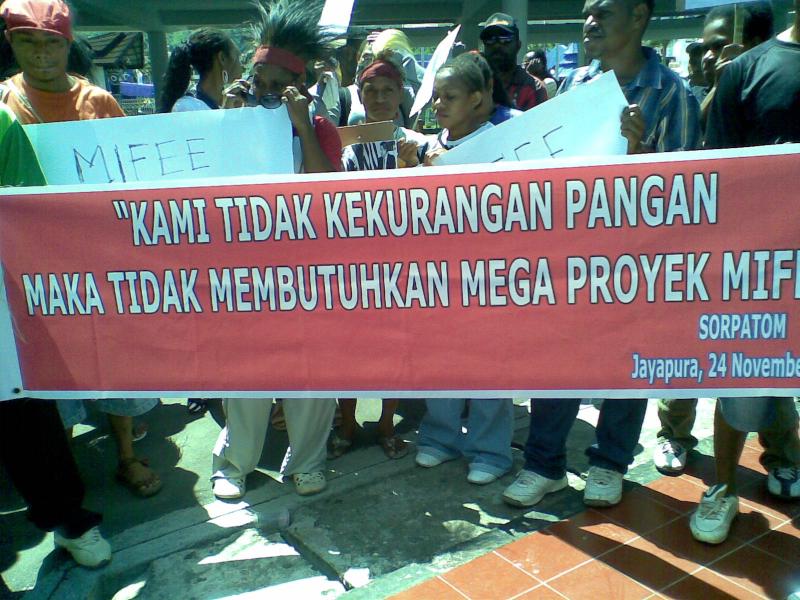
MIFEE in West Papua

From Food vs. Forests, Profits vs. People by John M. Miller and Octo More in WIN Magazine on the  Merauke Integrated Food and Energy Estate (MIFEE) in West Papua:
"Merauke’s mythic stature will make the Indonesian government all the more sensitive to opposition.Land-grabbing is not new in West Papua; it has happened since colonial times (see sidebar). Every acre of Papuan land that has been claimed for a national project was taken by force. In a sense, there is nothing new about the Indonesian government’s latest project, Merauke Integrated Food and Energy Estate (MIFEE), nor is there anything new about West Papuan resistance."
Read the rest here


Protest against MIFEE in Jayapura. Photo: SORPATOMNews


Friday, October 21, 2011

Sign the Petition, Support a Deb-Free East Timor


Don't Let the Bankers Occupy Dili!
Support a Debt-Free Timor-Leste

Support a Debt-Free Timor-Leste


This is a joint project of ETAN and Timor's Movimento Kontra Deve, a coalition of civil society organizations in Timor-Leste opposed to the country taking out loans.


UPDATE: As additional background see La'o Hamutuk's Submission to Timor-Leste's National Parliament 
Regarding the Proposed General State Budget for 2012 (PDF)

ETAN on Papua attacks, Freeport strike

UPDATE: Read U.S. Congressman Faleomavaega's letter to the Indonesian ambassador, which concludes "It is obvious the actions by the TNI and police are contrary to the commitments made by President Yudhoyono to solve the issues in West Papua in a 'peaceful, just, and dignified manner.'"

ETAN joined others in two recent statements on events in West Papua.


With Tapol and the West Papua Advocacy Team (WPAT), ETAN condemned the assault on the close of the peaceful Third Papuan Congress. The groups demanded the release of those arrested. The release - Indonesian crackdown on Papuan Congress sparks outrage - also included comments from Lord Avebury, Vice Chair of the UK Parliamentary Human Rights Group and U.S. Congressmember Eni Faleomavaega (D-AS). Tapol's  Carmel Budiardjo said "The daily discrimination and violations experienced by Papuans are bad enough, but an attack of this nature on a democratic congress is an absolute outrage. ETAN is quoted as saying “The right to gather and speak out is a fundamental freedom, it doesn’t just disappear because the government doesn't like what is being said.”

Events are still unfolding with new information that at least six were killed in the Indonesian security force attack.


Some of the 100s arrested at Papua Congress.

In a separate statement WPAT and ETAN, expressed concern over 
"the escalating violence in the area of [Phoenix, Arizona]-based Freeport McMoran's massive gold and cooper mining operation located in the Timika-Tembagapura area of West Papua. Workers have been on strike since September 15 seeking higher wages on par with those that Freeport pays workers at its mines elsewhere. Freeport's response has been to stonewall, reject worker demands, and hire scab workers."
The groups said the U.S. government
should publicly emphasize its commitment to respect for worker rights in the context of the ongoing labor dispute. It should urge Freeport to negotiate in good faith with its workers. It is urgent that the U.S. government press the Indonesian government to forego the use of violence in addressing the current tensions in the area of the mining operation. The U.S. government also should investigate Freeport operations, especially actions taken by security forces at Freeport's behest to date. Finally, it is high time that the U.S. Congress undertake, including through committee hearings, a review of Freeport operations which have for decades undermined respect for the United States in Indonesia and West Papua.
Freeport strikers

UPDATE: Three more were shot dead at the mine on October 21.

Wednesday, October 12, 2011

Wrong example

A intervention by by Teguh Santoso(a lecturer at Indonesia Islam University) on Western Sahara before the United Nations' Fourth Committee, avoids mentioning the most relevant Indonesian experience. Santoso told the committee (as summarized by the UN) that that "the dispute about Western Sahara was quite similar to what Indonesia had experienced in the last decade," without acknowledging that  Indonesia's December 1975 illegal invasion and occupation of East Timor, which is exactly parallel to Morocco's illegal invasion of Western Sahara.


Instead he refers to what he calls "a similar situation," which Indonesia had solved "peacefully through democratic circumstances. As a result, Aceh and Papua enjoyed special autonomy status. Only genuine democracy could solve the Western Sahara dispute, and the [Morocco's unilateral] special autonomy plan was an outcome of the high degree of democracy in Morocco."


However, a truly democratic plan would allow the Saharawi to exercise their right to self-determination. A free and fair vote under UN-supervision would allow them the choice of say autonomy under Morocco or independence. Morocco (with the diplomatic and other support of its close allies France and the U.S.) has done everything it can to undermine U.N. resolutions and plans for a vote. 


For many years, Indonesia did the same (also with U.S. support) to East Timor. Belatedly , the East Timorese people exercised their right to self-determination in 1999. In the face of threats of retaliation that were soon realized, they expressed their choice of independence.


As we wrote in 2009 in a submission to the Fourth Committee:

In doing so, the people of Timor-Leste exercised their inalienable right and expressed their "passionate yearning for freedom" described by the UN General Assembly nearly 50 years ago in its 1960 declaration (1514 (XV)) on decolonization, which unambiguously declared that "all peoples have the right to self-determination; by virtue of that right they freely determine political status…"

We added: 
It should embarrass this institution – and all of you as representatives of United Nations member states – that this committee must continue to discuss the situation of Western Sahara. The discussion should have ended long ago, and its people should have exercised their right to self-determination.