Showing posts with label 1965. Show all posts

Friday, July 1, 2016

A Timorese View on Justice for Suharto's Crimes

A Timorese View: Time to End Impunity for Suharto's Crimes in Indonesia and Timor-Leste

Tetum: Agora mak tempu atu hapara impunidade ba krime sira Suharto nian iha Indonesia no Timor-Leste

Bahasa Indonesia: Sekarang Saatnya Memutus Impunitas untuk Kejahatan Soeharto di Indonesia dan Timor-Leste


some excerpts:

The tragedy of 1965-1966 is part of a long history of massacres by the Indonesian military. As East Timorese, we know very well the brutality of the Indonesian dictator's regime. I was born after the initial Indonesian invasion in 1975, but grew up under the occupation. As a young student, I saw the Indonesian military intimidate and abuse youth suspected of supporting East Timorese independence. We were not safe anywhere: Suharto's troops would seize us at home, school or on the streets; many were never seen again. I watched helplessly as soldiers murdered my cousin, Luis Gusmão Pereira, in a public market in Triloedae-Laga. 
....
The chains of impunity remain strong in Indonesia; U.S. leaders who supported crimes against humanity in Indonesia and elsewhere continue to avoid accountability and punishment. The U.S. and Indonesia claim they are democratic and law-abiding nations, but they openly resist holding their own officials accountable.
East Timorese demonstrate for justice.
Photo by Karen Orenstein/ETAN
.

Tuesday, June 21, 2016

Look, then ACT

see full alert here: http://etan.org/shattersilence/look_of_silence_on_PBS.htm

Watch The Look of Silence on PBS,
Act on U.S.-backed Massacres
 in Indonesia

The Oscar-nominated documentary, THE LOOK OF SILENCE will be broadcast Monday, June 27, on the PBS documentary showcase POV. We urge you to watch this important and disturbing film and then take action on U.S. support for mass violence in Indonesia.


1) Invite some friends to watch the documentary with you. Organize a discussion using ETAN's discussion guide.

2) Take a moment to urge your Senators to support Senator Tom Udall's (D-NM) S.Res. 273. It supports justice for the victims of the 1965-1966 mass murder in Indonesia, urges the U.S. to release all its records of these crimes, and expresses concern about the lack of accountability.

You can easily e-mail your Senators from here. Thanks to all who have e-mailed so far.
S.Res. 273 urges Indonesia to consider a truth, justice, and reconciliation commission to address crimes against humanity and other human rights violations and calls on all relevent U.S. government departments and agencies make available to the public all records from that time. Read more about the S.Res. 273 here: http://etan.org/news/2015/10senate.htm

3) Sign our petition urging the U.S. government to take two immediate steps:
a) declassify and release all documents related to the U.S. role in the 1965/66 mass violence, and b) formally acknowledge the U.S. role in facilitating the 1965-66 violence and its subsequent support for the brutalities of the Suharto regime.
For more you can do, go to http://etan.org/shattersilence/


Support ETAN. We need your support to continue our work for justice and accountability. Please donate today.

Wednesday, December 23, 2015

Happy Holidays!

We are talking a break and will be checking our e-mail less often. We wish everyone happy holidays and a fulfilling and peace-filled New Year! May the peoples of Timor-Leste, West Papua, and Indonesia find the peace, prosperity and justice they so deserve.

Thank you for your interest and support our work for justice and human rights. We look forward to working with you in the coming year.

We hope you will support the East Timor and Indonesia Action Network (ETAN) by including us in your end of year giving. You can safely donate by credit card and read a message from Noam Chomsky about why you should join him in supporting us here: http://bit.ly/noam_etan

If you haven't done so, we hope you will sign ETAN's petition calling for an end to 50 years of official silence concerning  U.S. complicity in Indonesian mass violence and  murder. Please sign and share http://chn.ge/1v50Edj

Thank you
John M. Miller, National Coordinator, ETAN

P.S. Use this link, if you want to sign up for ETAN's listservs on Timor-Leste, West Papua or Indonesia:  https://fs20.formsite.com/jmm555/form2/index.html

Tuesday, October 27, 2015

1965: Evidence from Canadian documents


by David Webster, Associate Professor, Department of History, Bishop's University 

At a time when the Indonesian government seems to be clamping down on discussion of the mass killings of 1965, it’s more important than ever to share documentary evidence about the wave of violence that swept Indonesia 50 years ago and brought the Suharto military dictatorship to power.

The events of 1965 are not just an Indonesian story. In the words of a recent book co-edited by Indonesian scholar Baskara Wardaya SJ and international scholar Bernd Schaefer: “So far the international dimension of those events is hardly explored. Although they were domestic by execution, they were also firmly embedded into the global Cold War.”

Fifty years ago an army-led campaign of brutality targeted hundreds of thousands of Indonesians accused of being left-wingers in sympathy with the Indonesian Communist Party (PKI). The killings started with a coup and counter-coup, and were encouraged by the US embassy’s provision of names to the army. As U.S. government documents published in 2001 reveal, the Johnson administration had severed most American ties to President Sukarno’s government, preferring to work with the Indonesian army.

The true extent of American involvement in the Indonesian regime change and mass killings of 1965 is a story still to be written. Increasingly, there seems to be evidence that those once accused of being “conspiracy theorists” were right on many scores. Peter Dale Scott, a former Canadian diplomat who became a professor of English in California, is one of the most prominent of those figures, and has recently written a retrospective on his seminal article on US complicity in the events of 1965, forty years after its first publication.

Many State Department documents have been released. But many more remain hidden. U.S. government documents are normally declassified on a fixed cycle and the key documents published in the series Foreign Relations of the United States. When the time came to release the FRUS volume dealing with Indonesia in 1965, the government stalled on releasing of the volume.

That’s why ETAN has launched a campaign for a full declassification of all the United States government documents and a U.S. government acknowledgement of the American role in aiding and abetting the 1965 killings. 

Indonesia's Major-General Suharto, in camouflage uniform, at the funeral for
six generals killed by rebels in the abortive attempt to overthrow
then president Sukarno in 1965. The coup attempt led to
nationwide massacres. 
Photo: AP
In the face of this withholding of information, it may be worth checking the files of more distant and less involved governments. Below I share some documents declassified by the Library and Archives Canada, part of the files of Canada’s Department of External Affairs. They reveal that Western governments had been aware of coup planning by the Indonesian army months before the actual coup; that Western governments did not initially believe the PKI was involved, but encouraged the army to attack the PKI regardless; that Canada’s government was one of those that did nothing to deter the mass killings – even with an estimate by the Indoensian ambassador in early 1966 that half a million people were already dead; and that the restoration of foreign aid to the new military regime of General Suharto was designed to anchor Indonesia into the Western side in the Cold War rather than aiming at humanitarian relief. Canada was a minor but well-informed player. Like other Western governments, it was pleased to see the Indonesian army take power, and indifferent to the enormous death toll that aided that path to power.

Many accounts depict the coup attempt of October 1, 1965, as a surprise that caught Western governments unaware. But in fact, coup talk had been around for some time. In June 1965, for instance, the prime minister of Malaysia informed diplomats from Britain, Canada, Australia and New Zealand that that Indonesia’s ambassador, a noted anti-communist, had told him that the army planned to get Sukarno out of the country and have him held hostage while it destroyed the PKI. PM Tunku Abdul Rahman said his information was that the Indonesian army “had decided time had come for drastic action to save country from Communist take-over. Army leaders were plotting to get Soekarno out of country and to hold him ‘if necessary at pistol point’ while army suppressed Communists and established pro-Western Govt.” The Tunku thought that the story might be fabricated, but also suspected the hand of the United States behind the army’s alleged plans.

DOCUMENT 2.
When, as September turned to October, soldiers led by Lt.-Col. Untung struck at the army command, capturing and killing top generals, General Suharto was quick to blame the PKI. Army-orchestrated massacres began soon after. The evidence shows that the “Old Commonwealth countries” put little faith in the claim that Untung’s coup was masterminded by the PKI. “As far as Brits could learn,” a Canadian diplomat in London wrote after meeting the responsible official at the Foreign Office, “Untung himself was not Communist and there was no firm evidence that Sep. 30 movement was inspired by Communists.” The British official reportedly told his Canadian counterpart: “Although it was tempting to believe that army would take advantage of present opportunity as excuse to deliver really crushing blow to Communists, unfortunately there were signs already that this was not likely to happen…” The hopes of the British Foreign Office, in other words, lay parallel to those of the US State department as already revealed in US documents – that the army would seize the chance to destroy the PKI. Their fears were that the army lacked the resolve or the capacity to carry out this task.

DOCUMENT 5.
In information-gathering about the coup, Canada’s mission in Tokyo similarly learned that the Japanese government assessment was also that there was no PKI involvement. “There was no evidence of sufficient prior planning to indicate organized effort by PKI,” a report stated. In a subsequent report, Japanese officials expressed a “low opinion of [the Indonesian army’s] admin[istrative] capacity and honesty” and predicted that they thought the army would do a poor job of governing Indonesia.

DOCUMENT 8.
Increasingly in the final months of 1965, the army command took the reins of government and encouraged violence against PKI members and others. By January 1966, the army-dominated government in Jakarta was ready to ask for foreign aid. The Canadian response to an Indonesian request to resume aid, which Canada had ended in 1964, was cautious to a fault. Ottawa planned to consult its major allies before acting, but noted that aid “might provide a means by which Indonesia could be drawn back into corporate international life.” Short-term relief, delivered ideally through the United Nations and its specialized agencies, might help ensure that the new regime in Jakarta would be pro-Western. 

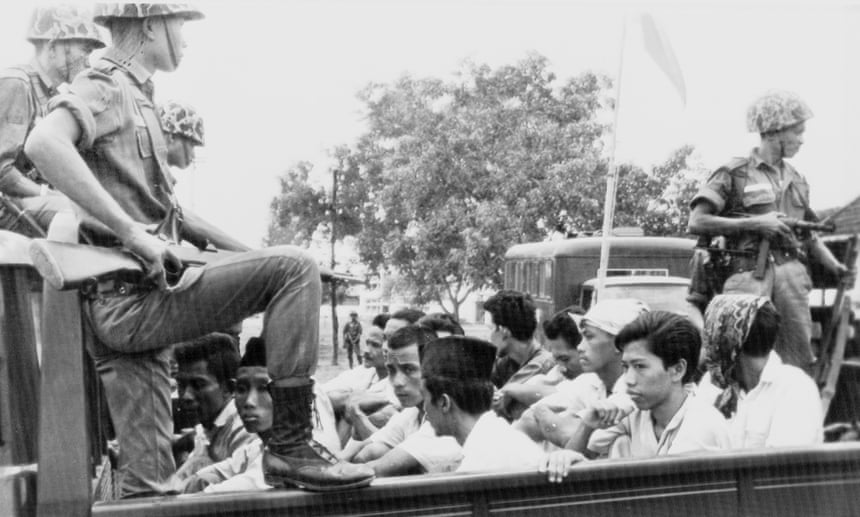
Members of the Youth Wing of the Indonesian Communist party are guarded
by soldiers as they are taken by open truck to prison in Jakarta, 1965. Photo: AP
DOCUMENT 22.
What is striking in Canadian embassy reporting from Jakarta in the last months of 1965 and the early months of 1966 is the lack of attention to killings engulfing parts of the country. One embassy report opened with a declaration that the major challenges in Indonesian domestic affairs were led by high prices and inflation. Ironically, it took the Indonesian ambassador to Canada to put an estimate of the death toll of record. In his last call in Ottawa before being recalled to Jakarta, Ambassador L.N. Palar, speaking with “great frankness,” said that half a million people might have been killed by January 1966. Palar was one of the most respected members of Indonesia’s diplomatic corps – he had led the insurgent Indonesian independence delegation at the UN in the 1940s and then Indonesia’s UN delegation and been ambassador in Washington. His views, therefore, carried weight. His estimate was that the official estimate of 87,000 dead “was on the conservative side; speaking personally he would not be surprised if the tally came closer to 500,000.”

DOCUMENT 27.
This death toll did not alter Canadian views. Indeed, the Canadian ambassador in Jakarta, like U.S. colleagues, lamented the “passivity of [the] generals” in the face of President Sukarno’s efforts to remain in office. Canada, like its allies, hoped that the army would be more ruthless and seize power sooner rather than later.

DOCUMENT 31.
Days later, Indonesian generals forced Sukarno to sign the “11 March 1966 order” in which he handed real power to General Suharto. A representative was dispatched to stress to the British ambassador that the transfer of power was “gentlemanly” rather than brutal, and that “it would greatly help the Generals if this view could be taken abroad, rather than a renewed impression of lawless violence.” Britain’s man in Jakarta duly made that recommendation.

DOCUMENT 33.
In sum, the Canadian documents add to the weight of evidence that 1965 was an international story, as well as an Indonesian tragedy. Western governments were not surprised by events. They did not look on passively – instead, they encouraged the army to finish off its PKI rivals. They carefully used levers such as diplomatic pressure and foreign aid to support the result they desired: a military regime in Indonesia. And if that meant thousands killed, this was not bad news to the West, but simply the cost of bringing about the intended end of a pro-Western, army-governed Indonesia.

etanetanetanetanetanetanetanetanetanetanetanetan

Help ETAN  shatter the 50 years of silence concerning US complicity in
Indonesian violence. Sign, share http://chn.ge/1v50Edj

ETAN needs your support. Please donate today. Go to http://etan.org/Donate.htmSubscribe to ETAN's email lists

Friday, September 18, 2015

new on ETAN's website: Watching The Look of Silence in Dili

On August 22, 2015, the first public screening of Joshua Oppenheimer's filmThe Look of Silence drew around 60 people to the Asosiasaun HAK human rights office in Dili. The documentary probes the impact of the 1965/66 mass killings that brought the dictator Suharto to power in Indonesia and the impunity which continues to prevail for these and others crimes by Indonesian security forces.

read the rest here


Sign and share ETAN's petition

Thursday, July 16, 2015

Reveal the Truth, Acknowledge the Crime


ETAN ALERT

Reveal the Truth, Acknowledge the Crime
Take Action on U.S. Support for Mass Violence and Genocide in Indonesia

The Look of Silence glassesThe massacre of up to 1,000,000 communists, leftists, ethnic Chinese, and others in Indonesia in 1965-1967 is a foundational event in modern Indonesian political history, but it remains mostly a footnote for most in the United States and elsewhere.

The documentary THE ACT OF KILLING shocked audiences as perpetrators of the mass murder reenacted their violence. The film has fueled a debate within Indonesia and drawn attention internationally to events unknown to many. Events that the U.S. facilitated and cheered at the time.
THE LOOK OF SILENCE, a companion film to THE ACT OF KILLING will soon be showing in U.S. theaters It follows the investigation by Adi Rukun into the murder of his older brother who was killed during the violence.

These powerful films tell us much about Indonesia today as they do about the past. However, any evaluation of the events of 1965-1967 must include a discussion of the role of Western powers in the violence, especially the United States. The 
East Timor and Indonesia Action Network (ETAN) continues to call for accountability for those in the West who encouraged and assisted in the mass violence in Indonesia. The full truth must come out and the U.S. should declassify all files related to Suharto's U.S.-backed seizure of power and the murderous events which followed.

ETAN has prepared a background piece on the events and aftermath of Suharto's brutal seizure of power, where we focus on the U.S. role and responsibility. Read Breaking the Silence: The U.S. and Indonesia's Mass Violence
What You Can Do

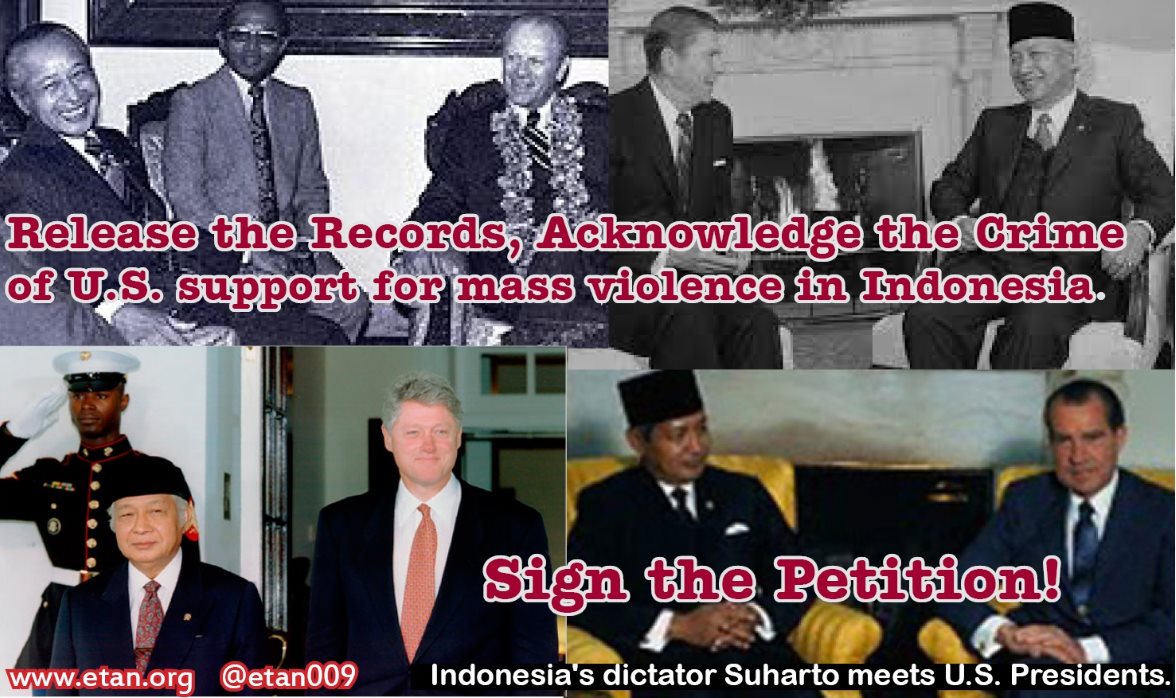
1) Sign the petition urging the U.S. government to take two immediate steps:
a) declassify and release all documents related to the U.S. role in the 1965/66 mass violence, and b) formally acknowledge the U.S. role in facilitating the 1965-66 violence and its subsequent support for the brutalities of the Suharto regime.
Thanks to all who have signed so far.

2) See the THE LOOK OF SILENCE Going to a showing of The Look of Silence? Print out our leaflet and hand it out to the audience. PDFs: half-page: 8.5" x 5.5" or full page - 8.5" x 11"

3) Spread the word about the petition and the film. Write a letter to the editor and post to facebook or other social media calling for the U.S. to take responsibility for its role in the mass killings in Indonesia. Go here for sample letters, tweets and facebook posts. It is best to use your own words. Also use ETAN's Backgrounder: Breaking the Silence: The U.S. and Indonesia's Mass Violence. for additional information. 

4) Organize a discussion of the films. (We will soon have a short discussion guide to assist, write etan@etan.org for a copy.) If you are high school teacher or college professor teaching an appropriate subject, consider assigning THE ACT OF KILLING or THE LOOK OF SILENCEto your students. Use it as a springboard for discussions on the impact of U.S. foreign policy, the need to address human rights violations, and how the past affects the present. (Contact: Chris Lundry for further info or assistance.)

5) Support ETAN. We need your support to continue our work for justice and accountability. Please donate today.


For more information see http://etan.org/shattersilence/default.htm 


Sunday, December 14, 2014

ETAN Supports Senate Resolution on 1965 Mass Violence in Indonesia

Read the whole media reelase here: ETAN Supports Senate Resolution on 1965 Mass Violence in Indonesia

December 11 - The East Timor and Indonesia Action Network (ETAN) today urged the U.S. Senate to act quickly and pass Sen. Tom Udall's (D-NM) resolution calling on the U.S. government to "make available to the public all classified records and documents concerning the mass killings of 1965 and 1966" in Indonesia.

The resolution, introduced on December 10, Human Rights Day, "condemns the mass murder" and "expresses great concern about the lack of accountability enjoyed by those who carried out crimes during this period."


"The peoples of the U.S. and Indonesia deserve to know the full truth about these events. The U.S. must declassify and release all files related to Suharto's U.S.-backed seizure of power and the horrific events which followed," said Chris Lundry of ETAN. 

Read the rest here: http://etan.org/news/2014/12senate.htm


Thursday, October 2, 2014

ETAN ALERT: Watch the Act of Killing, Take Action on U.S. Support for Mass Violence in Indonesia


ETAN ALERT
Take Action on U.S. Support for Mass Violence in Indonesia
The Oscar-nominated documentary, The Act of Killing will be broadcast on PBS, Monday October 6, 2014, on POV. We hope you will watch this important and disturbing film, where

Although the massacre of between 500,000 and 1,000,000 communists, leftists, ethnic Chinese, and others in Indonesia in 1965-1967 is a foundational event in modern Indonesian political history, it remains mostly a footnote for most in the United States and elsewhere. In 2012, the documentary The Act of Killing shocked audiences throughout the world as perpetrators of the mass murder reenacted their violence. The film shows sociopathic gangsters from Medan, Sumatra, who committed these acts as they are celebrated by many in modern Indonesia. The film has fueled a debate within Indonesia and drawn attention internationally to events unknown to many. Events that the U.S. facilitated and cheered at the time.

The public television program POV will be airing the Oscar-nominated The Act of Killing on October 6 (and you can watch it on POV's website from October 7-21) and the film is available for online streaming and purchase elsewhere. The Look of Silence, a companion film currently showing at film festivals, focuses on the victims. It follows the investigation by Adi Rukun into the murder of his older brother who was killed during the violence.

These powerful films tell us much about Indonesia today as they do about the past. However, any evaluation of the events of 1965-1967 must include a discussion of the role of Western powers in the violence, including that of the United States. The East Timor and Indonesia ActionNetwork (ETAN) continues to call for accountability for those in the West who encouraged and assisted in the mass violence in Indonesia. The full truth must come out and the U.S. should declassify all files related to Suharto's U.S.-backed seizure of power and the murderous events which followed.

ETAN has prepared a backgrounder on the events and aftermath of Suharto's brutal seizure of power, where we focus on the U.S. role and responsibility. Read Breaking the Silence: The U.S. and Indonesia's Mass Violence
What You Can Do

 
The World Bank gave $30 billion to a dictator who killed 1 million. ETAN projected the film on World Bank headquarters in Washington to highlight international complicity in Indonesia's mass violence. Photo by Dakota Bell. 
1) Sign the petition urging the U.S. government to take two immediate steps:
a) declassify and release all documents related to the U.S. role in the 1965/66 mass violence, including the CIA's so-called "job files." These detail its covert operations,
b) and formally acknowledge the U.S. role in facilitating the 1965-66 violence and its subsequent support for the brutalities of the Suharto regime.

2) Watch The Act of Killing and write a letter to the editor about the need for the U.S. take responsibility for its role in the mass violence in Indonesia. We will have some sample letters available by the weekend, but it is better to write your own. Feel free to use ETAN's Backgrounder: Breaking the Silence: The U.S. and Indonesia's Mass Violence, if you do so.
3) If you are high school teacher or college professor teaching an appropriate subject, consider assigning The Act of Killing to your students. Use it as a springboard for discussions on the impact of U.S. foreign policy, the need to address human rights violations, and how the past affects the present. (Contact: Chris Lundry for further info or assistance.)

4) Support ETAN. We need your support to continue our work for justice and accountability. Please donate today.
Donate to ETAN!

For more information see http://www.etan.org

Thursday, August 15, 2013

Guatemalan path for Indonesian justice

Guatemalan path for Indonesian justice
By Andrew de Sousa*
Over two months ago, a packed courtroom in Guatemala City appeared to be in chaos. Many were in tears as the room filled with cries of "justicia!". The former military dictator General Efrain Rios Montt, meanwhile, was surrounded to ensure he would not escape.

What many assumed to be impossible had happened: someone was being held responsible for some of the worst human rights abuses of the past century, the genocide of the indigenous Maya of Guatemala. Despite its notoriously corrupt judicial system, Guatemala had become the first country in the world to convict a former president for genocide in its own territory. It was a legal victory for human rights everywhere and ideally will serve as precedent for holding other leaders accountable, including in Indonesia.

While separated by some 16,000 kilometers of Pacific Ocean, Guatemala and Indonesia have similar modern histories. At the beginning of the Cold War, the United States government felt threatened by progressive, leftist movements in both countries. A decade before the Central Intelligence Agency supported General Suharto's rise to power, the democratically-elected Guatemalan president Jacobo Arbenz was ousted in a CIA-backed coup d'etat, just two years after legalizing the communist party and 18 months into a modest land reform program perceived as a threat to US business interests.

Throughout the Cold War, the US provided support to both the Indonesian and Guatemalan militaries under the pretext of stopping the spread of Communism. Just as perceived links to the Communist Party of Indonesia, or Partai Komunis Indonesia (PKI), or Chinese ethnicity were used to justify the massacre of as many as one million Indonesians, the Guatemalan military killed an estimated 200,000 mostly unarmed indigenous Mayans who were assumed to be guerrilla sympathizers based solely on their ethnicity. Before the purge, the PKI was the world's largest non-ruling communist party.

In the late 1970s and early 1980s, while the Indonesian military's atrocities extended to the annexed island of East Timor, now known as Timor-Leste, across the Pacific a succession of military regimes increased their repression of the Guatemalan people. While thousands of activists were disappeared in the cities, the military conducted a scorched earth campaign against the entire Maya population.

While then US president Ronald Reagan applauded the "wise and steadfast leadership" of General Suharto, his praise for Guatemalan General Rios Montt was even more effusive. According to Reagan, the military dictator who oversaw the 16 bloodiest months of the 36-year conflict in Guatemala was "a man of great personal integrity and commitment".

The conflict in Guatemala officially ended with the signing of the 1996 Peace Accords. The government agreed to uphold international human rights standards, end extra-judicial or clandestine security forces, stop extra-judicial executions and enforced disappearances, and create a United Nations-supported Historical Clarification Commission. The commission found that acts of genocide had occurred, with successive military governments responsible for 626 separate massacres and 93% of the deaths during the conflict, with 83% of the victims being indigenous Maya.

Still, for almost 15 years after the Peace Accords, Guatemalan courts refused to hold high-ranking officials responsible for the atrocities of the 1980s. A group of brave Maya survivors, organized as the Association for Justice and Reconciliation (AJR), helped to change that.

In 2000 and 2001, AJR filed legal charges of genocide, crimes against humanity, and war crimes against two former presidents, Romeo Lucas Garcia and Rios Montt, and their top military commands. The move appeared quixotic: Rios Montt enjoyed immunity as a sitting member of parliament, and his political ally, Alfonso Portillo, was president. With a lack of political will among judges and public prosecutors, the case stalled under the regularly filed appeals of defense lawyers.

In 2006, however, the system began to change. The UN created an International Commission against Impunity in Guatemala, placing an international prosecutor in Guatemala to target organized crime. Then, in 2011, four low-level former soldiers were convicted and sentenced to 6,060 years in prison each for their role in the 1982 Dos Erres Massacre, the first time members of the military were found guilty for atrocities committed during the 1980s. A year later a fifth soldier was convicted and sentenced. When Rios Montt left parliament in 2012, he was placed under house arrest pending trial.

Within a year, Rios Montt was before a three-judge panel. Over six weeks, the court heard evidence of the military's systematic rape, torture and murder of rural subsistence farmers targeted merely for being from the Ixil Maya communities. Experts provided evidence that Rios Montt was fully aware and in command of these scorched earth operations, making him culpable of genocide. Rios Montt was sentenced to 80 years and immediately taken to prison.

On May 20, in an unprecedented ruling 10 days after the conviction, the Constitutional Court annulled the second half of the trial. Rios Montt was back under house arrest and many lamented a major defeat for the pursuit of justice. While the reversal was unwanted, for those most involved it was far from unexpected. From the beginning, the trial was not only about Rios Montt but also about to create a process of justice for Guatemala as a whole - and the elite in particular - to acknowledge that what had happened to the poor and indigenous Ixil Maya population was illegal and wrong.

The trial gave the people of Ixil a national stage to tell their story. Their testimony was broadcast and the public heard how children were forced to watch their parents being killed and fetuses ripped from their mothers' wombs. A former solider testified how the current president, Otto Perez Molina, ordered his troops at the time to burn villages and kill anyone who tried to escape. The most powerful message of all was "si hubo genocido!", or that genocide did occur. This motto was a rallying cry for an emboldened fight for justice - what was once only said in private or abroad was now in the open.

While impunity still reigns in Guatemala, it is only a momentary victory. The testimony of dozens of survivors, built upon decades of struggle and resistance, engendered hope more powerful than any court ruling. By refusing to let those in power silence them, some of the poorest and most oppressed people in the Western Hemisphere were able to accomplish the impossible. By holding Rios Montt accountable, if only temporarily, they have shown that it is possible for justice to prevail in even the most unlikely of circumstances.

Who is to say that the same cannot happen in the courts of Jakarta or the fledgling legal system in recently independent Timor-Leste? Certain prominent Indonesian politicians, including former military generals and at least one presidential hopeful, could easily be found culpable for human rights abuses if justice was legitimately pursued. While Guatemala's fight for justice has only now gained traction, 15 years after the initial calls ofreformasi and Indonesia still has not come to terms with its genocidal past.

In the words of Guatemalan genocide survivor Edwin Canil, "This has got a long way to go yet. It's just a question of who gets tired first: them or us. But we're still here and staying firm."

* Andrew de Sousa is with the Bangkok-based Focus on the Global South and a member of the board of the East Timor and Indonesia Action Network (ETAN),

also published in Speaking Freely at Asia Times Online 

(Copyright 2013 Andrew de Sousa) 

Friday, July 19, 2013

Watch The Act of Killing, Say Sorry for 65


In 1965-1966, up to a million Indonesians were massacred. Hundreds of thousands more were injured, disappeared, raped and imprisoned without trial. The United States and the United Kingdom secretly welcomed and supported the killings.
Many of the mass murderers are still alive today and have never been brought to justice – on the contrary, the killers are celebrated as heroes. For fifty years the victims have been asking for justice and for the government to Say Sorry for ‘65, but Indonesia denies these crimes even happened.
The new film THE ACT OF KILLING has finally exposed the staggering reality of Indonesia’s holocaust, and given the victims the chance they dream of – take action now to support their call for President SBY to Say Sorry for '65.

Say Sorry for ’65 is campaign initiated by Tapol and supported by the East Timor and Indonesia Action Network (ETAN).


Take action!

1.Join the call for Indonesia President SBY
to Say Sorry for 65

Sign Our Petition
2.Support the campaign for justice
Donate

3.Find a screening near you
Watch 
Going to a showing of The Act of Killing?
Print this and give out to the audience
4.Spread the word
Watch the trailer

Share the Video 
 
5.Learn more about our campaign
Read More 

Download and print Factsheet:
Minta Maaf! Say Sorry for 65 (PDF)
 

Subscribe ETAN's Key Contact List:
ETAN action alerts, media releases, news and other resources

Monday, January 25, 2010

Interesting Reading

U.S. Embassy, Dili: U.S. military engagement in Timor-Leste - 2009 review (PDF)

Sacred Cloth and Development in Timor-Leste (PDF)

Inside Indonesia: The killings of 1965-66 articles include: Accomplices in atrocity The mass killings of 1965-1966 in Indonesia were international, not just local, events - and the US played an important role - Brad Simpson


Human Rights Watch: World Report 2010 Indonesia Chapter