Showing posts with label US government. Show all posts

Sunday, December 14, 2014

Read the December 2014 West Papua Report: TNI in Papua, political prisoners, protesters under attack, more

Read the December 2014 West Papua Report


CONTENTS

This edition's Perspective is the first part of an article by Made Supriatma about Indonesian security force deployments in West Papua. In Update: Papuan leaders from around the world gathered in Vanuatu. Peaceful Papuan demonstrators were detained and shot during events commemorating the founding of the West Papua National Committee (KNPB). Papuan Behind Bars reports that 69 West Papuan political prisoners are currently in Indonesian government custody. The U.S. government plans to expand its support for "modernization" of the Indonesian military (TNI). Reform of that deeply corrupt, human rights abusing and unaccountable institution is not on the U.S. or TNI "modernization" agenda. Indonesia's new defense minister plans to re-institute military influence in civilian sectors. The plan would undo much of the limited post-Suharto reforms with specific negative consequences for West Papua. Another military plan, apparently endorsed by President Widodo, would put new military commands in West Papua. In Chronicle, Papuan political prisoner Filep Karma is interviewed by Michael Bachelard. A review of the 2001 Bloody Waisor incident provides important context to new logging plans. Budi Hernawan revisits the murder by Kopassus of Theys Eluay and the disappearance of his driver. Finally, we note a timely analysis of Indonesia's growing efforts to wield influence in Melanesia where support for West Papuan self determination is growing.

ETAN Supports Senate Resolution on 1965 Mass Violence in Indonesia

Read the whole media reelase here: ETAN Supports Senate Resolution on 1965 Mass Violence in Indonesia

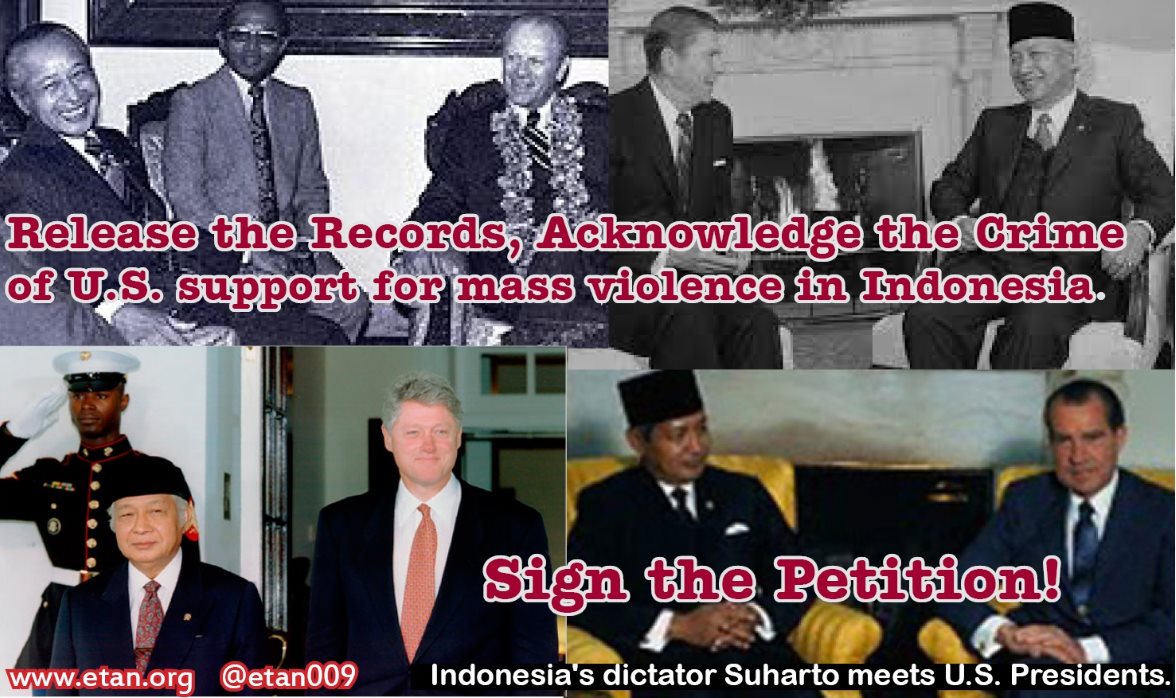
December 11 - The East Timor and Indonesia Action Network (ETAN) today urged the U.S. Senate to act quickly and pass Sen. Tom Udall's (D-NM) resolution calling on the U.S. government to "make available to the public all classified records and documents concerning the mass killings of 1965 and 1966" in Indonesia.

The resolution, introduced on December 10, Human Rights Day, "condemns the mass murder" and "expresses great concern about the lack of accountability enjoyed by those who carried out crimes during this period."


"The peoples of the U.S. and Indonesia deserve to know the full truth about these events. The U.S. must declassify and release all files related to Suharto's U.S.-backed seizure of power and the horrific events which followed," said Chris Lundry of ETAN. 

Read the rest here: http://etan.org/news/2014/12senate.htm


Wednesday, January 23, 2013

Nine Questions for Sen. John Kerry, nominee for Secretary of State, on Indonesia, Timor-Leste and West Papua


East Timor and Indonesia Action Network and West Papua Advocacy Team

Contact: John M. Miller (ETAN), +1-917-690-4391
Ed McWilliams (WPAT), +1-575-648-2078

Human Rights and Security Assistance

Senator John Kerry (D-MA)

Background: Reform of the military and police in Indonesia has come to halt as the U.S. provides increased assistance to both. No credible effort has been made to bring to justice those responsible for the destruction of Timor-Leste in 1999 or the many human rights violations that occurred during Indonesia's 24-year-long illegal occupation. In July 2010, then Secretary of Defense Robert Gates announced the resumption of engagement with Indonesia's notorious Kopassus special forces. The U.S.-funded and trained police Detachment 88 is regularly accusedof human rights violations. The national government has done little to protect freedom of religion. Indonesian security forces often standby or actively assist in violations of religious freedom. Engaging with Indonesia's military and police has not worked to improve human rights or accountability.

Question: To what extent has U.S. training and other assistance to the Indonesian security forces, especially the Kopassus Special Forces and the "anti-terror" Detachment 88 abetted those forces' violations of human rights? What is the current relationship between the U.S. Administration and such forces as the Indonesian Special Forces and Detachment 88? Have the numerous well-founded allegations of human rights abuse and corruption targeting these institutions been thoroughly examined by the U.S. Administration? What has been the result of those examinations? Do you agree that the U.S. should stop training and selling weapons to the Indonesian military and police?
see also Congress Writes Administration on Kopassus Training

U.S. Military Assistance to Indonesia

Background
: Recent administrations have ended restrictions on military assistance to Indonesia. They argued that U.S. engagement encourages reform and progress on human rights. The opposite is true. Historically, reform in Indonesia has coincided with U.S. restrictions on security assistance. In recent years, the U.S. has re-engaged with Indonesia's notorious Kopassus special forces and is actively considering the sale of Apache attack helicopters which can be used for internal repression, including attacks on civilians in West Papua.

Question: What systems are in place to ensure that U.S.-provided weaponry and associated equipment have not been and will not be employed to violate human rights? Specifically, what guarantees are in place to ensure the Apache attack helicopters will not be employed to support Indonesian security force "sweep" operations in West Papua, where villagers have long suffered indiscriminate security force attacks? What restrictions should be placed on U.S. security assistance to Indonesia as a way to encourage reform, accountability for past human rights crimes, and ongoing respect for human rights?
Indonesia as Strategic Partner

Recent administrations have ended restrictions on military assistance to Indonesia, arguing that U.S. engagement encourages reform and progress on human rights. The opposite is true. Historically, reform in Indonesia has coincided with U.S. restrictions on security assistance.


Background: This administration has identified Indonesia as a "strategic partner" reflecting its growing regional economic, political and security importance. Despite Indonesia's impressive democratic progress, Indonesian security forces continue to be a target of strong criticism as a regular violator of human rights and as a corrupt institution that remains largely unaccountable to civilian rule. The State Department annual human rights reports have documented the broad unaccountability of the security forces under Indonesia's judicial system. The limited efforts to prosecute crimes against humanity during the Suharto dictatorships and its immediate aftermath have ended in failure. These security forces, notably, continue to conduct "sweep operations" in rural West Papua which have forced thousands of villagers to flee, destroyed homes, crops and churches, and led to the death of many. Security forces, including police, have repressed freedom of speech, harassing peaceful dissenters and employing draconian Suharto-era laws to label peaceful protesters as "treasonous." Similar repression has also been employed in the Moluccan islands.

Question: Given the strong and growing ties between the U.S. and Indonesian security forces, what should the U.S. do to influence these forces to end their violations of human rights and corruption and to subordinate themselves to civilian control?
see also Human Rights in PapuaWest Papua Report (monthly) 

Justice for Timor-Leste
Background: During more than two decades of illegal occupation of Timor-Leste, Indonesian security forces committed serious crimes with impunity, taking as many as 184,000 Timorese lives and torturing, raping and displacing countless others. In 1999, after the East Timorese voted for independence, the Indonesian military and its militia proxies ransacked Timor-Leste. The magnitude of this destruction is clearly documented. Last year during a visit to Timor-Leste, UN Secretary-General Ban Ki-moon said: "All the perpetrators for the crimes against humanity and war crimes must be brought to justice." Timor-Leste's Commission on Truth, Reception and Reconciliation recommended an international tribunal should other efforts at justice fail. The government of Indonesia has proved unwilling to hold its security forces accountable.

Question: Do you support going to the UN Security Council to create an international tribunal for East Timor to make certain justice is served? What other steps should the U.S. take to support justice for these serious crimes, war crimes and crimes against humanity committed in East Timor since Indonesia invaded in 1975?
see also ETAN: 10 Years after Timor's Independence, Where Is the Justice?

Timor-Leste's Truth Commission
Background: The U.S. government has yet to respond to the report of Timor-Leste's Commission for Reception, Truth and Reconciliation (CAVR), although the president of Timor-Leste officially delivered a copy in 2003. Its recommendations include calls for an international tribunal, reparations from countries that supported the occupation, and restrictions on foreign assistance to the Indonesian military until it shows that it is a rights-respecting institution.

The U.S. government has yet to respond to the report of Timor-Leste's Commission for Reception, Truth and Reconciliation (CAVR)... Its recommendations include calls for an international tribunal.


Question: A number of Timor-Leste's Commission for Reception, Truth and Reconciliation recommendations are directed at the U.S. What do you think of the work of the CAVR and its recommendations about justice? Should the U.S. government issue a formal response to the CAVR report?
 
see also Congressmembers Urge Greater U.S. Commitment to Promote Justice for Timorese, Call for U.S. Response to CAVR Report
U.S. Aid to Timor-Leste
Background
: Timor-Leste has been independent for 10 years and remains heavily dependent on petroleum revenue. Following centuries of exploitation and occupation by external powers, its people are among the most impoverished in Asia. Current U.S. assistance to Timor-Leste is biased toward creating an unregulated economy and is increasingly emphasizing military aid. Former President Jose Ramos-Horta has argued that aid is better spent on the ground for rural development initiatives, rather than "to cover endless study missions, extremely generous consultant fees, repetitive reports and recommendations stating the obvious."

Question: Would you support assistance to Timor-Leste that is focused on improving the lot of the poorest? What should be done to strengthen non-oil sectors of its economy? Do you plan to re-evaluate the assistance the U.S. provides to Timor-Leste to make it more useful and effective? What should be the top priority of U.S. development assistance? Do you think current policy supports that emphasis? What would you change?
West Papua
Background: The Indonesian government maintains a heavy police and military presence in West Papua. The security forces regularly intimidate and threaten human rights activists, church leaders and members of indigenous communities who support greater autonomy or independence from Indonesia through peaceful means. Restrictions on international journalists, human rights advocates and diplomats hinder independent monitoring. Abuses committed in West Papua include the imprisonment of peaceful activists who raise the "Morning Star" flag, regarded as a symbol of Papuan identity and independence. Indonesian security forces opened fire on the peaceful Third Papuan National Congress in October 2011, killing at least three people. This interference with the right to peacefully assemble and express one's political views is a clear violation of international human rights. Last September, Secretary Clinton on her visit to Indonesia "deplore[d] violence of any sort in Papua" and called for "dialogue between Papuan representatives in the Indonesian Government" aimed at "resolving conflict peacefully, [and] improving governance and development."
Question: Does U.S. security assistance to Indonesia help or hinder an end to violence in West Papua? How can the U.S. best assist a peaceful resolution of the conflict there? Would you support suspension of security assistance to Indonesia until these human rights violations cease in West Papua?
see also West Papua Report (monthly); Crimes Against Humanity: When Will Indonesia’s Military Be Held Accountable for Deliberate and Systematic Abuses in West Papua?” Hearing in House of Representatives September 22, 2010; Members of U.S. Congress Call Upon Indonesia to End Systematic Abuses in West Papua (November 18, 2011); Congressmember Faleomavaega Calls on Indonesia to Assure Safe and Humane Treatment of West Papuans in Custody and to Work for Their Release (October 21. 2011)

The U.S. government has yet to respond to the report of Timor-Leste's Commission for Reception, Truth and Reconciliation (CAVR)... Its recommendations include calls for an international tribunal.


West Papua Special Autonomy
Background: Since passage of legislation in 2001, the Indonesian government has pledged to institute "special autonomy" within West Papua. The approach, as conceived, was to grant greater autonomy to West Papua and to end decades of neglect that has led to stagnation of development and denial of basic services. For decades, West Papua has ranked at the bottom of for Indonesian provinces on indices measuring health, education and employment opportunities. The people of West Papua, through their elected and civil society leaders and through mass demonstrations, have declared "special autonomy" a failure. Nevertheless, the U.S. government continues to support this failed approach.

Question: Under your leadership, will the Department of State review "special autonomy" in the provinces of Papua and West Papua, and will you press the Indonesian government to revamp its failed approach to West Papua?
Access to West Papua
Background: The Government of Indonesia has long sought to prevent the international community from witnessing the repression of the Papuan people. It has forced the closure of the offices of the International Committee of the Red Cross and Peace Brigades International, blocked missions by Amnesty International and other international human right organizations, and regularly blocked or impeded travel to or within West Papua by diplomats, international journalists, researchers and others. A joint report by the Faith-Based Network on West Papua, Franciscans International, Papua Land of Peace and the Asian Human Rights Commission concluded that the Indonesian government is tightening restrictions on journalists and non-governmental organizations which seek to cover developments in West Papua. The U.S. Congress and several U.S. administrations have repeatedly called for an end to restrictions on travel to West Papua.

Question: What specific steps would the State Department, under your leadership, take to end restrictions on access to West Papua by journalists, humanitarian organizations and others?

Also

Friday, April 6, 2012

West Papua Report April 2012 - repressing dissent, oppose U.S. copter sale, soldiers not services

Read the April 2012 West Papua Report here 


Summary: 
An Indonesian court has sentenced five senior Papuans to three years imprisonment following their conviction on "treason" charges. They fell victim to the same undemocratic law employed against more than 90 Papuans and Malukans for their peaceful dissent in recent years. The five were charged for their central role in the October 16-19, 2011 "Third Papuan National Congress," a peaceful assertion of Papuans' right to self-determination that came under brutal assault by Indonesian security forces. In a statement, WPAT calls for an end to that law which was developed during Dutch colonial times, was employed by the dictator Suharto, and now has no place in a democratic Indonesia. 


Banners at protest in Jayapura. West Papua Media
Thousands of Papuans took to the streets in West Papua and elsewhere on the occasion of the visit to Indonesia of UN Secretary General Ban Ki-Moon. The largely peaceful demonstrations called for a special referendum to at last allow Papuans a genuine act of self-determination. 


More than 90 international organizations have called on the U.S. Congress to block sale of Apache helicopters. They would significantly expand the capacity of Indonesian security forces to conduct "sweep operations" that have devastated rural Papuan villagers. 


A recent book and a commentary by a Papuan legislator have underscored the Indonesian governments persistent failure to bring essential services to rural Papuans. WPAT observes that for many rural Papuans the face of the Indonesian government is not that of a teacher, doctor or nurse but rather, that of a solider, policeman or intelligence agent.
 
Back issues of West Papua Report

Wednesday, May 4, 2011

West Papua Report May 2011

now out West Papua Report May 2011


Summary

Thousands of Papuans, on May 2, began peaceful rallies demanding a referendum on West Papua's political future, an end to "Special Autonomy," and international intervention in to end decades of human rights abuse and injustice at the hands of the Indonesian government. The date coincides with Indonesian forced annexation of West Papua over four decades ago. Security personnel are out in force in many West Papua towns and cities and some arrests have already been reported. The annual U.S. Department of State report on human rights in Indonesia accurately and in some detail describes the extensive human rights violations in West Papua, correctly assigning blame for the abuse principally to Indonesian security forces. The report also notes that those perpetrating the abuse are largely unaccountable for their crimes. The report, as in the past, largely fails to address violations of cultural, economic and social rights. Indonesian security forces have run amok in Dogiyai district driving many from their homes following a violent protest by Papuans over the police killing of two unarmed Papuans. Papuans have urged the suspension of disbursement of special autonomy funds following findings by the Supreme Audit Agency that the funds intended to benefit Papuans have been embezzled. Yale University hosted a seminar to review of developments in and affecting West Papua. The Forestry Minister has pledged not to issue permits that would entail the destruction of pristine Papuan forests. The massive Merauke Integrated Food and Energy Estate (MIFEE) appears to be an exception to this policy.

Thursday, February 3, 2011

ETAN: Letter to State Department on issuing visas to U.S. in Dili

ETAN writes to Secretary of State Clinton about issuing visas in Dili to East Timorese wanting to travel to the United States.

Thursday, December 23, 2010

ETAN letter on labor dispute at US Embassy in Dili

Campaign updates from APHEDA are here.

Ambassador Judith Fergin
US Embassy
Dili, Timor-Leste

December 22, 2010

Dear Ambassador,

We are writing regarding the dismissal of Mario Baretto and the subsequent refusal of the US Embassy in Timor-Leste to meet with his union.

We understand that the embassy will not meet with Mr Baretto's trade union, the General Workers Union of Timor-Leste (SJTL), about the dismissal arguing that "as part of the terms of his employment, Mr Baretto was/is not allowed to be a member of any organized union and therefore we will not meet with any representative acting on his behalf."

This position is contrary to international human rights law, and we urge you to quickly meet with his union representatives as called for in the Timor-Leste's Labor Code. If needed, we urge the Embassy to accept mediation before Timor-Leste's labor board to resolve the dispute about Mr. Baretto's dismissal.

The right to form and to join trade unions is a fundamental human right, included in the Universal Declaration of Human Rights. The International Labor Organization Convention on the Freedom of Association and Protection of the Right to Organize, which Timor-Leste ratified on June 16 2009, also protects the right to unionize.

As you know, the U.S. Department of State each year publishes an annual report on human rights in countries around the world. The chapter on Timor-Leste in this year's report observes that "The country has a labor code based on the International Labor Organization's standards. The law permits workers to form and join worker organizations without prior authorization." The report notes a number of the practical obstacles to the effective exercise of labor rights, to which we would now add the U.S. government.

The U.S. speaks regularly about the need to strengthen the rule of law in Timor-Leste. It has funded a number of programs over the last decade aimed at that goal. Howerver, its words would carry more weight and its actions more credibility, if the embassy were in compliance with Timor-Leste's labor law.

We urge the United States government and your embassy to honor its obligations under national and international law by meeting with Mr. Baretto's representatives and accepting mediation before Timor-Leste's labor board.

We look forward to your response.

Yours sincerely

John M. Miller
National Coordinator
East Timor and Indonesia Action Network

cc: Secretary of State Hillary Clinton
Michael Posner, Assistant Secretary of State for Democracy, Human Rights, and Labor

Tuesday, December 7, 2010

35th Anniversary of U.S.-backed Indonesian Invasion of East Timor

Today, December 7, 2010, marks the 35th anniversary of the U.S.-backed Indonesian invasion of East Timor. On the 30th anniversary of Indonesia's full-scale assault on Timor, ETAN
"called on the world to listen to East Timor’s victims and act on their demands for justice. The group also urged the United States government to formally acknowledge its past support for Indonesia’s brutal military occupation of East Timor, and for the international community to learn from this history and never repeat the same crimes."
December 7 invasion day, via Timor Archives

It is well-documented that the Indonesian military launched its 1975 invasion just hours after then President Ford and Secretary of State Henry Kissinger gave their explicit permission to go ahead. They reassured Suharto that U.S. military support would continue, despite U.S. law and Indonesia's treaty obligations. U.S. weapons, military training and political support enabled Indonesia to seize the territory and maintain its occupation for 24 years. These brutal events claimed the lives of up to 200,000 people.

The report of Timor-Leste's Commission for Reception, Truth and Reconciliation (known by its Portuguese initials, CAVR) thoroughly documents the impact of the Indonesia's illegal invasion and occupation.
While the report was long ago officially delivered to the U.S. and other governments, the CAVR's recommendations to the international community remain largely ignored. anniversary. Despite being urged to do so, President Obama did not address these issues during his recent visit to Jakarta.

Kopassus troops
We continue to urge the U.S. government and Congress to seriously respond to the report by holding hearings and formally acknowledge the U.S. role in the suffering of the East Timorese and Indonesian peoples. The U.S. and others who backed Indonesia should apologize and provide reparations. The U.S. should work to establish an international tribunal to try those most responsible the heinous crimes committed in Timor-Leste from 1975-1999 and withhold support for Indonesia's security forces especially their most brutal units - including Kopassus, as recommended by the CAVR to encourage genuine accountability and promote reform. These forces continue to terrorize the people of West Papua.

We highlight some of the CAVR's  most pertinent recommendations after the jump.


Sunday, November 28, 2010

Wikileaks

UPDATE: The Jakarta Post reports that "3,059 [documents] came from the US Embassy in Jakarta and 167 from the US Consulate in Surabaya. The latest document among the Jakarta files was dated Feb. 27, 2010, while the earliest was sent out on Nov. 19, 1990. Only 14 of the files were sent out during the 1990s, and another 20 from 2000 to 2005. The vast majority were sent out from 2006 to February this year."
--

Wikileaks U.S. State Department document dump will include about 350 from embassy in Dili and ten times as many from the embassy in Jakarta.

According to Wikileaks:
"Wikileaks began on Sunday November 28th publishing 251,287 leaked United States embassy cables, the largest set of confidential documents ever to be released into the public domain. The documents will give people around the world an unprecedented insight into US Government foreign activities.
The cables, which date from 1966 up until the end of February this year, contain confidential communications between 274 embassies in countries throughout the world and the State Department in Washington DC. ...
The embassy cables will be released in stages over the next few months.
Only a few hundred documents have been posted so far. Much interesting, and possibly revelatory, reading to come.