Read the whole release here: http://www.etan.org/news/2015/10obama_wpt.htm
ETAN Urges Obama to Raise West Papua Rights with Indonesia President
The East Timor and Indonesia Action Network (ETAN) today urged President Obama to forcefully urge Indonesia's President Joko "Jokowi" Widodo to end human rights violations.
In a petition signed by nearly 1400 people, the U.S. president was urged "to condition U.S. support for the Indonesian security forces on concrete improvements in human rights."
John M. Miller, the national coordinator of ETAN, said that "President Widodo pledged to improve human rights in West Papua. By conditioning assistance to the Indonesian military and police, President Obama can support this policy by striking at those most reluctant to implement it."
Miller added that "Widodo's rights pledge has been undermined by Indonesia's security forces and some of Jokowi's own officials."
Obama and Widodo are scheduled to meet in Washington, DC, on Monday, October 26.
Read more here
Showing posts with label President Obama. Show all posts
Showing posts with label President Obama. Show all posts
Saturday, October 24, 2015


Thursday, October 22, 2015
Demonstrate during Jokowi's U.S. Visit
If we didn't know any better, we would say President Widodo was avoiding us! He cancelled the two events on his preliminary schedule that we had planned to bring our messages of support for human rights and justice in Indonesia and West Papua. Stay tuned for future activities.-- John M. Miller for ETAN.
Join ETAN, Sign up today!
Protest Freeport and Indonesia's Theft of West Papuan Resources
Please note; The Washington, DC demonstration is cancelled. President Jokowi's planned meeting with Freeport will not take place. The California demonstration is still on!
Sign up for ETAN's email lists
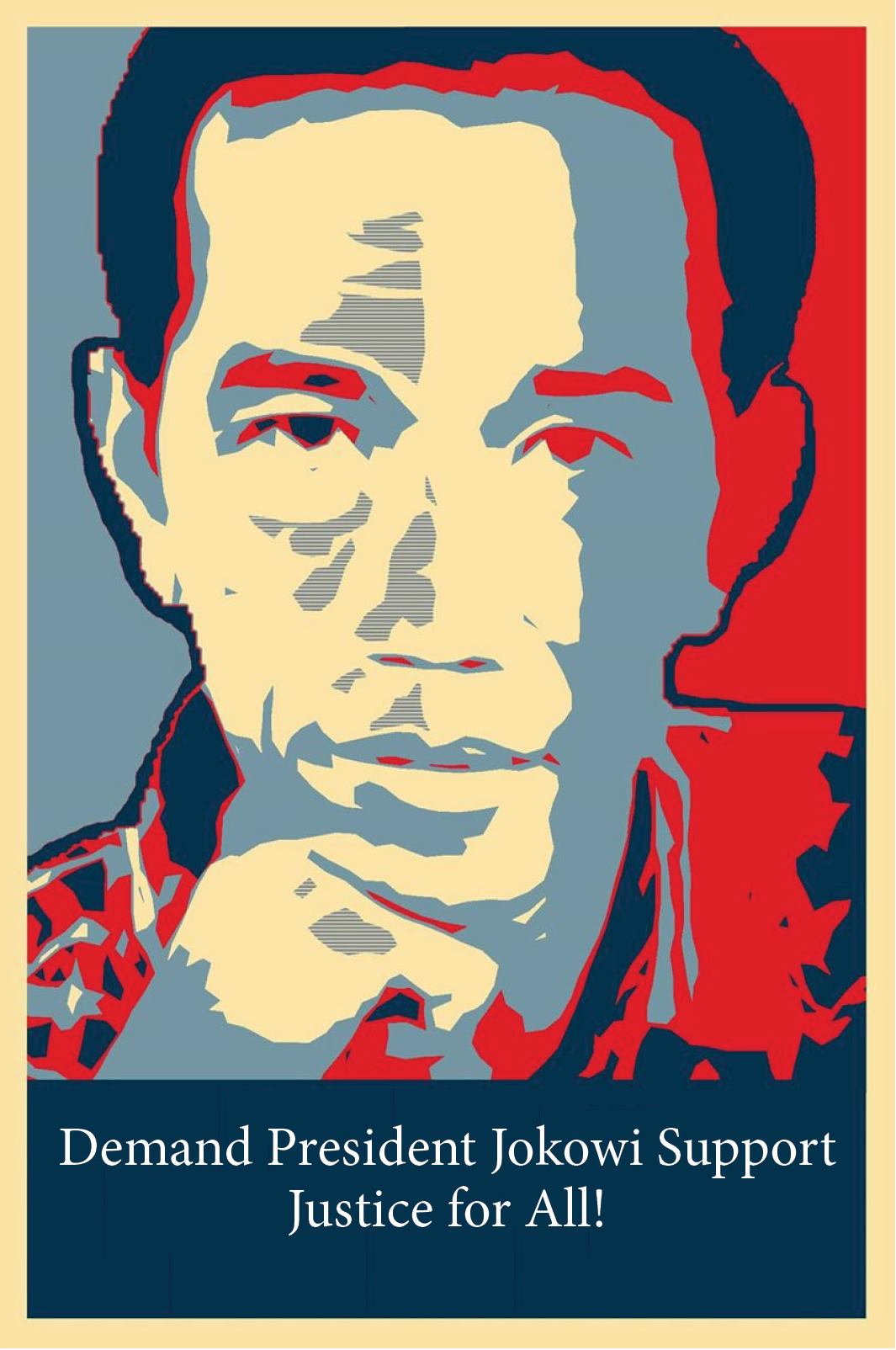
Demand President Jokowi Support Justice for All
Wednesday, October 28, 2015, 09:00 - noon
Where: Computer History Museum
1401 N. Shoreline Blvd, Mountain View, CA 94043
Contact : Peter Phwan, ETAN/ICANet, San Francisco (415) 812-2414
Muhamad Amin, www.jokowitodo.org, San Francisco (415) 412-6372
John M. Miller, East Timor and Indonesia Action Network (ETAN), 917-690-4391 john@etan.org
Facebook page
Indonesia's President Joko "Jokowi" Widodo will shortly visit the United States to meet with President Obama. On October 28, President Jokowi is set to give a speech at Computer History Museum in Silicon Valley. This forum will be all about business. Jokowi was elected with the promise that his administration would different. He has yet to fulfill this promise. Positive initiatives by President Jokowi have been undermined by his own officials and many important issues, such as justice and accountability for past human rights crimes, have not been seriously addressed.
More information here
Join ETAN, Sign up today!
Monday, October 26, 2015, 8:45 - 9:45 am
Willard Hotel
Contact John M. Miller, East Timor and Indonesia Action Network (ETAN), 917-690-4391, john@etan.org
On Monday, Oct. 26, Indonesia's President Joko "Jokowi" Widodo will meet with officials of the Freeport McMoRan mining company. Freeport, which runs what at among the world's largest copper and gold mine in West Papua. The mine is Indonesia's largest revenue generator. Monday's meeting is part of negotiations about the renewal of Freeport's license, including a new split of the mine's revenue. Revenue that rightfully belongs to the West Papuan people.
More information here
Join ETAN, Sign up today!
Protest Freeport and Indonesia's Theft of West Papuan Resources
Please note; The Washington, DC demonstration is cancelled. President Jokowi's planned meeting with Freeport will not take place. The California demonstration is still on!
Sign up for ETAN's email lists
| . |
Wednesday, October 28, 2015, 09:00 - noon
Where: Computer History Museum
1401 N. Shoreline Blvd, Mountain View, CA 94043
Contact : Peter Phwan, ETAN/ICANet, San Francisco (415) 812-2414
Muhamad Amin, www.jokowitodo.org, San Francisco (415) 412-6372
John M. Miller, East Timor and Indonesia Action Network (ETAN), 917-690-4391 john@etan.org
Facebook page
Indonesia's President Joko "Jokowi" Widodo will shortly visit the United States to meet with President Obama. On October 28, President Jokowi is set to give a speech at Computer History Museum in Silicon Valley. This forum will be all about business. Jokowi was elected with the promise that his administration would different. He has yet to fulfill this promise. Positive initiatives by President Jokowi have been undermined by his own officials and many important issues, such as justice and accountability for past human rights crimes, have not been seriously addressed.
More information here
Join ETAN, Sign up today!
Monday, October 26, 2015, 8:45 - 9:45 am
Willard Hotel
Contact John M. Miller, East Timor and Indonesia Action Network (ETAN), 917-690-4391, john@etan.org
On Monday, Oct. 26, Indonesia's President Joko "Jokowi" Widodo will meet with officials of the Freeport McMoRan mining company. Freeport, which runs what at among the world's largest copper and gold mine in West Papua. The mine is Indonesia's largest revenue generator. Monday's meeting is part of negotiations about the renewal of Freeport's license, including a new split of the mine's revenue. Revenue that rightfully belongs to the West Papuan people.
More information here
 |
| Freeport's Grasberg mine in West Papua. Credit: Panos Pictures/Rob Huibers |
Tuesday, September 29, 2015
Tell Obama to support West Papua #humanrights
Sign our petition
Tell Obama to support Papua Human Rights

On October 26, 2015, President Obama will meet with Indonesia's President Joko "Jokowi" Widodo.
Beginning in May 1963, West Papua was occupied by Indonesia with U.S. government support and encouragement. By 1969, Indonesia had annexed the territory. Over the course of five decades, West Papuans have suffered mass killings, torture, rape, and the loss of their culture and lands. U.S. corporations like the mining giant Freeport McMoRan have devastated the environment. At least 100,000 Papuans are estimated to have died as a result of Indonesian rule. In addition, the region has been so inundated with migrants that indigenous Papuans are no longer a majority in their own land.
The U.S. continues to arm and train the security forces that repress the West Papuan people. The Indonesian government's attempts to conceal the truth about West Papua include banning foreign journalists and UN Special Rapporteurs on human rights from visiting the territory. While President Widodo has announced several positive initiatives, elements in his government, including the security forces, are resisting change and the human rights violations continue.
The West Papuans continue to resist Indonesian rule. Groups supporting self-determination recently came together in the United Liberation Movement for West Papua (ULMWP) in a broad coalition to press their case within West Papua and internationally.
Restrictions on security assistance from the United States were important in Timor-Leste (East Timor) gaining their independence from Indonesia. The U.S. should again restrict training and weapons to Indonesia in support of the rights of West Papuans.
This is a petition of the East Timor and Indonesia Action Network For more information on West Papua, read the monthly West Papua Report, published by the West Papua Advocacy Team and ETAN.
Thursday, October 3, 2013
ETAN and WPAT on Obama's Upcoming Trip to Indonesia
UPDATE: Obama is not going to Indonesia because of U.S. government shutdown. Our criticisms of U.S. policy to Indonesia remain; the policy needs to change.
Read: ETAN Urges President Obama to Put Human Rights at Center of U.S.-Indonesia Relations During Upcoming Visit to Indonesia
excerpts:
Read: West Papua Advocacy Team Open Letter to President Obama
excerpts:
Read: ETAN Urges President Obama to Put Human Rights at Center of U.S.-Indonesia Relations During Upcoming Visit to Indonesia
excerpts:
“The U.S. must not ignore injustice and human rights violations to advance narrow strategic and economic interests that have little to do with the well-being of the U.S. or Indonesian people,” said ETAN National Coordinator John M. Miller. “While much has changed in Indonesia since the Suharto dictatorship, U.S. security assistance does not promote further change. Instead it encourages impunity and further violations of human rights.”
“We are calling for a new relationship between the two countries built on an honest assessment of the bloody past,” said Miller. “Instead of offering more weapons and more training to Indonesia’s military, President Obama should suspend this assistance until there is an end to abuses and real accountability for past human rights crimes.”
Since Obama's last visit to Indonesia, the human rights situation has deteriorated in West Papua and religious intolerance has grown.
We are calling for a new relationship between the two countries built on an honest assessment of the bloody past.
“President Obama can send a strong message against impunity by making clear he and and other senior U.S. officials will not to meet with any Indonesian politicians -- including likely presidential candidates, such as retired generals Prabowo and Wiranto -- who have been credibly accused of human rights and other crimes,” said Miller.
 |
| The two presidents. |
excerpts:
This year marks 50 years of Indonesian rule over West Papua, which had previously been a Dutch colony slated for independence. Half a century of Indonesian rule has seen West Papua subjected to crimes against humanity, according to numerous credible human rights reports. Half a century of colonization of one people by the armed forces of another has taken place. Half a century of ongoing conflict has been the result. To resolve the conflict peacefully, international mediation is needed. West Papua was delivered to Indonesian rule as a result of American mediation, which confers upon the United States a special responsibility to act to resolve the current conflict peacefully.and
The increasing militarization of West Papua indicates that there is no let-up in sight to the half-century of widespread violations of basic human rights in West Papua. If Indonesia is democratizing, the reverse is the case in West Papua.
We therefore recommend that on your trip to Indonesia, you:
- Press for a dialogue between the Indonesian government and West Papuan civil society, with international third-party mediation, along the lines of the successful international medication of the Aceh conflict in 2005. Current policy is not advancing dialogue. Internationally-mediated dialogue is a growing call from civil society voices in both West Papua and Indonesia.
- Halt military assistance to the Indonesian security forces. United States cooperation with the most brutal elements of the security forces encourages the climate of impunity, and United States sale of Apache helicopters increases the repressive capacity of the security forces in West Papua. Cooperation with the Kopassus Special Forces and Detachment 88of the Indonesian National Police should be suspended pending an improvement of the human rights situation in West Papua and the initiation of dialogue, and the agreement to provide Apache helicopters should be cancelled. Non-military ties should continue to expand but military cooperation be made conditional on respect for human rights in West Papua, as it was with respect to the Timor-Leste situation prior to Timor-Leste's independence.
- Press for open access to West Papua by international observers, NGOs and others, so that the conflict will no longer be hidden.
- Support efforts from within Melanesia to address the root causes of the conflict in West Papua, the denial of self-determination and the persistence of repressive policies by the Indonesian security forces.
- Press President Yudhoyono to order a halt to security forces' violations of the human rights of West Papuan civilians, and hold security personnel accountable for their crimes by laying charges, where evidence merits, in civilian courts.
West Papua Advocacy Team
Monday, December 20, 2010
Obama's Potemkin Visit to Jakarta
 |
| Ed McWilliams |
by Edmund McWilliams
In early November President Obama indulged himself with a nostalgic visit to the place he called home for four years of his youth. He charmed ordinary Indonesians with formal and informal remarks drawn from recollections of Indonesia of four decades ago. More troublingly, President Obama also praised Indonesians in ways that betrayed a broad ignorance of the ugly reality faced by many in this archipelago today.
Obama made much of the "tolerance" that Indonesian (and US) officials contend the post-Suharto Indonesian governments have fostered within Indonesian society. "Here can be found the ability to bridge divides of race and regions and religions", he said. He described Indonesia as a "country that has figured out how to create a genuine democracy despite great diversity". Obama also commended the triumph of that democracy: "Indonesia has charted its own course through an extraordinary democratic transformation from the rule of an iron fist to the rule of the people". While President Obama can be forgiven a bit of dewy-eyed reminiscing, his false depictions of Indonesia today, presumably shaped by his advisers, are a dangerously unstable basis for US policy formulation.
The Indonesia Obama chose not to see is one of significant social tensions often aggravated by a government and especially a security force which stoke these tensions for political and economic gain. The democratic progress of the last ten years, moreover, has been a victory for the Indonesian people who struggled against a brutal, corrupt military and an unaccountable police system that is a threat to further democratic progress. The real Indonesia was reflected in the interviews I conducted with Indonesians in Jakarta who were not invited to the major events celebrating the US President's brief return.
An activist from the Ahmadiyya sect of Islam described the ongoing assaults targeting that group's several hundred thousand adherents. In recent years mobs have destroyed twenty-seven Ahmadiyya mosques, most recently in the province of Riau on September 27. A video clip of a mosque's destruction shows a mob almost casually attacking the building, eventually destroying its central pillars and causing the massive roof to collapse. At one point a uniformed Indonesian police officer leisurely walks through the video frame, seemingly oblivious to the ongoing violence. Government complicity in this persecution extends beyond security force failure to take action. Indonesian Minister for Religious Affairs Suryadhama Ali recently told the media that the solution to the ongoing strife between the Ahmadiyya and the more traditional Muslims was the banning of the Ahmadiyya sect. His recommendation, which has drawn no rebuke from Indonesian President Yudhoyono, only encourages further thug violence targeting the Ahmadiyya and a continued failure of the security forces to rein in the attackers.
State condoned and executed violence is especially apparent in West Papua, where generations of Papuans have faced extraordinary brutality since the coerced annexation of the land over four decades ago. Tens of thousands of Papuans have been killed by security forces while the surviving Papuan population has been marginalized by government-organized migration of non-Papuans to West Papua. The systematic brutalizing of the Papuans, described in recent testimony before a US House subcommittee as "creeping genocide", was revealed most recently by release of secret Indonesian military documents. These documents, which surfaced during the Obama visit on the blog of investigative journalist Alan Nairn, show that Indonesian special forces (Kopassus) targeted leading church and other civil society and government leaders for intelligence collection, intimidation and worse. The importance of these documents lies in their revelation that criminal human rights abuse by the special forces targeting Papuans is not simply a matter of individual security personnel operating outside regulations as is regularly claimed by the Indonesian government and US officials. Rather, the documents make clear that the beating and torture of individual Papuans constitutes a military policy that ignores internationally recognized civil and political rights and Indonesian law. The documents together constittute a doctrine that has been funded and implemented, requiring approval at senior level and thereby implicating senior military leaders.
 |
| President Obama meets with President Yudhoyono at the Istana Merdeka State Palace Complex in Jakarta, Nov. 9, 2010. (Official White House Photo by Pete Souza) |
The Obama administration, like its predecessors, has been reluctant to publicly acknowledge either ongoing security force abuses in West Papua or these forces' unaccountability. The Indonesian government was clearly troubled by the surfacing of the torture videos on the eve of President Obama's and Prime Minister Gillard's visits. President Yudhoyono convened his senior ministers, and a government spokesperson assured there would be a prompt military investigation. Calls by Papuans and other human rights advocates for an independent investigation were ignored. On November 5 army personnel faced a judge in Jayapura; senior military officials told the media that the tribunal was convened to hold the perpetrators of the video abuses accountable. In a classic bait and switch, the military produced for trial not those responsible for the torture but rather the troops depicted beating villagers. The identity of the torturers remains unknown. In one respect, it appears the government demonstrated both alacrity and sophistication in responding to the surfacing of the torture videos. Within days of the videos appearing on the internet, five major NGOs who carried the footage on their websites suffered simultaneous cyber attacks. Analysts assessed that the coordinated attack could only have been the work of a government, or government agencies with substantial resources. US officials have yet to comment on either the bait and switch trial or the cyber attack.
President Obama's limited travel within Jakarta was carefully crafted to obscure a reality that his public comments carefully ignored. He did not see a march by thousands of labor supporters who were protesting new proposed labor legislation that would impede workers' right to organize, to obtain insurance or to press for a minimum wage. Nor did he see the extraordinary wealth gap between rich and poor Indonesians. While he marveled at the gleaming skyscrapers that dominate the Jakarta landscape, he did not see the filthy hovels that crowd beneath them and along the city's canals, where millions of Indonesians survive without access to adequate food, health care or education. Notwithstanding the manifest non-egalitarian nature of Indonesia's economy, Obama congratulated the nation's leaders that in Indonesia "development and democracy reinforce one another". In reality, development continues to be at the expense of democratization, much as it was during the three decades of Suharto dictatorship. Indonesian human rights advocates and journalists describe an endemic atmosphere of intimidation enforced by security forces which collude with major domestic and international firms bent on "development" of the archipelago's vast natural resources and enormous labor pool. Those who report on corrupt dealings or the destruction of the environment are subjected to physical or threatened abuse targeting them and their families. A journalist in Papua who reported critically on plans for a massive agriculture plantation that will dispossess local people was found murdered earlier this summer. Human rights advocates who reveal security force brutality suffer similar threats, and both often fall victim to legal suits which employ Indonesia's notoriously corrupt judicial system as a weapon in service of commercial and security forces interests. Usman Hamid, a prominent human rights advocate and former director of the key human rights advocacy group Kontras, is facing a legal suit alleging defamation. The false charge arose as a result of his determined pursuit of justice in the murder of his predecessor at Kontras, the renowned Munir Said Talib.
Ignoring the reality of security forces that operate brutally and without accountability before the law, the Obama administration is expanding financial, equipment and training assistance to those forces. After a decade of withholding assistance to the Indonesian special forces, the Obama administration announced in July that it was resuming collaboration with the organization, notwithstanding its repression of Papuans and lengthy record of human rights abuse throughout the archipelago. The administration is also continuing assistance to Detachment 88, which has been credibly accused by human rights groups and the media of torture, beatings and kidnappings.
The US government's willingness to co-operate with security forces that continue to commit human rights abuses, operate illegally and remain unaccountable was enshrined in the "comprehensive partnership" signed by Obama and Yudhoyono. US support for security forces that threaten human rights and democratic development is born of blindness to the reality of current day Indonesia. President Obama's brief visit only reinforced a deliberate misperception by US policy makers of Indonesia's complex and growing challenges.
----------
Support ETAN in 2011!
Support ETAN in 2011!
"ETAN's work is unique and essential at this critical time.
It needs and deserves your support." - Ed McWilliams
It needs and deserves your support." - Ed McWilliams
Thursday, December 2, 2010
West Papua Report - December 2010
now out here
Summary:
Summary:
During his November 9-10 visit to Indonesia, President Obama and President Yudhoyono unveiled a "comprehensive partnership" that strongly reflects Washington's traditional perception of Indonesia as a platform servicing U.S. security and commercial interests. A key element of the "partnership," broadened security ties, comes at the expense of human rights and democratization which are under growing threat from corrupt and unaccountable Indonesian security forces. Secret Kopassus documents released by investigative journalist Alan Nairn reveal that the targeting of senior members of Papuan civil society is official policy, approved at senior levels. Papuans used the occasion of President Obama's visit to protest the denial of self determination and the continuing devastation of local resources by the U.S. mining giant Freeport McMoran. Journalists have complained loudly over Indonesian government subterfuge regarding the trial purportedly of security personnel involved in the torture of Papuans. On December 1, Papuans and their supporters in West Papua and in cities around the world celebrated the day in 1961 when the Papuans declared their independence from Dutch colonial rule. A late November visit to West Papua by President Yudhoyono and many members of his cabinet failed to address long-standing Papuan concerns. A statement by an Indonesian military leader indicates military intent to deepen already substantial military involvement in commercial activities in West Papua.
Friday, November 5, 2010
Statement of East Timor and Indonesia Action Network on President Obama's Visit to Indonesia
November 5, 2010 - As President Obama departs on his twice-delayed trip to Indonesia, the East Timor and Indonesia Action Network (ETAN) urge him to use the opportunity to build a relationship between the U.S. and Indonesia based on the promotion of human rights and the rule of law.
As we wrote to President Obama last March, "the history of U.S.-Indonesia relations is much better known for the U.S.'s largely uncritical support of the Suharto dictatorship, from its bloody seizure of power in 1965 through its illegal invasion and occupation of then Portuguese Timor to the Kopassus kidnappings and murders of student leaders in 1997 and 1998."
President Obama's visit coincides with Indonesia's Heroes Day, and the dictator Suharto is under consideration to be named as a "National Hero." We urge President Obama to use the opportunity of his visit to decisively break with past U.S. support for torture, disappearances, rape, invasion and illegal occupation, extrajudicial murder environmental devastation. and more. U.S. weapons, training, political backing and economic support of Indonesia facilitated these crimes. President Obama should apologize to the peoples of Indonesia and Timor-Leste for the U.S. role in their suffering during the Suharto years and to offer condolences to Suharto's many victims throughout the archipelago.
Crimes against humanity and other violations of human rights did not end with Suharto’s fall. Since then U.S. policy has largely focused instead on narrow strategic and economic interests that have little to do with the well-being of the Indonesian people. In recent weeks,horrific videos and other reports of torture, the burning of villages and other crimes show that the people of West Papua and elsewhere continue to suffer at the hands of military and police.
As we wrote to President Obama last March, "the history of U.S.-Indonesia relations is much better known for the U.S.'s largely uncritical support of the Suharto dictatorship, from its bloody seizure of power in 1965 through its illegal invasion and occupation of then Portuguese Timor to the Kopassus kidnappings and murders of student leaders in 1997 and 1998."
President Obama should apologize to the peoples of Indonesia and Timor-Leste for the U.S. role in their suffering during the Suharto years and to offer condolences to Suharto's many victims throughout the archipelago. |
President Obama's visit coincides with Indonesia's Heroes Day, and the dictator Suharto is under consideration to be named as a "National Hero." We urge President Obama to use the opportunity of his visit to decisively break with past U.S. support for torture, disappearances, rape, invasion and illegal occupation, extrajudicial murder environmental devastation. and more. U.S. weapons, training, political backing and economic support of Indonesia facilitated these crimes. President Obama should apologize to the peoples of Indonesia and Timor-Leste for the U.S. role in their suffering during the Suharto years and to offer condolences to Suharto's many victims throughout the archipelago.
Crimes against humanity and other violations of human rights did not end with Suharto’s fall. Since then U.S. policy has largely focused instead on narrow strategic and economic interests that have little to do with the well-being of the Indonesian people. In recent weeks,horrific videos and other reports of torture, the burning of villages and other crimes show that the people of West Papua and elsewhere continue to suffer at the hands of military and police.
We urge President Obama to condition U.S. security assistance on an end to human rights violations and impunity. We urge him to follow the recommendation of Timor-Leste's Commission for Reception, Truth and Reconciliation in Timor-Leste (CAVR), which urged nations to "regulate military sales and cooperation with Indonesia more effectively and make such support totally conditional on progress towards full democratisation, the subordination of the military to the rule of law and civilian government, and strict adherence with international human rights, including respect for the right of self-determination."
We urge the President to announce that the U.S., as a permanent member of the UN Security Council, will work to establish an international tribunal to bring to justice the perpetrators of human rights crimes committed during Indonesia’s 24-year occupation of Timor-Leste. This would send the critical message that no one is above the law and would serve as an important deterrent to future human rights violators. A tribunal was recommended by the CAVR and is supported by the many victims of these crimes and by human rights advocates in Timor-Leste, Indonesia and elsewhere.
We urge the President to announce that the U.S., as a permanent member of the UN Security Council, will work to establish an international tribunal to bring to justice the perpetrators of human rights crimes committed during Indonesia’s 24-year occupation of Timor-Leste. This would send the critical message that no one is above the law and would serve as an important deterrent to future human rights violators. A tribunal was recommended by the CAVR and is supported by the many victims of these crimes and by human rights advocates in Timor-Leste, Indonesia and elsewhere.
We urge the President to announce that the U.S., as a permanent member of the UN Security Council, will work to establish an international tribunal to bring to justice the perpetrators of human rights crimes committed during Indonesia’s 24-year occupation of Timor-Leste. |
We are deeply concerned about the administration's recent announcement that the U.S. will for the first time in a dozen years engage with Indonesia's notorious Kopassus special forces. We also call on President Obama to end this planned engagement and to suspend all funding and training of Indonesia's Detachment 88 police unit pending review of charges leveled against the unit for systemic human rights violations, including use of torture. We believe that U.S. law bars cooperation with military and police units with such egregious human rights records.
These actions by President Obama would change the current course from one of repeating failed policies. While much has changed in Indonesia, U.S. security assistance does not promote further change. Instead it encourages impunity and violations of human rights and sets back reform.
In his book The Audacity of Hope, President Obama wrote that "for the past sixty years the fate of [Indonesia] has been directly tied to U.S. foreign policy," a policy which included "the tolerance and occasional encouragement of tyranny, corruption, and environmental degradation when it served our interests."
A new relationship between the two countries must be built on an honest assessment of the bloody past. President Obama's special connection to Indonesia offers an important opportunity to usher in a new era in the relationship between our two nations. One that rejects a relationship based largely on militarism with one that respects human rights and promotes the rule of law.
In his book The Audacity of Hope, President Obama wrote that "for the past sixty years the fate of [Indonesia] has been directly tied to U.S. foreign policy," a policy which included "the tolerance and occasional encouragement of tyranny, corruption, and environmental degradation when it served our interests."
A new relationship between the two countries must be built on an honest assessment of the bloody past. President Obama's special connection to Indonesia offers an important opportunity to usher in a new era in the relationship between our two nations. One that rejects a relationship based largely on militarism with one that respects human rights and promotes the rule of law.
-30-
Members of ETAN are available for interviews
contact: John M. Miller, ETAN, +1-718-596-7668, +1-917-690-4391, etan@etan.org, www.etan.org
contact: John M. Miller, ETAN, +1-718-596-7668, +1-917-690-4391, etan@etan.org, www.etan.org
See also ETAN's letter to President Obama and West Papua Advocacy Team Open Letter to President Obama on The Eve of His Visit to Indonesia
Thursday, November 4, 2010
West Papua Advocacy Team: Open Letter to President Obama on The Eve of His Visit to Indonesia
November 4, 2010
Dear President Obama,
The West Papua Advocacy Team welcomes your upcoming visit to Indonesia as an opportunity to deepen U.S.-Indonesia ties and to encourage further democratic progress in Indonesia. This progress has been impressive in the decade since the overthrow of the Suharto dictatorship and has facilitated the expansion of U.S. cooperation with this important nation.
Critical to Indonesia's democratization is the expansion of respect for human rights. However, respect for human rights -- and democratic progress more generally -- continue to face threats from security forces that continue to evade full civilian control and remain largely unaccountable before Indonesia's flawed judicial system.
The West Papua Advocacy Team welcomes your upcoming visit to Indonesia as an opportunity to deepen U.S.-Indonesia ties and to encourage further democratic progress in Indonesia. This progress has been impressive in the decade since the overthrow of the Suharto dictatorship and has facilitated the expansion of U.S. cooperation with this important nation.
Critical to Indonesia's democratization is the expansion of respect for human rights. However, respect for human rights -- and democratic progress more generally -- continue to face threats from security forces that continue to evade full civilian control and remain largely unaccountable before Indonesia's flawed judicial system.
However, respect for human rights -- and democratic progress more generally -- continue to face threats from security forces that continue to evade full civilian control and remain largely unaccountable before Indonesia's flawed judicial system. |
The United States maintains significant influence with Indonesian military, due in large measure to the Indonesian military's long-standing desire for U.S. training and equipment. It is imperative that your administration employ this influence as leverage to promote the full subordination of the Indonesian military to civilian control and accountability before the law. The recent decision to renew contact with the notorious Indonesian Special Forces (Kopassus) and continued U.S. support for Detachment 88 ignore numerous credible reports of human rights abuse and unaccountability before the law by both organizations.
This policy of support for Indonesian forces acting criminally and with impunity sabotages the courageous efforts by Indonesian NGOs and citizens, who often face intimidation as they work to secure fundamental reform of all the Indonesian security forces.
Nowhere in the Indonesian archipelago is military insubordination, corruption, abusive behavior and unaccountability more on display than in West Papua, where the military continues to operate in a manner that reflects the rules and practices fostered under the Suharto dictatorship. Papuan human rights activists face intimidation, arrest, torture and extra-judicial execution.
Recent video evidence of Indonesian security force employment of torture targeted against Papuan civilians, continued security force involvement in illegal activities including unlicensed logging, prostitution and extortion, reveal rogue state forces bent on repression and the plundering of Papuan resources.
Recently, the international community has been shocked by graphic video footage of Indonesian security personnel torturing Papuan civilians. Less than ten days before your scheduled arrival in Jakarta a cyber attack was launched against international websites that carried the video. The resources required for such an attack indicate that elements within the Indonesian government were behind it. This is in line with determined Indonesian government efforts to prevent the international community from monitoring developments in West Papua.
Also in recent weeks, Indonesian security forces destroyed the Papuan village of Bigiragi. For decades, especially in the Puncak Jaya region, security force "sweeping operations" have driven villagers into the surrounding mountains and forests where hundreds have died due to lack of access to food, medical care and adequate shelter. Security force refusal to allow humanitarian relief to these displaced civilians has exacerbated their plight.
This policy of support for Indonesian forces acting criminally and with impunity sabotages the courageous efforts by Indonesian NGOs and citizens, who often face intimidation as they work to secure fundamental reform of all the Indonesian security forces.
Nowhere in the Indonesian archipelago is military insubordination, corruption, abusive behavior and unaccountability more on display than in West Papua, where the military continues to operate in a manner that reflects the rules and practices fostered under the Suharto dictatorship. Papuan human rights activists face intimidation, arrest, torture and extra-judicial execution.
Recent video evidence of Indonesian security force employment of torture targeted against Papuan civilians, continued security force involvement in illegal activities including unlicensed logging, prostitution and extortion, reveal rogue state forces bent on repression and the plundering of Papuan resources.
Recently, the international community has been shocked by graphic video footage of Indonesian security personnel torturing Papuan civilians. Less than ten days before your scheduled arrival in Jakarta a cyber attack was launched against international websites that carried the video. The resources required for such an attack indicate that elements within the Indonesian government were behind it. This is in line with determined Indonesian government efforts to prevent the international community from monitoring developments in West Papua.
Also in recent weeks, Indonesian security forces destroyed the Papuan village of Bigiragi. For decades, especially in the Puncak Jaya region, security force "sweeping operations" have driven villagers into the surrounding mountains and forests where hundreds have died due to lack of access to food, medical care and adequate shelter. Security force refusal to allow humanitarian relief to these displaced civilians has exacerbated their plight.
Wednesday, November 3, 2010
Sample Letters to Editor on President Obama's Visit to Indonesia
Sample Letters to Editor on President Obama's Visit to Indonesia
In a few days, President Obama is expected to leave for a trip to Asia, including a several-times postponed visit to Indonesia where he lived as a boy. Letters to the editor are often the most widely-read section of newspapers, especially by decision-makers. Try to keep your letter to about 200 -250 words and be sure to include your full name, address, and telephone number when submitting the letter to the newspaper. If possible, include a local angle or directly respond to an article or opinion published in the paper. The more timely your response, the more likely it is to be published.Contact us at etan@etan.org or 718-596-7668, if you would like some help with your letter. Please send us copies of your letters, published and unpublished.
Adapt, mix and match the text of the 3 updated sample letters below. Use it in responses to online posting of articles and in blogs. Adapt the letters to your own words. Please check http://etan.org/action/letters/obama2010.htm for additional letters as events develop.
Monday, October 25, 2010
Suharto's No Hero
Three short years after his death, Indonesia's dictator Suharto has been nominated to a shortlist to be designated a "National Hero." The final decision rests with President Susilo Bambang Yudhoyono. and any honors will likely be announced on November 10, Heroes’ Day. President Obama is scheduled to visit Indonesia around that date.
After Suharto died in January 2008, ETAN wrote:
 We hope Indonesian authorities do not take their clue from the appalling U.S.'s condolence statement on Suharto's death by now departed Ambassador Cameron Hume. He observed that while "there may be some controversy over his legacy" Suharto oversaw "a period during which Indonesia achieved remarkable economic and social development."
At the time, we expressed our dismay that the "condolence statement on behalf of the U.S. government fails to even acknowledge the extraordinary crimes of this brutal and corrupt dictator" or the U.S. role in arming and supporting the regime.
President Obama once understood this. In his book The Audacity of Hope, Obama wrote that "for the past sixty years the fate of [Indonesia] has been directly tied to U.S. foreign policy," a policy which included "the tolerance and occasional encouragement of tyranny, corruption, and environmental degradation when it served our interests." In Dreams from My Father, he described Suharto's seizure of power: "The death toll was anybody's guess: a few hundred thousand, maybe, half a million. Even the smart guys at the [CIA] had lost count." These "smart guys" had, of course, encouraged and assisted in the coup.
Whether or not the corrupt or brutal dictator receives the posthumous honor, we urge President Obama to apologize to the people of Indonesia and East Timor for the U.S. role in their suffering during the Suharto years and to offer his condolences to Suharto's many victims throughout the archipelago.
After Suharto died in January 2008, ETAN wrote:
Indonesia's former dictator General Suharto has died in bed and not in jail, escaping justice for his numerous crimes in East Timor and throughout the Indonesian archipelago. One of the worst mass murderers of the 20th century, his death tolls still shock...
We cannot forget that the United States government consistently supported Suharto and his regime. As the corpses piled up after his coup and darkness descended on Indonesia, his cheerleaders in the U.S. welcomed the "gleam of light in Asia." In the pursuit of realpolitik, U.S. administration after administration, fully aware of his many crimes, provided military assistance and hardware, training and equipping Suharto's killers. The Indonesian dictator sought and received U.S. approval before he launched his invasion of East Timor; ninety percent of the weapons used in this illegal attack came from the U.S.Indonesia's human rights, anti-corruption and other activists are opposed. Agence France Presse quotes human rights activist Raharjo Waluyo Jati,
"He caused so much suffering. So many activists were arrested, detained, punished and some even killed without trial during his rule. All the mess Indonesia is in now, with problems of corruption and human rights violations, were his doing. He built this chaos."
At the time, we expressed our dismay that the "condolence statement on behalf of the U.S. government fails to even acknowledge the extraordinary crimes of this brutal and corrupt dictator" or the U.S. role in arming and supporting the regime.
President Obama once understood this. In his book The Audacity of Hope, Obama wrote that "for the past sixty years the fate of [Indonesia] has been directly tied to U.S. foreign policy," a policy which included "the tolerance and occasional encouragement of tyranny, corruption, and environmental degradation when it served our interests." In Dreams from My Father, he described Suharto's seizure of power: "The death toll was anybody's guess: a few hundred thousand, maybe, half a million. Even the smart guys at the [CIA] had lost count." These "smart guys" had, of course, encouraged and assisted in the coup.
Whether or not the corrupt or brutal dictator receives the posthumous honor, we urge President Obama to apologize to the people of Indonesia and East Timor for the U.S. role in their suffering during the Suharto years and to offer his condolences to Suharto's many victims throughout the archipelago.
Tuesday, October 19, 2010
WPAT: Torture video reveals "Indonesia's Abu Ghraib" on eve of Obama visit
UPDATE: Interview with Ed McWilliams on Radio Australia's Connect Asia program
Contact: Ed McWilliams (WPAT) +1-575-648-2078
October 19, 2010 - A new video shows the torture of helpless men in the Indonesian-ruled territory of West Papua. Monitoring groups are already describing the footage as "Indonesia's Abu Ghraib." The video reveals indisputably Indonesian security force brutality, and raises serious questions about the Obama administration's decision to embrace cooperation with Indonesian security forces engaged in active and ongoing torture.
The video, available at ; http://material.ahrchk.net/video/AHRC-VID-012-2010-Indonesia.html is the second in recent months to offer graphic footage of Indonesian security force torture of Papuans. In it, a Papuan man is held to the ground while a hot stick, still smoldering from a fire, is held against his genitals. A plastic bag is wrapped around his head several times, a rifle held against him. Another man has a large knife held against him while he pleads: "I'm just an ordinary civilian, please..." One of his interrogators responds: "I'll cut your throat... Do not lie, I will kill you! Burn the penis!" The video appears to have been taken on the cell phone of one interrogator.
Thanks to the courage of Papuan human rights advocates in the face of harsh security measures designed to silence them, the world periodically has been witness to the harsh rule of West Papua. In the past, the faith in international justice and humanity demonstrated by these courageous Papuans has been betrayed by the international community's deference to the Indonesian government's insistence that neither its course nor rule there not be challenged. Numerous governments have placed the territorial integrity of Indonesia and the desire to support its democratization process first. In the process, however, they have abandoned what could have been constructive efforts to uphold human rights in West Papua, which continue to be systematically violated.
Geopolitical and commercial goals led the U.S. government to ignore Suharto dictatorship atrocities targeting its own people and the people of East Timor for decades. President Bill Clinton acknowledged this when East Timor gained its independence in 2002, saying : "I don't believe America or any of the other countries were sufficiently sensitive in the beginning and for a long time, a long time before 1999, going all the way back to the '70s, to the suffering of the people of East Timor." It was the suffering of the people of East Timor that led to Congress deciding tosuspend military cooperation with Indonesia.
The system of security force rule and repression of peaceful dissent has been dismantled in much of Indonesia, but the same security system and the same systematic human rights violations continue in West Papua today. Such stopgap solutions as "special autonomy" have been clearly rejected by the Papuan people. Despite the continued human rights violations, the Obama administration has continued the Bush administration's policy of support to the Indonesian security forces. It has continued support to the Indonesian military through the IMET program, and support through the Anti-Terror Assistance Program to the notorious Detachment 88 of the Indonesian National Police, credibly accused of torture and other rights violations. It has resumed cooperation with the Indonesian special forces (Kopassus) notwithstanding that unit's decades-old record of human rights abuse including recent, credible accounts of brutality targeting Papuan civilians. In so doing the Obama Administration, like its predecessors, has wittingly or unwittingly made itself complicit in the repression now underway in West Papua.
The United States, under President John F. Kennedy, was responsible for the transfer of West Papua to Indonesian rule. In that act, the United States made itself co-responsible for the outcome of its actions. Successive administrations have not been sufficiently sensitive to the ongoing human rights violations, including torture to this day, which resulted from Indonesian rule.
President Obama's upcoming visit to Indonesia offers an opportunity to end the silence on West Papua, and to craft new policies that advance human rights rather than lending support to human rights violators. Information about the ongoing human rights violations in West Papua was
heard on September 22 by the House of Representatives Sub-committee on Asia, the Pacific.
The Obama administration should:
see also
Contact: Ed McWilliams (WPAT) +1-575-648-2078
October 19, 2010 - A new video shows the torture of helpless men in the Indonesian-ruled territory of West Papua. Monitoring groups are already describing the footage as "Indonesia's Abu Ghraib." The video reveals indisputably Indonesian security force brutality, and raises serious questions about the Obama administration's decision to embrace cooperation with Indonesian security forces engaged in active and ongoing torture.
The video, available at ; http://material.ahrchk.net/video/AHRC-VID-012-2010-Indonesia.html is the second in recent months to offer graphic footage of Indonesian security force torture of Papuans. In it, a Papuan man is held to the ground while a hot stick, still smoldering from a fire, is held against his genitals. A plastic bag is wrapped around his head several times, a rifle held against him. Another man has a large knife held against him while he pleads: "I'm just an ordinary civilian, please..." One of his interrogators responds: "I'll cut your throat... Do not lie, I will kill you! Burn the penis!" The video appears to have been taken on the cell phone of one interrogator.
 | |
| Still from video via Sydney Morning Herald |
Thanks to the courage of Papuan human rights advocates in the face of harsh security measures designed to silence them, the world periodically has been witness to the harsh rule of West Papua. In the past, the faith in international justice and humanity demonstrated by these courageous Papuans has been betrayed by the international community's deference to the Indonesian government's insistence that neither its course nor rule there not be challenged. Numerous governments have placed the territorial integrity of Indonesia and the desire to support its democratization process first. In the process, however, they have abandoned what could have been constructive efforts to uphold human rights in West Papua, which continue to be systematically violated.
Geopolitical and commercial goals led the U.S. government to ignore Suharto dictatorship atrocities targeting its own people and the people of East Timor for decades. President Bill Clinton acknowledged this when East Timor gained its independence in 2002, saying : "I don't believe America or any of the other countries were sufficiently sensitive in the beginning and for a long time, a long time before 1999, going all the way back to the '70s, to the suffering of the people of East Timor." It was the suffering of the people of East Timor that led to Congress deciding tosuspend military cooperation with Indonesia.
The system of security force rule and repression of peaceful dissent has been dismantled in much of Indonesia, but the same security system and the same systematic human rights violations continue in West Papua today. Such stopgap solutions as "special autonomy" have been clearly rejected by the Papuan people. Despite the continued human rights violations, the Obama administration has continued the Bush administration's policy of support to the Indonesian security forces. It has continued support to the Indonesian military through the IMET program, and support through the Anti-Terror Assistance Program to the notorious Detachment 88 of the Indonesian National Police, credibly accused of torture and other rights violations. It has resumed cooperation with the Indonesian special forces (Kopassus) notwithstanding that unit's decades-old record of human rights abuse including recent, credible accounts of brutality targeting Papuan civilians. In so doing the Obama Administration, like its predecessors, has wittingly or unwittingly made itself complicit in the repression now underway in West Papua.
The United States, under President John F. Kennedy, was responsible for the transfer of West Papua to Indonesian rule. In that act, the United States made itself co-responsible for the outcome of its actions. Successive administrations have not been sufficiently sensitive to the ongoing human rights violations, including torture to this day, which resulted from Indonesian rule.
President Obama's upcoming visit to Indonesia offers an opportunity to end the silence on West Papua, and to craft new policies that advance human rights rather than lending support to human rights violators. Information about the ongoing human rights violations in West Papua was
heard on September 22 by the House of Representatives Sub-committee on Asia, the Pacific.
The Obama administration should:
- Insist upon an investigation and prosecution of those who recently tortured Papuans in Puncak Jaya
- Seek an investigation by relevant United Nations human rights rapporteurs of this and other instances of torture in West Papua
- Suspend cooperation with Indonesian security forces accused of systematic human rights violations, including Detachment 88 and the Brimob (Mobile Brigade) of the National Police and the Indonesian special forces (Kopassus)
- Call for full and open access for journalists, humanitarian assistance personnel including the International Committee of the red Cross and other international monitors to all of West Papua
- Seek meetings between President Obama and Papuan human rights and civil society leaders during his visit to Indonesia
- Call upon the Indonesian government to carry out an internationally facilitated, senior-level dialogue process with Papuan officials and civil society designed to resolve the Papuan conflict peacefully, as was done in Aceh province
Tuesday, September 28, 2010
Preliminary transcript of Congressional hearing on West Papua
The preliminary transcript of the House of Representatives Asia subcommittee historic hearing on Crimes Against Humanity: When Will Indonesia's Military Be Held Accountable for Deliberate and Systematic Abuses in West Papua is available on ETAN's website.
The hearing was held on Wednesday, September 21, 2010 by the Asia, the Pacific and the Environment Subcommittee of the House Committee on Foreign Affairs.
Ed McWilliams was unable to attend but submitted a written statement.

The hearing was chaired by Del. Eni Faleomavaega:

The hearing was held on Wednesday, September 21, 2010 by the Asia, the Pacific and the Environment Subcommittee of the House Committee on Foreign Affairs.
Ed McWilliams was unable to attend but submitted a written statement.
photos by John M. Miller/ETAN
Tuesday, May 25, 2010
U.S. State Dept briefing on Obama's trip

She held a press briefing yesterday. No questions touched on military assistance or Kopassus, justice and accountability, Papua or much else beside that the Indonesian people are overwhelmingly muslim. What's up with the State Department press corps?
Thursday, April 8, 2010
Amnesty International USA issues statement opposing Kopassus training
Amnesty International USA has issued a statement opposing Kopassus training (PDF).
Amnesty USA also calls for an independent investigation of "credible" charges that Kopassus and other officers were involved in poltical killings in Aceh in 2008
Amnesty advises that it would be counterproductive to United States and Indonesian interests to override existing prohibitions against support of Kopassus until the Indonesian government meets agreed-to obligations to legally resolve crimes committed by Kopassus members.The statement cites the Leahy Law, saying "Leahy provisions apply to the Indonesian military as a whole (TNI), as well as to other governments whose military has been complicit in serious human rights abuses."
Amnesty USA also calls for an independent investigation of "credible" charges that Kopassus and other officers were involved in poltical killings in Aceh in 2008
Friday, April 2, 2010
Ed McWilliams comment on The Kopassus Kerfuffle
Ed McWilliams posted a comment on The Asia Security Initiative's March 29 post, "The Kopassus Kerfuffle" by Catharine Dalpino, who mostly agrees with his points which she says "primarily expand on brief mentions I had made of other points (e.g., Indonesian human rights NGO concerns over Kopassus). "
Here is McWilliams comment in full:
The Asia Security Initiative’s March 29 post, “The Kopassus Kerfuffle” by Catharine Dalpino, is a timely and thoughtful analysis regarding the U.S. decision whether to provide training or other assistance to Indonesia’s Special Forces Kopassus.
Here is McWilliams comment in full:
The Asia Security Initiative’s March 29 post, “The Kopassus Kerfuffle” by Catharine Dalpino, is a timely and thoughtful analysis regarding the U.S. decision whether to provide training or other assistance to Indonesia’s Special Forces Kopassus.
This issue is important, as indicated by Ms. Dalpino, not only for the future of U.S.-Indonesia military relations, but also for the future of U.S. observance of the 1997 Leahy law which prohibits foreign military units from participating in military training or receiving assistance for weapons purchases if unit members have committed human rights violations for which they have not been brought to account. The decision whether or not to skirt provisions of the Leahy law is a litmus test of whether the Administration respects U.S. Congressional mandates not to provide assistance to corrupt, human rights abusing forces that remain unaccountable for their crimes.
Ms. Dalpino’s piece fails to place the U.S. debate over assistance to Kopassus in the broader context of U.S. assistance to the Indonesian military (TNI). For many years, a bipartisan, bi-cameral majority in the U.S. Congress insisted that the prospect of U.S. assistance to the TNI be used as leverage to exact real reform. This consensus was based on the recognition that this key institution had not been a part of the transformative reform movement that followed the 1998 overthrow of the military dictator Suharto. Instead, the TNI has remained the single greatest threat to democratization in Indonesia, eluding civilian control and insisting on impunity before the courts for its personnel who violate human rights or engage in illegal activities, including people trafficking.
U.S. observance of the Leahy law suffered serious erosion during the Bush Administration. In 2005 the administration used a “national security waiver” to remove remaining restrictions and U.S. assistance ceased to serve as a key incentive for reform. Unsurprisingly, faltering TNI reform stopped. Since then, the TNI failed to meet legislative requirements that it disburse its business empire which includes both legal and illegal businesses. That action, mandated by the Indonesian Parliament in 2004 was to have been completed by 2009. Failure of that key reform has enabled the TNI to maintain access to non-Indonesian government budget resources and to evade civilian control. The TNI also remains unaccountable for human rights violations and other crimes, enjoying impunity before an Indonesian justice system that is deeply corrupt and easily intimidated. Despite this the Obama administration has continued to pursue a broad military-to-military relationship with the TNI (but not its special forces).
Ms. Dalpino’s article also fails to emphasize that the debate over U.S. assistance to Kopassus is not simply a U.S. debate. Many Indonesian NGO’s and individual Indonesians are opposing U.S. assistance to Kopassus, and have urged U.S. and international NGOs and observers to join them. These Indonesian voices have been especially important and noteworthy given the risk they face for their criticism of the Indonesian military which has regularly targeted its Indonesian critics.
Finally, Ms. Dalpino raises the “osmosis” theory which conjectures that Kopassus could become a human-rights respecting organization through collaborative contact with U.S. forces. Yet, the Kopassus awful record was indelibly established during decades of close association with U.S. forces during the Suharto era. The reality is that Kopassus contact with rights-respecting Australian and other foreign forces has had no impact on the essential criminality of the Kopassus. The “osmosis” argument does not wash.
President Obama ultimately faces a choice on principle. Inevitably, that choice will reveal the level of importance he attaches to respect for human rights, accountability and civilian control of the military.
Subscribe to:
Posts (Atom)