Showing posts with label military assistance. Show all posts

Monday, April 15, 2019

New report from Allan Nairn on Prabowo's post-election plan to betray allies, democracy

New from Allan Nairn

Breaking News: Prabowo strategy session planned mass arrests of political opponents, Islamist allies; behind-the-scenes effort to please US includes Prabowo order to kill lawsuit v Freeport-McMoRan, pledge to "crush" FPI, HTI, PKS; SBY's Demokrats also targeted; plan to return Army to "New Order" role


Prabowo Subianto, a retired general now seeking the presidency of Indonesia, has made plans to stage mass arrests of political opponents and his current allies.
According to minutes of a strategy session he held with fellow generals and others last December, Prabowo — a longtime US protege who has been implicated in mass killing,abduction, and torture, has also made plans to restore Indonesia’s army to the role it played in the Suharto dictatorship.
 [For full scrollable text of Minutes see link, and bottom of this piece]
At the meeting, held last December 21 at a Prabowo home in Kebayoran Baru, Jakarta, he and his team made specific assignments for "putting on trial as many political opponents as possible," but also for "crippling" the Islamist groups that now propel his campaign, after he assumes the presidency.
Read the full article here:  https://www.allannairn.org/2019/04/breaking-news-prabowo-strategy-session.html


Thursday, April 3, 2014

West Papua Report April 2014: Remembering Edward Masters, Mangrove forests, MIFEE, Unity, Vanuatu, human rights

Now out! West Papua Report April 2014 Read here; http://etan.org/issues/wpapua/2014/1404wpap.htm

CONTENTS
This edition of the West Papua Report marks ten years of monthly publication. It leads with a PERSPECTIVE that takes a detailed look at the career of Edward E. Masters, former U.S. Ambassador to Indonesia and founder of the U.S. Indonesia Society. UPDATE completes the analysis of the most recent U.S. Department of State's annual human rights report. Also, development threatens vital mangrove forests in West Papua. A conference in West Papua underscored the need for unity among Papuans. Hunted activist Buchtar Tabuni has appealed for international protection. The U.S. plans to ship the Indonesian military additional F-16s jet fights later this year. We also note reports of the continuing failure of the Indonesian government to provide minimal health care for Papuans. In CHRONICLE, we highlight a report detailing the human costs of the agribusiness MIFEE project. Vanuatu Prime Minister Moana Carcasses Kalosil brought his call for respect for Papuan rights to the UN Human Rights Council. Budi Hernawan analyzes the prospects for the resolution called for in the speech. Members of the European Parliament are urging the EU to support human rights and peace in West Papua.  The East Timor and Indonesia Action Network (ETAN) has published a backgrounder examining the problematical records of some of the possible candidates for Indonesia's president or vice president.

Mangrove forest in West Papua.

Monday, November 18, 2013

Indonesia and the School of the Americas

Indonesia and the School of the Americas:

excerpts:
"Inside Indonesia impunity continues to reign supreme: despite some modest gains in reforming the military over the past decade, regular human rights violations continue in West Papua and elsewhere, and the U.S.-created Detachment 88 acts like a death squad, killing suspected terrorists at will. Past crimes continue to go unpunished, with those responsible enjoying prominent positions: Prabowo has formed his own political party and is a leading contender for president, Sjafrie Syamsuddin is a vice-minister, and Lumintang is set to be the next ambassador to the Philippines. General Wiranto, indicted in Timor for his role as head of the military in 1999, is also planning a presidential run."
"It is clear that the Pentagon has also failed to absorb the lessons of the past. With the State Department as a willing ally, human rightsconditions on U.S. military training and other assistance to Indonesian security forces have been systematically dismantled. Despite its rights rhetoric, the Obama administration, like its predecessors, has put made engagement with Indonesia’s security forces a priority. This is what makes actions like the annual mobilization against the SOA so important.
"When the School of the Americas is finally closed it will be an important victory for its victims across the Western Hemisphere, Indonesia, and the world. However, its end must be followed by larger moves to dismantle the system of training which supports atrocities across the globe – including full accountability for those who committed past atrocities, and for those who trained and equipped them."

'via Blog this'

Tuesday, November 5, 2013

West Papua Report November 2013: Divesting Freeport, MIFEE, MSG, New Provinces, Travel Restrictions, 1970s Massacres

West Papua Report
November
2013


CONTENTS

This month's PERSPECTIVE covers the growing international movement for divestment in Freeport-McMoran. This reflects growing international concern on the mining operation's violations of human rights and ecological destruction in West Papua.

UPDATE looks at a new report that details the Indonesian military's use of U.S. and Australian provided aircraft to devastating effect on Papuan civilians in the 1970's. A plan to create new Papuan provinces will further disenfranchise West Papuans. Despite claims by the governor of Papua province, severe Indonesian government restrictions on journalists and other international visitors to the region remain in place. An Indonesian military-linked businessmen reportedly bribed Solomon Island officials in advance of Melanesian states consideration of a Papuan application for membership in the Melanesian Spearhead Group (MSG). International NGOs and others have written to the MSG urging the regional Melanesian organization to accept the application. Merauke Integrated Food and Energy Estate (MIFEE) continues to face criticism.

In CHRONICLE we note the publication of two important books dealing with West Papua; new statements by ETAN and WPAT, and a new report on the impact of the proliferation of new political districts in Papua.

Monday, August 26, 2013

Groups Condemn Sale of Deadly Attack Helicopters to Indonesia

Contact: Contact: John M. Miller, +1-917-690-4391, etan@etan.org
Ed McWilliams, +1-575-648-2078

August 26, 2013 - The East Timor and Indonesia Action Network (ETAN) and the West Papua Advocacy Team (WPAT) today condemned the U.S. government's decision to approve the sale of deadly Apache attack helicopters to Indonesia. The sale demonstrates that U.S. concern for greater respect for human rights and justice in Indonesia are nothing more than hollow rhetoric.


The new Apache attack helicopters will greatly augment the capacity of the TNI to pursue "sweeping" operations, extending TNI capacity to stage operations after dark and in ever more remote areas.

The sale, announced during the visit of Secretary of Defense Chuck Hagel to Jakarta, ignores the appalling record of human rights violations by the Indonesian military (TNI), which will operate this deadly weapons system.

The helicopters are offensive weapons often used in counter-insurgency campaigns.

The TNI continues to conduct military campaigns in West Papua. The military's "sweeps" and other military operations purportedly target the few remaining, lightly-armed pro-independence guerrillas. In reality, the operations are aimed at repressing and intimidating Papuans. The sweep operations, involve assaults on remote villages in West Papua, destroying civilian homes, churches and public buildings and forcing civilians from their homes. These attacks drive civilians into surrounding mountains and jungles where many have died due to a lack of food, shelter or medical assistance.

The new Apache attack helicopters will greatly augment the capacity of the TNI to pursue "sweeping" operations, extending TNI capacity to stage operations after dark and in ever more remote areas.


The statement by Indonesia's Minister of Defense that the sale does not include any conditions on the use of these weapons is especially concerning. The TNI use of these weapons platforms will be largely unconstrained. TNI personnel are not accountable to the civilian judicial system nor is the TNI as an institution subordinated to civilian government policy or operational control. For decades, the TNI has drawn funding from a vast network of legal and illegal businesses enabling it to evade even civilian government budgetary controls. Legislation to restrain the TNI has been weak or only partially implemented.
 
U.S. Defense Secretary Chuck Hagel, second from left, meets with Indonesia President Susilo Bambang Yudhoyono, in Jakarta, Aug. 26, 2013. DOD photo by U.S. Marine Corps Sgt. Aaron Hostutler 
Background

On Monday August 26, Secretary of Defense Hagel announced that the U.S. had closed a deal for Indonesia to buy eight AH-64E Apache attack helicopters for a half a billion dollars. The U.S. did not attach conditions restricting their use.

The sale represents the latest step in the Pentagon's increased engagement with the TNI. In 1999, restrictions on U.S. engagement with the Indonesia military were tightened as the TNI and its militia allies were destroying East Timor (now Timor-Leste) following the UN-conducted referendum on independence. Through the 2000s, restrictions on engagement with the Indonesian military were gradually lifted, even though it remained unaccountable for its past crimes in Timor-Leste and throughout the archipelago  and rights violations continue in West Papua and elsewhere.

Last year, ETAN and WPAT coordinated a letter signed by more than 90 organizations urging the U.S. not to sell the deadly attack helicopters to Indonesia. The groups warned that the helicopters will escalate conflicts in Indonesia, especially in the rebellious region of West Papua: "Providing these helicopters would pose a direct threat to Papuan civilians."

ETAN, formed in 1991 and advocates for democracy, justice and human rights for Timor-Leste and Indonesia. Since its founding, ETAN has worked to condition U.S. military assistance to Indonesia on respect for human rights and genuine reform. See ETAN's web site:http://www.etan.org WPAT publishes the monthly West Papua Report.


Facebook
Twitter
ETAN BlogETAN's Blog
ETAN listservs
Subscribe to ETAN's e-mail Listservs

Friday, May 3, 2013

Groups Call on U.S. to Condemn Indonesian Attacks on Peaceful Demonstrations in West Papua


Contact: Ed McWilliams, West Papua Advocacy Team, +1-575-648-2078, edmcw@msn.com
John M. Miller, National Coordinator, ETAN, +1-917-690-4391, etan@etan.org

May 3, 2013 - The East Timor and Indonesia Action Network (ETAN) and West Papua Advocacy Team (WPAT) strongly urge the U.S. government to condemn the unwarranted assault by Indonesian government security forces on peaceful May 1 demonstrations in West Papua. They called for U.S. security assistance to be curtailed, absent an end to such egregious human rights violations and credible prosecution and sentencing of the perpetrators of these crimes among Indonesia's military, police, and "anti-terror" forces.
 
Widespread nonviolent Papuan protests commemorating the 50th anniversary of the United Nations 1963 handover of West Papua to Indonesian control were met with security force brutality. At least two West Papuans were killed; many more were wounded and/or detained.

On May 2, UN High Commissioner for Human Rights Navi Pillay "expressed serious concerns over the crackdown on mass demonstrations across Papua." Her statement said "These latest incidents are unfortunate examples of the ongoing suppression of freedom of expression and excessive use of force in Papua. I urge the Government of Indonesia to allow peaceful protest and hold accountable those involved in abuses.

Demo in Jayapura, May 1 (photo: Dawn Treader via http://westpapuamedia.info/ )
ETAN and WPAT, noting the close relations and expanding security relationship between Washington and Jakarta, call on President Barack Obama and Secretary of State John Kerry to press the Indonesian government to end its suppression of freedom of expression in West Papua and to hold those responsible for violence against civilian demonstrators accountable before civilian courts. 

The U.S. should also urge Indonesia to allow visits by UN Human Rights Special Rapporteurs, as the Indonesian Government agreed to do in late 2012, and more generally end restrictions on travel there by international observers. The planned visit by Frank La Rue, UN Special Rapporteur on the promotion and protection of the right to freedom of opinion and expression, remains stalled over Indonesian government restrictions that would prevent him from visiting political prisoners in West Papua and elsewhere.

ETAN and WPAT also urge the appropriate committees and subcommittees of the U.S. Congress to hold hearings examining the impact of expanding security ties between the U.S. and Indonesia and possible violations of the Leahy law. This is especially urgent given the continuing and even worsening violations of human rights by the Indonesian military and other security forces targeting Papuans seeking to exercise rights guaranteed them by international treaties and covenants. Legislation to curtail or fully suspend this assistance should be on the agenda for such hearings.

The latest attacks are the latest human rights violations that have continued unabated since Indonesia took control of the territory 50 years. These crimes are part of a larger pattern of repression and impunity perpetrated by troops and police armed and trained by the U.S.

This statement is also supported by the West Papua Action Network.

ETAN was formed in 1991. The U.S.-based organization advocates for democracy, justice and human rights for Timor-Leste, West Papua and Indonesia. ETAN on the web: http://www.etan.org. Twitter: etan009. The West Papua Advocacy Team is a U.S.-based NGO composed of academics, human rights defenders and a retired U.S. diplomat. Both organizations co-publish the monthly West Papua Report. http://etan.org/issues/wpapua/default.htm 


see also


Police anti-demonstration apparatus in a show of force, Jayaura, May 1, 2013
(Photo: SuaraPapua.com)


Saturday, May 12, 2012

Trying Kissinger, the Charles Taylor Precedent

Reed Brody of Human Rights Watch writing in The Nation magazine argues that the recent conviction of the former President of Liberia, Charles Taylor, provides an important precedent for bringing the Henry Kissinger and other officials to justice.
"In April a United Nations–backed special tribunal in The Hague convicted Taylor of “aiding and abetting” the rebels in neighboring Sierra Leone as they committed horrific abuses against civilians. The rebels’ crimes, which included their signature atrocity of cutting off victims’ arms and legs, as well as forcing children to execute their parents, were among the most heartless I have ever investigated.
"The verdict marked the first time since the post–World War II Nuremberg trials that a former head of state has been convicted by an international tribunal of war crimes and crimes against humanity. What may be of more lasting significance, however, is that Taylor was not convicted for oppressing his own people—though he did that as well—but for his material support to abusive forces in another country. In that respect, the decision speaks not just to tinpot dictators but to leaders of countries who fight proxy wars by knowingly giving client states or rebel allies the means to commit atrocities. 
As Reed writes: "very same legal reasoning could apply to those in Washington, Moscow or elsewhere who provide military assistance to abusive forces half a world away. Take, for example, the case of former US Secretary of State Henry Kissinger and East Timor."

Kissinger gave the green light with then-President Ford for Indonesia's 1975 invasion of East Timor. He then worked to make sure - as did his successors and many other U.S. officials - that the flow of weapons and training continued to flow to the Indonesia military, ignoring its abuses and human rights violations.

Long before Taylor's conviction ETAN and others had been pressing to hold Kissinger accountable for his role  in multiple crimes against humanity in Timor, Vietnam, Chile and elsewhere. These efforts must continue.

May 30, 2011, New York City protest against Kissinger appearance at 92nd Street Y .


Friday, April 6, 2012

West Papua Report April 2012 - repressing dissent, oppose U.S. copter sale, soldiers not services

Read the April 2012 West Papua Report here 


Summary: 
An Indonesian court has sentenced five senior Papuans to three years imprisonment following their conviction on "treason" charges. They fell victim to the same undemocratic law employed against more than 90 Papuans and Malukans for their peaceful dissent in recent years. The five were charged for their central role in the October 16-19, 2011 "Third Papuan National Congress," a peaceful assertion of Papuans' right to self-determination that came under brutal assault by Indonesian security forces. In a statement, WPAT calls for an end to that law which was developed during Dutch colonial times, was employed by the dictator Suharto, and now has no place in a democratic Indonesia. 


Banners at protest in Jayapura. West Papua Media
Thousands of Papuans took to the streets in West Papua and elsewhere on the occasion of the visit to Indonesia of UN Secretary General Ban Ki-Moon. The largely peaceful demonstrations called for a special referendum to at last allow Papuans a genuine act of self-determination. 


More than 90 international organizations have called on the U.S. Congress to block sale of Apache helicopters. They would significantly expand the capacity of Indonesian security forces to conduct "sweep operations" that have devastated rural Papuan villagers. 


A recent book and a commentary by a Papuan legislator have underscored the Indonesian governments persistent failure to bring essential services to rural Papuans. WPAT observes that for many rural Papuans the face of the Indonesian government is not that of a teacher, doctor or nurse but rather, that of a solider, policeman or intelligence agent.
 
Back issues of West Papua Report

Thursday, March 29, 2012

Groups Urge U.S. Not to Sell Attack Helicopters to Indonesia


Ninety organizations today urged the U.S. government and Congress not to provide deadly attack helicopters to Indonesia. Indonesia has announced that it plans to buy eight AH-64 Apache attack helicopters from the United States.
Apache helicopter
The groups warned that the helicopters will escalate conflicts in Indonesia, especially in the rebellious region of West Papua: "Providing these helicopters would pose a direct threat to Papuan civilians."

The Indonesian military (TNI) regularly conducts "sweep operations," involving attacks on villages where innocent villagers are forced from their homes. The groups write that "Papuan civilians either flee the attacks to neighboring villages or into the surrounding forests where many die or face starvation, cut off from access to their gardens, shelter, and medical care." Sweep operations are now underway in the Central Highlands region of West Papua.

The letter was organized by the U.S.-based East Timor and Indonesia Action Network (ETAN) and the West Papua Advocacy Team and signed by human rights, religious, indigenous rights, disarmament and other organizations based in 14 countries.

see full media release and letter with complete list of signers here: http://www.etan.org/news/2012/03helicop.htm

Tuesday, December 13, 2011

ETAN National Coordinator reflects on 20 years of ETAN


Read additional reflections on ETAN's 20th Anniversary

John M. Miller, ETAN National Coordinator
Reflecting on ETAN at 20


On November 12, 1991, Indonesia troops carrying U.S. supplied weapons gunned down peaceful East Timorese demonstration at Dili's Santa Cruz cemetery. And I can still recall vividly the tremor in Amy Goodman's voice in her first reports to Pacifica's WBAI radio here in New York, where she was News Director. Those reports inspired several of us who knew each other from organizing campaigns to begin meeting in New York. Out of those meetings ETAN began.

One detail from those reports was especially striking. Amy and Allan Nairn (also from New York) attributed their survival to the fact that they had waved their U.S. passports at the troops that were assaulting them. The journalists were from the same country that the soldiers' weapons came from.

Amy and Allan were the two U.S. eyewitnesses to the massacre and shared their knowledge with our fledgling group. Our first demonstration was on Human Rights Day 1991 at the Indonesian Mission to the UN. Many more were to follow.

Reports of the massacre sparked organizing efforts in cities throughout the U.S. Soon enough, there was ETAN/Rhode Island and ETAN/Los Angeles, then Madison, DC, and San Francisco. Gradually, we found each other and consolidated into ETAN/U.S. (We borrowed our initials - with their blessing - from Canada's East Timor Alert Network.)

We seized the chance to speak out, something that East Timorese could only do at great risk. One early ETAN leaflet bluntly stated that East Timorese could be shot for attending a demonstration, but that we in the United States could at much less risk support them. A simple recitation of the facts was all that was needed to convince many that the U.S. bore substantial responsibility for a grave injustice and that we needed to take responsibility for changing our own country's policies.

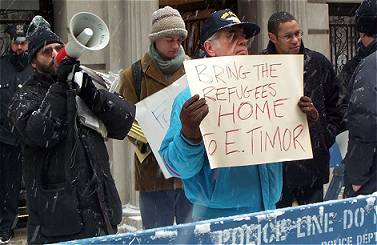
ETAN's John M. Miller (with bullhorn) speaks at the Indonesian consulate in Manhattan, January 2000. Protests also took place that day in Los Angeles, San Francisco, Chicago, Houston and Washington, DC.
We built on the efforts of others who had been working on the issues, some since 1975, many in church groups and Congress. But we brought our own energy and new ideas, at times a confrontational approach.

Early on, we determined to be non-partisan (working with people and politicians with a wide-range of views on other subjects). After all, U.S. presidents of both parties had supported Indonesia. We embraced a wide range of tactics from lobbying and letter-writing to supporting lawsuits against Indonesian generals. We spoke inside (and outside) the UN and organized countless demonstrations at Indonesia's diplomatic offices around the U.S. In New York, there were two and we probably have had an equal number of protests at the consulate and mission to the UN. Several hundred were arrested in civil disobedience sit-ins. We organized international election observers in 1999, 2001, and 2007. We successfully sued New York City to have the street in front of the Indonesian consulate temporarily renamed "East Timor Way" in 1999.

We always tried to be accurate; the situation was dire enough not to need exaggeration. This approach has helped us build credibility with the media, officials and others that carries through to today.

Our initial focus was on gaining self-determination for East Timor. Our political strategy was ambitious, but simple. We saw the Indonesian military as crucial to the occupation. The U.S. was the military's chief benefactor, and we set out to sever that relationship. Indonesia would value its ties to the U.S. more than its continued occupation of East Timor. Events would bear out this analysis - more quickly than many of us imagined in late 1991.

We won a quick victory when Congress barred Indonesia from IMET military training in May 1992, in response to our pressure. At the time, few other countries were barred from IMET. We learned that while East Timor wasn't on the radar of many, a few voices from a congressional district or state could sway many members of Congress. Some of them became staunch supporters of East Timorese rights.

In the end, there were very few floor votes directly on East Timor and we lost several of them. But each time East Timor was debated on the floor of congress or in committee, more were educated and more concessions were extracted. Bans on the transfer of categories of military weapons and police equipment were imposed throughout the 1990s, either by the administration (always under Congressional pressure) or Congress.  Indonesia's dictator Suharto twice refused training or weapons in a fit of pique over U.S. criticism of repression in East Timor. Finally in September 1999, responding to a global outcry at Indonesia's destruction after the East Timorese chose independence, President Clinton announced a full cut off of security assistance. The Indonesian military quickly agreed to honor the result of the August 30 UN-organized referendum and withdraw.


We seized the chance to speak out, something that East Timorese could only do so at great risk. One early ETAN leaflet bluntly stated that East Timorese could be shot for attending a demonstration, but that we in the United States could at much less risk support them.

The Congressional and public pressure that contributed to East Timor's independence came from years of organizing within U.S. and the tenacity of the East Timorese people in asserting their rights. ETAN initially built a base of support by borrowing lists from national groups, including the War Resisters League of which I and Charles Scheiner, another ETAN founder, are long time members. These groups allowed us to call their members just once (Brown University students did most of the calling). We also gathered initial support from sign up sheets at talks by Allan, Amy and others and by petitioning at showings of  the documentary "Manufacturing Consent," which features early ETAN supporter Noam Chomsky and includes a substantial section on East Timor.

In the early 1990s, the online organizing was coming into its own as an activist tool, both as a source of information and a way to spur action and activism. The internet enabled us to quickly link up with like-minded groups and individuals to compare information and share strategy. East Timorese leaders abroad were soon in touch and offered encouragement. We in turn supported their activities in the U.S. and at the UN as best we could.
We stayed current with events and activities through the reg.easttimor e-mail listserv, begun by Tapol in Britain the previous year. We soon became major contributors to the list and over time took over the major responsibility for the list, now officially the east-timor list. (People often confuse the list with ETAN the organization at times, to our frustration.). In 1999, when I first went to East Timor to observe the referendum, many Timorese knew my name because of my many posts to the listserv. With access to the internet limited, items from the list would be printed out and passed around. Occasionally, I had to explain that I hadn't written most of them, just forwarded the news, analysis and reports from activists and others. Even now, much of my morning is taken up with the list, which has more subscribers than ever (more than 2600 at last count). 

Help ETAN celebrate our 20th Anniversary. Donate today!
Read Noam Chomsky on ETAN's 20th Anniversary
With your help, we can put ETAN on a firmer footing for the future.
 Please give generously in this anniversary year. In doing so, you can help strengthen ETAN to meet the challenges of the coming years.


Thursday, November 4, 2010

West Papua Advocacy Team: Open Letter to President Obama on The Eve of His Visit to Indonesia

November 4, 2010

Dear President Obama,

The West Papua Advocacy Team welcomes your upcoming visit to Indonesia as an opportunity to deepen U.S.-Indonesia ties and to encourage further democratic progress in Indonesia. This progress has been impressive in the decade since the overthrow of the Suharto dictatorship and has facilitated the expansion of U.S. cooperation with this important nation.

Critical to Indonesia's democratization is the expansion of respect for human rights. However, respect for human rights -- and democratic progress more generally -- continue to face threats from security forces that continue to evade full civilian control and remain largely unaccountable before Indonesia's flawed judicial system.


However, respect for human rights -- and democratic progress more generally -- continue to face threats from security forces that continue to evade full civilian control and remain largely unaccountable before Indonesia's flawed judicial system.


The United States maintains significant influence with Indonesian military, due in large measure to the Indonesian military's long-standing desire for U.S. training and equipment.  It is imperative that your administration employ this influence as leverage to promote the full subordination of the Indonesian military to civilian control and accountability before the law. The recent decision to renew contact with the notorious Indonesian Special Forces (Kopassus) and continued U.S. support for Detachment 88 ignore numerous credible reports of human rights abuse and unaccountability before the law by both organizations.
This policy of support for Indonesian forces acting criminally and with impunity sabotages the courageous efforts by Indonesian NGOs and citizens, who often face intimidation as they work to secure fundamental reform of all the Indonesian security forces.

Nowhere in the Indonesian archipelago is military insubordination, corruption, abusive behavior and unaccountability more on display than in West Papua, where the military continues to operate in a manner that reflects the rules and practices fostered under the Suharto dictatorship. Papuan human rights activists face  intimidation, arrest, torture and extra-judicial execution.

Recent video evidence of Indonesian security force employment of torture targeted against Papuan civilians, continued security force involvement in illegal activities including unlicensed logging, prostitution and extortion, reveal rogue state forces bent on repression and the plundering of Papuan resources.

Recently, the international community has been shocked by graphic video footage of Indonesian security personnel torturing Papuan civilians. Less than ten days before your scheduled arrival in Jakarta a cyber attack was launched against international websites that carried the video. The resources required for such an attack indicate that elements within the Indonesian government were behind it. This is in line with determined Indonesian government efforts to prevent the international community from monitoring developments in West Papua.

Also in recent weeks, Indonesian security forces destroyed the Papuan village of Bigiragi. For decades, especially in the Puncak Jaya region, security force "sweeping operations" have driven villagers into the surrounding mountains and forests where hundreds have died due to lack of access to food, medical care and adequate shelter. Security force refusal to allow humanitarian relief to these displaced civilians has exacerbated their plight.

Thursday, July 22, 2010

Secretary of Defense Gates Goes to Jakarta Bearing Kopassus Gift

UPDATE: See ETAN's media release here

ETAN is disgusted to learn that while Secretary of  Defense Robert Gates was in Jakarta, he announced that U.S. will for the first time since 1998 provide training for Indonesia's notorious Kopassus special forces. This can only undermine reform and violate the Leahy Law, which prohibits military assistance to units with unresolved human rights violations. Kopassus has failed to reform and officers accused of the human rights crimes continue to serve with unit. While Gates spoke of  future changes, he did not mention accountability for past human rights crimes. While Gates met with Indonesia's Defense Minister Purnomo Yusgiantoro, news and other reports do not say whether or not Gates met with his deputy, former Kopassus;General Sjafrie Sjamsuddin, who has been barred from travel to the U.S. because of his history of human rights violations.

As ETAN said in March:
Training Kopassus will set back efforts to achieve accountability for past and recent human rights violations and will do little or nothing to discourage future crimes."
As we were learning about the Gates announcement, I was tracking down photos of torture during Indonesia's illegal occupation of East Timor (Timor-Leste) for an author with a book coming out soon. While the exact circumstances of the photos I was looking at are not known (they were taken by TNI soldiers and then bought or taken by the resistance), I have no doubt that Kopassus soldiers were involved in these or similar rights violations. None of these soldiers have been brought to justice for these and other human rights crimes.

Secretary Gates and President Yudhoyono meet, Jakarta, Indonesia, July 22, 2010. DoD photo by Cherie Cullen
 In his statement after bringing the news to President Susilo Bambang Yudhoyono, Gates said
I was pleased to be able to tell the president that as a result of Indonesian military reforms over the past decade... the United States will begin a gradual, limited program of security cooperation activities with the Indonesian Army Special Forces.

I noted to the president that these initial steps will take place within the limits of U.S. law and do not signal any lessening of the importance we place on human rights and accountability. What's more, our ability to expand upon these initial steps will depend upon continued implementation of reforms within Kopassus and TNI as a whole.'
However, there is no evidence that international assistance has ever improved the behavior of the Indonesian military. Just ask the hundreds of thousands people and their relatives, who were killed, tortured, disappeared, and raped in East Timor, Aceh, West Papua and elsewhere while the U.S. was most engaged with Indonesia's security forces.

Poengky Indarti from Imparsial told Reuters,
We regret this development very much. Until now, the perpetrators of past human rights abuses in East Timor, Aceh and Papua are still free. There is still impunity in the Indonesian military, especially in Kopassus." 
She added "We are confused about the position of Barack Obama. Is he pro-human rights or not?"

In May, a number of senior members of Congress wrote Secretary Gates raised a number of concerns about any plan to train Kopassus members.

ETAN is available for media comment on the announcement. Contact 718-596-7668 or 917-690-4391.

more to come

Monday, June 7, 2010

KontraS's Usman Hamid on assistance to Kopassus and the Indonesian military

Usman Hamid, coordinator for the Commission for Missing Persons and Victims of Violence (KontraS),  has published an op-ed in the Jakarta Post, "No justice, no aid to Kopassus!" He wrote that "restoring assistance would be seen as Washington’s 'green light' for further military impunity in Indonesia. Such a policy threatens the hopes of democracy and justice in Indonesia."
If the US does restore all aid to Kopassus, without concrete and meaningful preconditions, it would be a disaster for Indonesian human rights. Aid which is not meant just for Kopassus, but also for the TNI, the State Intelligence Agency, and the Ministry of Defense should be carefully tailored to exert maximum pressure to put structural reforms in place that can ensure accountability and civilian control.
He continues:
Accountability for past crimes is not a separate question from military professionalism and human rights protection in present-day Indonesia. Kopassus has been implicated in major crimes such as the Wamena tortures in 2001 and the assassination of Papuan leader Theys Eluay in 2001, as well as recent reports of the assassination of Aceh political activists in 2009. These occurred under democratic governments, precisely because Kopassus has never been held accountable.
Vetting is not the answer.
The Obama administration has indicated that it only intends to give aid to officers and soldiers who have passed human rights “vetting”. But this procedure only operates on an individual basis, and does so ineffectively. It is not possible to know the names of all these who have pulled the trigger, and, in any case, the disappearances, tortures and murders are not the result of individual soldiers running amok.


GoPetition

Tuesday, June 1, 2010

Give A Heart for Ila and Others In East Timor!


Medical Aid for East Timor


GIVE A HEART FOR ILA AND OTHERS IN EAST TIMOR!


We are writing to you today to ask for your help in contacting your U.S. Senators and Representative about the visit of the US Navy Hospital ship USNS Mercy (T-AH 19) which is expected in East Timor for a short two week visit beginning August 6. 

Dr. Dan Murphy of the Bairo Pite Clinic and numerous Timorese heart patients are seeking your help in convincing the US Navy Sealift Command to provide the use of one surgical bay on the USNS Mercy Hospital Ship in order for a team of Australian heart surgeons to help untold numbers of East Timorese with heart problems. At present East Timorese with heart problems needing surgery have little hope of survival unless they are one of the chosen few sent to Australia for heart surgery. Sending East Timorese to Australia is difficult, expensive and involves complicated visa and immigration paperwork - all of which takes precious time, resources and money from being used in other critical areas of healthcare at the clinic and East Timor. As of next year the national hospital in East Timor will have a heart surgery bay, but in the interim the US Navy has the facilities, resources and opportunity to help these patients and we hope you can spend some time to make this happen.


An 8 year old little girl by the name of Ila with severe mitral valve disease needs your help to give her the chance to live a full vibrant life, full of energy, like other children have. At this point little Ila has no chance of growing up to early adulthood, but, with a few minutes of your time she may live a full life. Please do not allow this opportunity to pass without contacting your elected officials in Washington and encouraging them to contact the US Navy Sealift Command to make this happen for Ila and many others with heart disease.

Please call or send e-mail to your elected officials encouraging them to contact the US Navy's Sealift Commander Rear Admiral Mark H Buzby immediately and express support for offering a surgical bay aboard the USNS Mercy hospital ship, for use by the Australian surgical team in Dili, East Timor.

Call your Senators and congressional Representatives via the Congressional switchboard at 202-224-3121 (ask for the office of your Representative and Senators), or check www.congress.org for other contact information.  

This small effort requires only a little time only your valuable voice of support for the future of numerous East Timorese medical patients. We hope that you will see this small effort through to its successful completion.

Dr Mike Iltis/ communications

Elliot Stokes/facilitator
elliotisaacstokes@yahoo.com
Medical Aid for East Timor

Keep us up to date on the response you get.

If you have time please also contact:

Dean Tano, Humanitarian and Civic Affairs,
Commander, Pacific Fleet, (NO1H),
250 Makalapa Dr, Pearl Harbor, HI. 96860. 
808-471-2463, fax 808-474-7806,
Dean.Tano@navy.mil

Other contacts:

Rear Admiral MH Buzby, c/o Public Affairs, 
914 Charles Morris Court, Navy Yard, S.E.
Washington, D.C. 20398-5540 or
phone 1-888-SEALIFT (888-732-5438).

Give a heart for Ila and others in East Timor


PHOTO: USNS Mercy (T-AH 19) anchored in Dili harbor in 2008. U.S. Navy photo By Mass Communication Specialist 2nd Class Joseph Seavey.

Saturday, May 1, 2010

US Religious Freedom Commission calls for Indonesia military reform

The  United States Commission on International Religious Freedom has just released its annual report. The commission maintains Indonesia on its Watch List (the Indonesia chapter begins on page 255 of the PDF), citing governmental restrictions and violence against some religious minorities, including concerns
about new government decrees that are used to severely restrict, and in some provinces even ban, the activities of the Ahmadiyya community; the forced closures and vandalism of places of worship belonging to Christian, Hindu, and Ahmadiyya groups in some localities; the growth and political influence of religious extremists; the deepening sectarian divisions in Papua due to human rights abuses perpetuated by the military and police; and the harassment and arrest of individuals considered deviant under Indonesian law. USCIRF policy recommendations include urging the Obama administration to deal with pressing social, political, and economic concerns by supporting government offices, religious groups, and civil society organizations in Indonesia working to promote religious freedom, counter extremism, teach tolerance and human rights, pursue legal reform, and build interfaith alliances.
The commission in its recommendations cites the need for reform of the Indonesian military and the need to deny assistance and visas to "any police or military unit or security agency personnel found to have engaged in violations of human rights." It does not name Kopassus explicitly. It calls for the removal from conflict areas of officers indicted in East Timor. It stresses the police role in counter-terrorism, but highlights that the U.S. trained "counter-terrorism unit Detachment 88 ha[s] exacerbated existing sectarian tensions in Sulawesi. Local religious leaders claim that Detachment 88’s harsh tactics increased sympathy for extremists in Central Sulawesi and attracted religious militants from other regions. For example, in April, 2008 police shot and killed Madi, a sect leader involved in a 2005 clash with police." (page 257)

From the reports recommendations (page 266)

In addition, as part of U.S.-Indonesian counter-terrorism cooperation, the U.S. should ensure that any future ties with the Indonesian military and police should include, as priorities:

  •  reform of the Indonesian military, including transfer to civilian control, training in international human rights standards, technical assistance in military law and tribunals;


  •  transfer or removal from Papua, the Malukus, or Central Sulawesi any security, police, and militia personnel indicted for activities related to serious human rights abuses and war crimes by the UN's Serious Crimes Investigation Unit (SCIU) and the Ad Hoc Human Rights Court for East Timor in Jakarta;


  •  dedicated funds for training Indonesian police in counter-terrorism techniques and protecting human rights in areas of sectarian conflict, including fellowships to the International Law Enforcement Academy (ILEA) in Bangkok, Thailand and participation in UN Police training programs (UNPOL); and


  •  denial of U.S. assistance, training, or visas for any police or military unit or security agency personnel found to have engaged in violations of human rights.


  • Thursday, March 11, 2010

    ETAN in the news on Kopassus training

    The Christian Science Monitor: US Plan To Train Indonesia's Special Forces Sets Off Alarm (March 5, 2010)
    “Now if we simply circumvent this law, it will be like saying, ‘You haven’t held past abusers accountable, so we’re going to go ahead and reward you,’ ” he says.

    Radio Australia, Connect Asia: US Plans To Resume Training Of Indonesia's Kopassus  Forces (March 9, 2010) Listen: Windows Media
    LAM: And John Miller the East Timor and Indonesia Action network, your organisation ETAN, speaks of criminal activity within Kopassus. What is this alleged criminal activity?

    MILLER: Well as Australians would be well familiar with the killing of the journalists at Balibo in 1975, that was done by soldiers within Kopassus, to the exit of Indonesia from East Timor in 1999, Kopassus officers were heavily involved and orchestrated destruction and training of militia, to last summer Human Rights Watch released a report about Kopassus units in West Papua illegally arresting and harassing residents in the highlands of West Papua. So it's a very long history and most of those rights abuses are unresolved and in the few that have actually gone to court, such as the kidnapping of students in 1997 and 98, even where soldiers were actually convicted in court, many of them are still serving today in Kopassus.
    Inter Press Service: U.S. Seeks to Resume Training of Controversial Military Unit
    (March 4)
    "The best way to prevent future violations is to hold accountable those responsible for the multitude of human rights crimes committed by the Indonesian military in East Timor, West Papua, and elsewhere. Many of these crimes occurred while the U.S. was most deeply engaged with the Indonesian military providing the bulk of its weapons and training," he added.

    Asia Times: US, Indonesia in a tentative embrace (March 12)
    "Kopassus training is the last frontier for re-engagement and a US seal of approval for the Indonesian military," John Miller, national coordinator for the East Timor and Indonesia Action Network, said by e-mail.


    Jakarta Post: Indonesia welcomes US plan to boost military cooperation (March 2)
    "Clinton's remarks imply that Indonesian military human rights violations are in the past," the East Timor and Indonesia Action Network (ETAN) said. "But they aren't."

    Sunday, February 28, 2010

    ETAN: U.S. military assistance to Indonesia will harm reform, set back rights

    Contact: John M. Miller, East Timor and Indonesia Action Network (ETAN), 1-718-596-7668; 917-690-4391, etan@etan.org

    The East Timor and Indonesia Action Network (ETAN) today urged the Obama administration not to offer military assistance to Indonesia.

    "U.S. military assistance harms reform and sets back human rights accountability in Indonesia," said John M. Miller, National Coordinator of ETAN.

    Testifying before a U.S. Senate committee this week (video), Secretary of  State Hillary Rodham Clinton talked about expanded cooperation with the Indonesian military, including in the area of counter-terrorism. The Obama administration is currently considering offering resumed cooperation with Indonesia's Kopassus notorious special forces when the President visits the country next month.

    Clinton said while seeking to expand security cooperation "We are looking at ensuring... there is no resumption of any human rights abuses or other kinds of behavior that we deplore."

    "Clinton's remarks imply that Indonesian military human rights violations are a thing of the past. They aren't," said Miller.

    "The best way to prevent future violations is to hold accountable those responsible for the multitude of human rights crimes committed by the Indonesian military in East Timor (Timor-Leste), West Papua, and elsewhere. Many of these crimes occurred while the U.S. was most deeply engaged with the Indonesian military providing the bulk of its weapons and training," he added.

    "While Indonesia has made progress in many areas since the fall of Suharto, reform of the military has stalled. The shedding of military businesses has become a farce. And the military continues to resist efforts to bring soldiers and former soldiers into court for rights violations," said Miller

    "Restrictions on military assistance provide important leverage to encourage accountability and reform," he added.

    Secretary of State Clinton also spoke about Indonesia's successful counter-terrorism efforts. In Indonesia, the police have the major role in this area. "U.S. support for greater Indonesian military involvement will only undercut the police, strengthen the military internal, territorial role and further undermine reform," he said.

    "Working with the military on counter-terrorism means working with Kopassus," said Miller.

    GoPetition