Tuesday, September 6, 2011

September 2011 West Papua Report is out

Read the latest West Papua Report here

Summary: Twenty-six members of the U.S. House of Representatives appealed to Indonesian President Yudhoyono to release Papuan prisoner of conscience Filep Karma, noting concern that "your government meet its fundamental obligations to protect the rights of its people, as respect for human rights strengthens democracy." The bipartisan letter call Karma's case "an unfortunate echo of Indonesia's pre-democratic era." Amnesty International, meanwhile, appealed for the release of another Papuan, Melkianus Bleskadit, imprisoned for peaceful dissent. The Indonesian government granted a three month remission to the sentence of Papuan political prisoner Buchtar Tabuni on the occasion of Indonesian independence day, who was then released. The leak of secret Special Forces (Kopassus) documents reveal systematic Kopassus surveillance and intimidation targeting Papuans and even international personnel seeking to document human rights concerns in West Papua. The documents label prominent international leaders including Nobel Peace Prize laureate Desmond Tutu and dozens of members of the U.S. Congress as supporters of "separatism" in West Papua. Human Rights Watch urged that in the wake of the documents revelations that the U.S. military cease all activities in cooperation with Indonesian military units in West Papua. Papuan leaders to convene a broad congress in October. Papuan leaders write U.S. Congress to call for peacekeepers. Church leaders and ordinary civilians have called for an end to Indonesian military intimidation in the Paniai District. The Indonesian military commander has ruled out negotiations with armed separatists in West Papua, indicating the extent to which the TNI calls the shots in West Papua. In an organizational statement WPAT has called for Papuans to be afforded the internationally recognized right to self-determination.


Wednesday, August 31, 2011

Resolving Past Crimes Against Humanity is Key to Opening the Door to Truth and Justice now and in the future

A statement by ANTI (Timor-Leste National Alliance for an International Tribunal) marks the 12th anniversary of the Popular Consultation, 30 of August 1999- 2011 and also the International Day of the Disappeared is out.

Titled "Resolving Past Crimes Against Humanity is Key to Opening the Door to Truth and Justice now and in the future,"the statement condemns the "hypocrisy" within Timor-Leste:
"We are hypocrites because we forget our innocent people who lost their lives. We are hypocrites because we are not willing to look for those who were forcibly disappeared. We are hypocrites because we give priority to reconciliation, not to justice."
Photo by Karen Orenstein/ETAN
ANTI makes a series of demands. Among them a call to the UN Security Council to create an international tribunal to prosecute the "principal perpetrators of serious crimes and crimes against humanity in Timor-Leste during the Indonesian occupation...."

Other demands include:


  • Demands that the Prosecutor prosecutes the serious crimes cases that were investigated by the Serious Crimes Investigation Team (SCIT) and submits these cases to Court.


  • Asks the Judges and the Prosecutor General to imprison the criminal Valentim Lavio (ex-Militia BMP) who has already been sentenced to 9 years imprisonment but walks free today.


  • Asks the President of the Republic and the State of Timor-Leste to ratify the International Convention for the Protection of All Persons from Enforced Disappearance in order to guarantee that there will be no more disappeared persons in the future.


  • Asks the State of Timor-Leste to demand that the State of Indonesia give back those that the TNI forcibly took to Indonesia....


  • For the full statement and demands go here.


    Wednesday, August 17, 2011

    Timorese students support West Papua. Three arrested in Dili.

    Friday UPDATE: The three arrested have reportedly been released and are due in court early next week.

    -----
    A friend in Dili tells ETAN that police recently broke up a demonstration in support of West Papua. As we get more information, we will post updates on ETAN's blog here.

    Police arrest Juvntina Correia Ximenes.
    The morning of August 17, more than 30 Timorese students called for the right of West Papuan to self-determination and condemned human right violation by the Indonesian military and police against Papuans. The demonstration took place in front of Indonesia Embassy in Farol, Dili, on the 66th anniversary of Indonesia's independence proclamation.

    Timor-Leste Police (PNTL) arrested three of the protesters -- Juventina Correia Ximenes, Domingos de Andrade and Letornino da Silva. All are currently studying at Timor-Lorosae National University, UNTL.

    One of demonstrator, Nolasco Mendes, said that the PNTL treated the activists brutally. Police reportedly arrested the activist after the Indonesia Embassy asked the PNTL to stop the demonstration.

    According to a Timornewsline report the pro-Papua protesters were members of the Students Solidarity Council (Dewan Solidaritas Mahasiswa Timor-Leste) which previously fought for Timor-Leste's independence.

    Timor-Leste has a strict law on demonstrations which among other things requires four days notice and bans them within 100 yards of a government or diplomatic building.

    Police vehicle removes students supporting West Papua from in front of Indonesian embassy in Dili.

    Sunday, August 7, 2011

    Empty promises whitewash Freeport's rights, responsibility record

    Special for ETAN 
    by David Webster

    What does a mining company need to do to get a top score for “corporate social responsibility”?

    To judge by the recent “100 Best Corporate Citizens List”, all it takes to finesse a long and controversial record of human rights abuses is to come up with a piece of high-minded rhetoric, then carry on as usual.

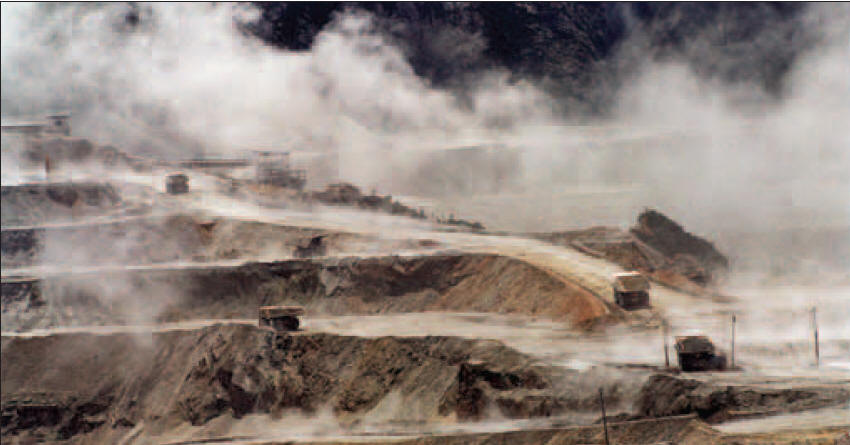
    Freeport's Grasberg mine, West Papua.
    Human rights advocates and those who have studied the record of Freeport McMoran in West Papua were startled to learn that Corporate Responsibility Magazine had named Freeport as the 24th-best corporate citizen in America (click for the full list). More startling still, the company scored well based mainly on a sixth-place ranking in the human rights category.

    How is this possible? Well, the survey’s methodology seems to pay no heed to human rights performance. Only human rights rhetoric matters. And in that, Freeport excels. A strong written policy on human rights declares: “Freeport-McMoRan does not tolerate human rights transgressions.” It points to rights risks in West Papua, Peru, and the Democratic Republic of Congo, and adds that PT Freeport Indonesia policy is to “notify the direct commanders of the perpetrators” in cases where human rights allegations are made against Indonesian security forces. Since reputable human rights groups suggest that the top ranks of the security forces are implicated in widespread human rights violations in West Papua, this is hardly striking at the root of the problem.

    As local people have pointed out, and researchers have confirmed, Freeport’s performance is a far cry from the written policies. The main trouble is intimate ties to Indonesian security forces.

    Security forces may be implicated in the murder of American citizens near the Freeport mine, as Eben Kirksey and Andreas Harsono have reported.

    Violence around the mine is used by security forces to target and scapegoat local people. In 2005, the New York Times revealed that Freeport paid the security forces more than $10 million in 2001 and 2002. Payments are now made “in-kind” rather than in cash. The local Amugme people have long protested Freeport seizure of their lands. Pictures of Freeport’s Grasberg mine from space (left) show the scale and environmental impact in the mountains that are home to the Amungme.

    And lest all of this be hailed as “old news,” the Amungme filed a lawsuit last year saying Freeport had taken their lands illegally. Meanwhile, the Indonesian army’s presence around Freeport, and the company’s close ties to Indonesian security forces, were reinforced this year. The continuing alliance between Freeport Indonesia and the Indonesian security forces is likely to exacerbate, rather than improve, the human rights situation.

    None of these reports are taken in to account in the “100 Best Corporate Citizens List.” All the human rights indicators measure “human rights disclosure” and the sole source, according to the methodology details, comes from “Company public disclosures” – a corporation’s own information about itself.

    The methodology, in other words, measures promises, not performance. There are parallels to the debate over whether companies accused of operating sweatshops overseas can be trusted to police themselves, or should accept independent monitoring. Thus the list cites the voluntary “Sullivan principles” first created under the Reagan administration and welcomed by companies resisting demands to divest from apartheid South Africa. And Freeport boasts of adherence to the Voluntary Principles on Security and Human Rights, launched by the British and American governments in 2000.


    Indonesian soldiers and police escort a convey of trucks along a road 
    to the mine 


    operated by US firm Freeport McMoRan (AFP
    The key word here is “voluntary.” As with the mining industry globally and with businesses jumping on the corporate social responsibility (CSR) bandwagon more generally, companies are happy to promise good performance, as long as no one will be looking over their shoulders.

    So perhaps it’s no surprise to learn that Corporate Responsibility Magazine is in fact published on behalf of the Corporate Responsibility Officers Association, a body made up of many of the companies being judged, and steered by such firms as Domtar and KPMG. Freeport is listed as a “recent member” of the CROA. It’s advanced in the listings – it was ranked 83rd in 2010.

    The problem here isn’t just the “corporate social responsibility” methodology, but the entire concept of “CSR”. It can all too often be used by companies to buy their way out of “corporate social irresponsibility.”

    Freeport is no champion of the best values of corporate citizenship: For human rights activists, it’s long been a poster child for corporate irresponsibility. A list of good corporate citizens with Freeport winning laurels demonstrates more than flaws in the study. As George Monbiot has written of climate change credits, the lists offer corporations a new form of medieval European Catholic “indulgences,” forgiveness for any form of offence. Jeff Ballinger recently pointed out on this blog that companies like Nike are wrapping themselves in the CSR garment to burnish their corporate images, despite continuing disregard for many labour rights. Freeport, too, is now having itself measured for a fine CSR wardrobe.

    ----

    David Webster is an assistant professor of International Studies at the University of Regina in Saskatchewan, Canada. He is a former coordinator with the East Timor Alert Network/Canada. 

    see also

    West Papua Report (monthly)

    ETAN/WPAT: Statement on the operations of the Freeport McMoran Mine in West Papua, to the U.S. Senate hearing on Extracting Natural Resources: Corporate Responsibility and the Rule of Law