Showing posts with label Brimob. Show all posts

Tuesday, October 19, 2010

WPAT: Torture video reveals "Indonesia's Abu Ghraib" on eve of Obama visit

UPDATE: Interview with Ed McWilliams on Radio Australia's Connect Asia program

Contact: Ed McWilliams (WPAT) +1-575-648-2078

October 19, 2010 - A new video shows the torture of helpless men in the Indonesian-ruled territory of West Papua. Monitoring groups are already describing the footage as "Indonesia's Abu Ghraib." The video reveals indisputably Indonesian security force brutality, and raises serious questions about the Obama administration's decision to embrace cooperation with Indonesian security forces engaged in active and ongoing torture.

The video, available at ; http://material.ahrchk.net/video/AHRC-VID-012-2010-Indonesia.html is the second in recent months to offer graphic footage of Indonesian security force torture of Papuans. In it, a Papuan man is held to the ground while a hot stick, still smoldering from a fire, is held against his genitals. A plastic bag is wrapped around his head several times, a rifle held against him. Another man has a large knife held against him while he pleads: "I'm just an ordinary civilian, please..." One of his interrogators responds: "I'll cut your throat... Do not lie, I will kill you! Burn the penis!" The video appears to have been taken on the cell phone of one interrogator.

Still from video via Sydney Morning Herald

Thanks to the courage of Papuan human rights advocates in the face of harsh security measures designed to silence them, the world periodically has been witness to the harsh rule of West Papua. In the past, the faith in international justice and humanity demonstrated by these courageous Papuans has been betrayed by the international community's deference to the Indonesian government's insistence that neither its course nor rule there not be challenged. Numerous governments have placed the territorial integrity of Indonesia and the desire to support its democratization process first. In the process, however, they have abandoned what could have been constructive efforts to uphold human rights in West Papua, which continue to be systematically violated.

Geopolitical and commercial goals led the U.S. government to ignore Suharto dictatorship atrocities  targeting its own people and the people of East Timor for decades. President Bill Clinton acknowledged this when East Timor gained its independence in 2002, saying : "I don't believe America or any of the other countries were sufficiently sensitive in the beginning and for a long time, a long time before 1999, going all the way back to the '70s, to the suffering of the people of East Timor." It was the suffering of the people of East Timor that led to Congress deciding tosuspend military cooperation with Indonesia.

The system of security force rule and repression of peaceful dissent has been dismantled in much of Indonesia, but the same security system and the same systematic human rights violations continue in West Papua today. Such stopgap solutions as "special autonomy" have been clearly rejected by the Papuan people. Despite the continued human rights violations, the Obama administration has continued the Bush administration's policy of support to the Indonesian security forces. It has continued support to the Indonesian military through the IMET program, and support through the Anti-Terror Assistance Program to the notorious Detachment 88 of the Indonesian National Police, credibly accused of torture and other rights violations. It has resumed cooperation with the Indonesian special forces (Kopassus) notwithstanding that unit's  decades-old record of human rights abuse including recent, credible accounts of brutality targeting Papuan civilians.  In so doing the Obama Administration, like its predecessors, has wittingly or unwittingly made itself complicit in the repression now underway in West Papua.

The United States, under President John F. Kennedy, was responsible for the transfer of West Papua to Indonesian rule. In that act, the United States made itself co-responsible for the outcome of its actions. Successive administrations have not been sufficiently sensitive to the ongoing human rights violations, including torture to this day, which resulted from Indonesian rule.

President Obama's upcoming visit to Indonesia offers an opportunity to end the silence on West Papua, and to craft new policies that advance human rights rather than lending support to human rights violators. Information about the ongoing human rights violations in West Papua was
heard on September 22 by the House of Representatives Sub-committee on Asia, the Pacific.

The Obama administration should:
  • Insist upon an investigation and prosecution of those who recently tortured Papuans in Puncak Jaya
  • Seek an investigation by relevant United Nations human rights rapporteurs of this and other instances of torture in West Papua
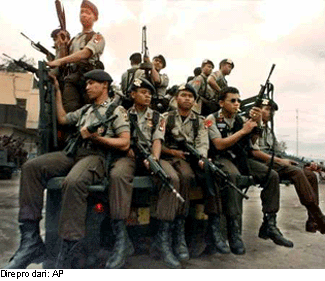
  • Suspend cooperation with Indonesian security forces accused of systematic human rights violations, including Detachment 88 and the Brimob (Mobile Brigade) of the National Police and the Indonesian special forces (Kopassus)
  • Call for full and open access for journalists, humanitarian assistance personnel including the International Committee of the red Cross and other international monitors to all of West Papua
  • Seek meetings between President Obama and Papuan human rights and civil society leaders during his visit to Indonesia
  • Call upon the Indonesian government to carry out an internationally facilitated, senior-level dialogue process with Papuan officials and civil society designed to resolve the Papuan conflict peacefully, as was done in Aceh province
This releasee is also posted on ETAN's website at  http://etan.org/news/2010/10video.htm

see also

Monday, September 6, 2010

West Papua Report - September 2010

This is the 77th in a series of monthly reports that focus on developments affecting Papuans. This series is produced by the non-profit West Papua Advocacy Team (WPAT) drawing on media accounts, other NGO assessments, and analysis and reporting from sources within West Papua. This report is co-published with the East Timor and Indonesia Action Network (ETAN) Back issues are posted online at http://etan.org/issues/wpapua/default.htm Questions regarding this report can be addressed to Edmund McWilliams at edmcw@msn.com.

Summary: 

More than a score of international non-governmental organizations called on President Yudhoyono to release Papuan Political Prisoners in commemoration of Indonesia's August 17 Independence Day. Although the President did release and reduce sentences for convicted terrorists and common criminals on the national day, he did not respond to the appeal regarding political prisoners. The Indonesian Government has banned activities by Cordaid, a Dutch humanitarian organization that has aided poor Papuans for over three decades. The action is reminiscent of the Indonesian Government's banning of International Committee of The Red Cross in West Papua in 2009. The Indonesian Commission on Human Rights and Papuan churches have urged the Indonesian government to reconsider  its security approach in the Puncak Jaya region and address the growing violence there, including attacks on churches. The Indonesian government is under growing pressure to investigate the mysterious murder of a journalist in Merauke. Local police claim he committed suicide. The murdered journalist had built a reputation on investigation of illegal military businesses. The murder comes at a time of growing tension in the area as corporate interests seek to develop a massive food plantation. A video circulating widely on YouTube reveals the final moments of a Papuan bayoneted while in custody as he is taunted by the police.

Read the complete issue here

Friday, June 18, 2010

WPAT: Concerns about operations in Puncak Jaya Region of West Papua

from the West Papua Advocacy Team (WPAT)

Reports from the Puncak Jaya region, inside the central highlands of West Papua, indicate that Indonesian security forces, principally the militarized police ("BRIMOB"), have launched actions against the small, armed Free Papua Movement (OPM). In May, security force spokespersons warned that if the local OPM leader, Goliat Tabuni, did not surrender by June 28, major operations would be launched to capture him and his small force. Notwithstanding that deadline, it appears that major operations are already underway. The Indonesian government announced in mid-June that additional BRIMOB personnel were being dispatched to the region.


According to reports from the field, the operations have already caused large numbers of civilians to flee to other villages or into the surrounding forests. Specifically, thousands of people are reportedly hiding in forests, notably some from the Tingginambut Distirct; other residents of Tingginambut District have fled to Kuyawagi Astir, Tiom, and Lani Districts. Civilians from the Districts of Yambi, Agandugume, and Ilaga Peak have fled to Majesty Towogi District.

These civilians, in particular those who have fled to the forests, face health and possibly life threatening conditions including lack of access to food, adequate shelter, and medical services. In the past such "sweeping operations," Indonesian security forces prevented provision of humanitarian assistance to these besieged populations.

Reports from the field also tell of security forces targeting of civilians through widespread arrests, also:
  • A church in Kayogwebur district Tingginambut has been taken over as headquarters for the BRIMOB. Local people unable to worship there.
  • Local people are forced to do labor tasks for Indonesian military.
  • In the district of Kampong Tinggineri Tingginambut, a pregnant woman was raped by BRIMOB personnel in the first half of June.
  • 12 houses and 2 churches have been burned by security forces in Gwenggu Pilia.
  • In Pos Nalime Tingginambut District residents have been forced to clear their gardens and prepare landing positions for military helicopters.
  • On June 11, BRIMOB conducted a residential sweep search of all houses on the road between Ilu and Mulia, detaining anyone without identification, putting them on Army trucks. (Most local people do not have ID and now afraid to leave their homes. As a result, gardens are untended and local commerce is crippled.)
Recalling previous such sweep operations - West Papua Advocacy Team (WPAT) is concerned that those civilians who have fled their homes are in urgent need of humanitarian assistance.

The WPAT urges those concerned about these operations to contact their members of Congress and the administration to urge that the U.S. government press the Indonesian government about the urgency of meeting the humanitarian needs of the people in this region and to express concern about military and police acts against civilians.

There have been growing Papuan calls, including by the Papuan Provincial Legislative Assembly (DPRD), to pursue negotiations rather than a "security approach" as a means of resolving tensions in the region. Indonesian officials have publicly discussed a release of Papuan political prisoners.

Those concerned about the growing violence in West Papua should also urge the Congress and the administration to press the Indonesian government to reduce tensions in West Papua through humanitarian steps including:


  • release Papuan prisoners of Conscience (Amnesty International has identified over 30 such prisoners);
  • open a senior level, internationally monitored dialogue between the Central Government and Papuans as called for by leading Papuans officials and civic leaders.
-----