Showing posts with label UN. Show all posts
Showing posts with label UN. Show all posts
Thursday, June 30, 2016
Indonesia opposes UN appointing expert to report on violence and discrimination based on sexual orientation and gender identity, Says won't cooperate with expert.
Council establishes mandate on protection against violence and discrimination based on sexual orientation and gender identity
from http://www.ohchr.org/en/NewsEvents/Pages/DisplayNews.aspx?NewsID=20220&LangID=E
Action on Resolution on Protection against Violence and Discrimination Based on Sexual Orientation and Gender Identity
In a resolution (A/HRC/32/L.2/Rev.1) on protection against violence and discrimination based on sexual orientation and gender identity, adopted by a vote of 23 in favour, 18 against and 6 abstentions as amended, the Council decides to appoint, for a period of three years, an Independent Expert on protection against violence and discrimination based on sexual orientation and gender identity, with the mandate to assess the implementation of existing international human rights instruments with regard to ways to overcome violence and discrimination against persons on the basis of their sexual orientation or gender identity; raise awareness of violence and discrimination against persons on the basis of their sexual orientation or gender identity, and to identify and address the root causes of violence and discrimination; and engage in dialogue and to consult with States and other relevant stakeholders. The Council also requests the Independent Expert to report annually to the Human Rights Council, starting from its thirty-fifth session, and to the General Assembly, starting from its seventy-second session.
The result of the vote was as follows:
In favour (23): Albania, Belgium, Bolivia, Cuba, Ecuador, El Salvador, France, Georgia, Germany, Latvia, Mexico, Mongolia, Netherlands, Nigeria, Panama, Portugal, Republic of Korea, Slovenia, Switzerland, The former Yugoslav Republic of Macedonia, United Kingdom of Great Britain and Northern Ireland, Venezuela, and Viet Nam.
Against (18): Algeria, Bangladesh, Burundi, China, Congo, Cote d'Ivoire, Ethiopia, Indonesia, Kenya, Kyrgyzstan, Maldives, Morocco, Namibia, Qatar, Russian Federation, Saudi Arabia, Togo, and United Arab Emirates.
Abstentions (6): Botswana, Ghana, India, Maldives, Philippines, and South Africa.
....
Indonesia, speaking in an explanation of the vote before the vote, reaffirmed its commitment to the elimination of violence against all persons as defined in international human rights treaties. The Council should take a constructive and cooperative approach, especially when concerned with issues touching on morality. Members of the Council should refrain from imposing values which did not enjoy international consensus. Indonesia was concerned that the draft resolution was divisive. While welcoming several amendments, Indonesia considered that the basic proposal remained the same, and for that reason was unable to support the draft resolution. Indonesia also wanted it put on the record that Indonesia would not engage with the mandate holder.


Wednesday, June 15, 2011
But not for Timorese...

Appearing at the memorial to thousands of Argentines tortured and killed during the “dirty war” from 1976 to 1983.
He said Argentina has "shown that there can be no safe refuge for those who commit crimes against humanity.”
In this world, there is no safe place now for any perpetrators who violate international human rights laws and international humanitarian laws. They must be held responsible; they must be brought to justice. This has been a fundamental principle and my strong commitment as Secretary-General of the United Nations.”
Will the the Secretary-General now follow up on his predecessor's call for “justice to prevail over impunity."
Wednesday, February 9, 2011
Timorese call on the UN Security Council to ensure accountability for crimes against humanity
A coalition of groups in Timor-Leste is urging the United Nations Security Council "to take concrete, effective actions to end impunity for those who directed and committed crimes against humanity in Timor-Leste" during Indonesia's invasion and occupation.
"Accountability for crimes against humanity must not be further delayed" the Timor-Leste National Alliance for an International Tribunal (ANTI) told the UN Security Council in a letter delivered this week.
"Accountability for crimes against humanity must not be further delayed" the Timor-Leste National Alliance for an International Tribunal (ANTI) told the UN Security Council in a letter delivered this week.
ANTI criticized UN Secretary-General Ban ki-Moon for failing "to mention the consequences of ongoing impunity for the serious international crimes committed during the Indonesian occupation" in his latest report to the Council.
The letter was endorsed by more than 30 other organizations from outside of Timor-Leste.
"We are still not yet free of the shadow of serious crimes committed during the 24 years of Indonesian occupation. We have suffered a lot during that period; physically and psychologically, because of torture from various types of violations, including sexual violence against women, and the loss of 180,000 human lives because of the brutal, illegal Indonesian military occupation," said ANTI.
ANTI added "If impunity continues to prevail in Timor-Leste, it will have a negative impact on the stability and security of our country; undercutting the efforts of the United Nations to establish rule of law and strength security institutions. In addition, the perpetrators are continuing to commit similar crimes in Indonesia."
The letter was endorsed by more than 30 other organizations from outside of Timor-Leste.
"We are still not yet free of the shadow of serious crimes committed during the 24 years of Indonesian occupation. We have suffered a lot during that period; physically and psychologically, because of torture from various types of violations, including sexual violence against women, and the loss of 180,000 human lives because of the brutal, illegal Indonesian military occupation," said ANTI.
ANTI added "If impunity continues to prevail in Timor-Leste, it will have a negative impact on the stability and security of our country; undercutting the efforts of the United Nations to establish rule of law and strength security institutions. In addition, the perpetrators are continuing to commit similar crimes in Indonesia."
The Security Council is scheduled to meet on February 22 to discuss the future of the UN Mission in Timor-Leste (UNMIT). The mission's current mandate expires February 26.
The Security Council should "discuss the recommendations of the [2005] Commission of Experts regarding the establishment of an International Criminal Tribunal when national mechanisms fail." They also urged the Council to enlarge the mandate of the Serious Crimes Investigation Team (SCIT) to allow the investigation and support the prosecution "of the principal perpetrators of serious crimes and crimes against humanity throughout the Indonesian occupation from 1975-1999." The SCIT current mandate only allows investigations of murders committed during 1999, when the UN sponsored the referendum which led to Timor-Leste's independence.
ANTI argues that such prosecutions are "the only solution to end impunity in Timor-Leste and Indonesia, so that democracy and human rights that we yearn for can be achieved in Timor-Leste and other countries."
The Security Council should "discuss the recommendations of the [2005] Commission of Experts regarding the establishment of an International Criminal Tribunal when national mechanisms fail." They also urged the Council to enlarge the mandate of the Serious Crimes Investigation Team (SCIT) to allow the investigation and support the prosecution "of the principal perpetrators of serious crimes and crimes against humanity throughout the Indonesian occupation from 1975-1999." The SCIT current mandate only allows investigations of murders committed during 1999, when the UN sponsored the referendum which led to Timor-Leste's independence.
ANTI argues that such prosecutions are "the only solution to end impunity in Timor-Leste and Indonesia, so that democracy and human rights that we yearn for can be achieved in Timor-Leste and other countries."
Endorsing groups include the East Timor and Indonesia Action Network (U.S.); KontraS, the Indonesian human rights organization; Japan East Timor Coalition; International Federation for East Timor; Australian Coalition for Justice for East Timor; and the regional Asia-Pacific Solidarity Coalition.
Full letter (in english and tetun) and signatures here
Tuesday, June 29, 2010
Congratulations to Timor's Milena Pires on CEDAW election
ETAN congratulates Milena Pires (full name: Maria Helena Lopes de Jesus Pires) on her election to the Convention on the monitoring commission Elimination of All Forms of Discrimination against Women, She was elected as an expert, although she was nominated by the government of Timor-Leste. Her four-year term begins on January 1 of next year.
Milena has served as Country Programme Coordinator for UNIFEM and worked or consulted for various government agencies and NGOs. She was a member of the Constituent Assembly which drafted Timor's consitution.
Sofia Borges, Timor-Leste's ambassador to the UN wrote on Facebook:

Milena has served as Country Programme Coordinator for UNIFEM and worked or consulted for various government agencies and NGOs. She was a member of the Constituent Assembly which drafted Timor's consitution.
Sofia Borges, Timor-Leste's ambassador to the UN wrote on Facebook:
Dear friends today marked a very historic and important day for Dra Milena and Timor-Leste. I want to congratulate dra Pires for winning the elections today and wish her every success in further promoting the rights of women worldwide and enhaning the work of CEDAW. This win only goes to show that small islands have big ideas, big dreams and contribute big. Congratulations we are truly proud of you Milena. It has been a tough campaign but we have proven that with little resources but with sheer determination we can do this. Cograutlations to Minister Zacarias da Costa, this has been a big day for Foreign Affairs.

Wednesday, February 3, 2010
Timor-Leste's UN Ambassador fired by Foreign Minister over Burma vote
La'o Hamutuk reports that Timor-Leste's Ambassador to the UN was fired by Foreign Minister Zacarias da Costa, because he voted in favor of a General Assembly resolution on Burma (Myanmar) last December.
Santos had voted in favor of a General Assembly resolution on human rights in Burma (Myanmar) following Timor-Leste's previous policy of supporting this annual resolution.
see more details here
Santos had voted in favor of a General Assembly resolution on human rights in Burma (Myanmar) following Timor-Leste's previous policy of supporting this annual resolution.
see more details here
Saturday, January 23, 2010
What do Haitians need to know about the international responses to Timor and Indonesia
What should Haitians know about the international responses to the humanitarian disasters in Timor-Leste and Indonesia? What can they learn about ensuring the international responses serve their needs and wishes? What lessons can be learned from the international responses to the destruction in 1999, the tsunami in Aceh, various earthquakes and volcanic eruptions throughout Indonesia?
Post your thoughts as responses as comments.

Post your thoughts as responses as comments.
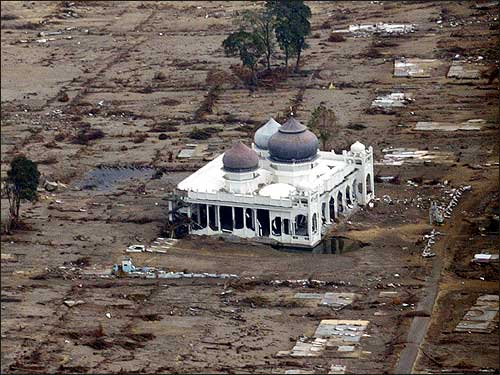
Banda Aceh mosque remains standing after tsunami devastates Aceh in 2004. AP Photo
Thursday, January 14, 2010
UN and Justice

The relevant excerpts from the transcript follow.
And thirdly, as the new leader of the UN Mission here in Timor-Leste what do you see, I mean what is your view on the UN’s commitment to bring the perpetrators of serious crimes to justice? There is a contradiction between the UN commitment and our government in this matter.the full UNMIT transcript is here.
Ameerah Haq:
...The recommendations of the TAM [Technical Assessment Mission - now in Dili] will go before the Security Council, which will result in another mandate for the Mission. And those recommendations as always will contain the work that the UN will continue to do on justice, on rule of law, and on human rights. And with respect to all of these there will continue to be the position that there must be no impunity for serious crimes against humanity. The work of all the institutions of justice here will continue to be part of the mandate of UNMIT as they have been doing.
And there is a great deal to be done on legislation, on policy, on capacity building; we are working very closely with the Prosecutor General’s office and all the other organs. But again there I think I go back also to what I said in my initial commentary: that I think you know there is a great role not only for the media but also non-governmental organizations to play with respect to advocacy on these issues.
As to "non-governmental organizations... advocacy on these issues" -- it will certainly continue.
Photo: Ameerah Haq (third from left) arrives in the Timorese capital, Dili, to take up her post. UN Photo/Martine Perret
Friday, October 23, 2009
Blogging the UN Security Council meeting
[Webcast: Archived Video - Original Language: 2 hours and 55 minutes ]
***
The meeting is being broadcast on the UN website.
10:10 Deputy PM Jose Luis Guterres is representing Timor-Leste (TL). Other non-Security Council members, among them Australia, Brazil, New Zealand, Portugal and Sweden have asked to speak.
 10:11 SRSG Atul Khare will also address the Council.
10:16 Khare is talking about TL's budget, Tour d'Timor bicycle race, "successful" Suco elections (67.75% of registered voters cast ballots). communal peace, water, roads and infrastructure and education were issues.
10:20 Now talking about parliamentary debate on no confidence because of Maternus Bere release - Khare called the debate a positive step. Said legal issues must be dealt with in a competent court. Said Xanana said in debate that AMP does not seek amnesty law. Said Lasama (President of Parliament) said CTF and CAVR "may be discussed by parliament after budget debate" Khare said he has repeatedly stated "UN firm postion that there can be no amnesty or impunity for serious crimes"
*** see recent letters on justice to Security Council from ETAN and other groups and Lao Hamutuk ***
10:25 other issues Khare is discussing - judicial reform, police and security sector reform, phasing out of international security forces and UN Security Council mandate. Upcoming assessment of UN in TL must include consulting with national authorities, civil society and others. Seems to acknowledge that some see UN in TL as increasing irrelevent. Talking about examples of bi-lateral aid from various countries.
10:29 chronicling efforts by UNMIT to reduce its environmental impact ("footprint"), including less paper use. Atul is no saying his farewell and final thank yous as SRSG - his term ends shortly.
 10:29 Jose Luis Guterres is now speaking. Speaking about parliamentary debate on Fretilin motion of no confidence. Called it 'lively debate," says decision taken was constitutional and in nation's interest. Says Bere was released to Indonesia because he is an Indonesian citizen, is still in Indonesian Embassy. Says lawyer petitioned court to release Bere on health grounds.
10:40 - praises judicial review commission which recently finished. Now discussing 2006 crisis - all IDP camps closed and IDPs integrated. Social housing, food assistance and other programs for most vulnerable. Praises conduct of Suco elections. Security sector review is priority. Reform is a long-term prospect, may take a generation.
10:46 talking petroleum - fund, national oil company; economic growth - 7 national priority areas for next year; national corruption commission. Now saying thanks to Atul Khare. Say TL needs UN presence until 2012. Japan is next up.
10:53- Japan is pleased with progress in a number of areas and agrees with SG reports cautious optimism. Says police handover should be based on criteria not timeline. Says civilian control of armed forces is fundamental. Says not take "hasty action" in next steps.
Thursday, October 22, 2009
Groups write UN Security Council on Justice
ETAN coordinated this letter to the UN Security Council on justice and accountability for the people of Timor-Leste. More than 65 individuals representing nearly 50 organizations signed on short notice. Some excerpts below, full text here. La'o Hamutuk sent their own letter and memo.
As you meet this week to discuss the situation in Timor-Leste, we remind you that United Nations -- and more specifically Security Council -- pledges and obligations concerning human rights and accountability for serious human rights crimes remain unfulfilled.
Once again we urge the Security Council to implement the recommendations of the 2005 Commission of Experts (CoE) report and Chega! (Enough!), the final report of the Timor-Leste's Reception, Truth and Reconciliation Commission (CAVR). Both reports urge establishing an ad hoc international tribunal should other efforts at justice fail. If anything, recent events confirm that the governments of Timor-Leste and Indonesia are unwilling or able to pursue justice. It is time for the Council to act.
Recent events have highlighted the necessity for international involvement in prosecuting serious crimes committed in Timor-Leste between 1975 and 1999, including the August arrest and extra-judicial release (under Indonesian pressure) of the former militia leader Martenus Bere. He had been arrested under an outstanding indictment for serious crimes committed in 1999 after crossing the border into Timor-Leste. His release not only undermined the rule of law in Timor-Leste, it clearly demonstrated that the government of Indonesia continues to undermine efforts by the judiciary in Timor-Leste to prosecute Indonesian citizens accused of serious crimes committed in 1999 and before. There was an outcry from broad segments of Timor-Leste society against Bere's release, as shown by letters recently delivered to you from East Timorese.***
We believe that the United Nations and the Council must live up to its promises to deny impunity to worst perpetrators, if only to reinforce your own credibility. We urge you to act now to implement the UN’s repeated promises by allocating the necessary political, financial and legal resources to end impunity for these crimes against humanity.
We strongly believe that real accountability will reinforce democracy and the rule of law in both Indonesia and Timor-Leste, as well as support genuine reconciliation between the two peoples.
***
A full decade has passed since Indonesia’s violent exit from Timor-Leste. Indonesia has repeatedly demonstrated that it will act to prevent credible prosecution of Indonesian citizens for crimes connected with Indonesia’s occupation of Timor-Leste. We urge Interpol to issue arrest warrants for all those indicted by the Serious Crimes Unit who remain at large, at a minimum to discourage these suspects from traveling internationally. Other sanctions should be considered as well.***
Thursday, October 1, 2009
Blair story among 'most censored'
Dennis Blair nomination is among "most censored" stories of 2010. Project Censored which issues an annual list of Top 25 Most Censored Stories. The group cites Allan Nairn's Democracy Now! appearance of January 7, 2009 where he discussed Blair's record as U.S. Pacific Commander in Chief in 1999. ETAN opposes the nomination to be National Director of Intelligence. ETAN began highlighting Blair's record on East Timor in early December 2008. In the end, Blair was confirmed.
Project Censored citation (under the heading "Obama’s Military Appointments Have Corrupt Past") states:
ETAN wrote in December 2008:
Project Censored citation (under the heading "Obama’s Military Appointments Have Corrupt Past") states:
Admiral Dennis Blair, Obama’s pick to head National Intelligence, which oversees all sixteen intelligence agencies, was the Commander of Military Forces in the Pacific under Clinton. As such he played a critical role in the backing of the Indonesian occupation of East Timor after the US-backed dictator Suharto fell in 1998. In 1999, when the Indonesian military terrorized the population to thwart democratic reform, Blair was sent by Clinton and the US State Department to demand that Indonesian General Wiranto stop the massacres. Instead, Admiral Blair falsely informed the general of unwavering US support. Government-sponsored atrocities escalated. Blair then lied to Congress, claiming that only small unit violence was involved, when in fact the top echelons of the Indonesian military were carrying out kidnapping, massacres and torture. Blair essentially sided with General Wiranto in the mass killing of Indonesian [sic] civilians, against US Congress’s orders and knowledge.
ETAN wrote in December 2008:
"President-elect Barack Obama's rumored selection of Admiral Dennis C. Blair for Director of National Intelligence is unacceptable...In early January, we reiterated our concerns - calling Blair a "poor choice."
"During his years as Pacific Commander, Blair actively worked to reinstate military assistance and deepen ties to Indonesia's military despite its ongoing human rights violations in East Timor and consistent record of impunity...
"His actions demonstrate the failure of engagement to temper the Indonesian military’s behavior and his actions helped to reinforce impunity for senior Indonesian officials that continues to this day...
"He undermined the Clinton administration's belated efforts to support human rights and self-determination in the Indonesian-occupied territory and opposed congressional efforts to limit assistance.”
In April 1999, just days after Indonesian security forces and their militia proxies carried out a brutal churchyard massacre, Adm. Blair delivered a message of 'business-as-usual' to Indonesian General Wiranto, then Commander of the Indonesian armed forces. Following East Timor's pro-independence vote, Blair sought the quickest possible restoration of military assistance, despite Indonesia's highly destructive exit from the territory.
Saturday, August 29, 2009
Conference reaffirms importance of solidarity with Timor-Leste
Klibur Solidaridade Timor-Leste/ Timor-Leste Solidarity Group
Contact:
Xisto dos Santos lanarra.del@gmail.com +670-726-6564
Charles Scheiner charlie@laohamutuk.org +670-734-0965
Manuela Leong Pereira, +670-723-7267
29 August 2009 - On the 10th anniversary of Timor-Leste's historic vote for independence, activists from five continents came together to reaffirm their solidarity with the newly independent country. Meeting in Dili, more than 200 people from solidarity groups in 18 countries discussed the continuing need for justice and accountability. In addition to ending impunity for those who committed crimes against humanity and other human rights violations during Indonesia's illegal occupation, participants developed proposals to address current issues, including economic justice, gender justice and West Papua.
Participants in the three-day conference, "Strengthening Solidarity: The Struggle for Justice Continues," ranged in age from 15 to 85 years. They warmly welcomed long-time supporters of Timor such as Carmel Budiardjo of TAPOL in England and James Dunn, a former Australian diplomat sent to Portuguese Timor 48 years ago. Many young Timorese enthusiastically participated, exchanging ideas with veteran activists from Timor-Leste and abroad.
Attendees both from inside and outside Timor had worked for self-determination for the occupied country. They campaigned together for a decade or more to end the quarter-century of Indonesian occupation and to enable the Timorese to determine their political destiny, which they voted for overwhelmingly on August 30, 1999. Both Timorese and international participants reaffirmed their support for Timor-Leste's development as a new nation based on economic, legal and social justice.
Three Timorese leaders who worked with solidarity activists in exile and later rose to high government positions addressed the conference. President José Ramos-Horta graciously opened the conference, telling stories of his long association with some of the long-time activists present. Mari Alkatiri, Secretary-General of FRETILIN and former Prime Minister, said that "if we don't continue to talk about justice, we shouldn't have thought we could rule ourselves." Agio Pereira, Secretary of State for the Council of Ministers, closed the conference.
Participants enthusiastically endorsed self-determination for West Papua and Western Sahara and ending military rule in Burma and human rights violations in Sri Lanka. They also clearly linked the struggle for justice for Timor-Leste with that for democracy and human rights in Indonesia. Participants felt strongly that others should benefit from the international solidarity extended to Timor-Leste over the decades.
Solidarity activists from Indonesia and Ireland, and two Timorese women, one who worked with the solidarity movement from inside the country and another from Australia, shared their experiences and analysis of their activist campaigns that led up to the referendum. People involved in unfinished human rights and self-determination struggles for Burma, Sri Lanka, Western Sahara and West Papua urged participants to extend their solidarity. Speakers on the second day detailed the consequences of impunity, as well as obstacles to and mechanisms for achieving justice for crimes committed during the brutal Indonesian occupation of Timor-Leste.
Workshops then discussed future solidarity actions on several topics. The justice group reaffirmed the need to end the culture of impunity through the creation of an international tribunal and urged more coordination of international and local campaigns for justice. They called for greater dissemination of Chega!, the report of the Timor-Leste truth and reconciliation commission (CAVR). The group on economic justice called for people-centered development that benefits all Timorese citizens, as well as greater transparency and accountability from government. The gender justice workshop called for improving the judicial system to better support victims of conflicts over the years. The People-to-people/religious solidarity group encouraged religious denominations to get more involved in working for justice and accountability and to provide more information about human rights issues. The Solidarity with West Papua group strongly supported self-determination for the Indonesian-controlled territory.
The conference urged the government of Timor-Leste, the international community and the UN to take principled action against impunity, and demanded an international tribunal for Timor-Leste, saying there cannot be impunity for crimes from 1975-1999. The conference urged attention to the victims of sexual violence from the Japanese occupation as well (1942-1945).
The conference called on Timor-Leste's National Parliament to debate the CAVR and the joint Commission on Truth and Friendship (CTF) recommendations. We urge the Timor-Leste government to implement the CAVR recommendations. Governments of other nations must also implement the CAVR recommendations that are addressed to them. The Timorese government and parliament must attend to the victims of the occupation and intra-Timorese violence, and the UN must establish the solidarity fund to support victims of the occupation. The conference urged cooperation in resolving the cases of stolen children, and investigation into the question of people disappeared. The problem of the East Timorese "refugees" in Indonesia must also not be forgotten; their living condition is growing from bad to worse.
Attendees plan to amplify the voices of the victims of war, violence and occupation and push responsible governments to improve the living conditions of victims. We need to improve data collection on victims (including victims of sexual violence); NGOs need to consolidate the data they have collected (on present and past victims), and use that data to end the cycle of violence.
The conference demanded an end to impunity for the perpetrators of the killings of Papuan political leaders and human rights activists, including Arnold Ap, Opinus Tabuni, Theys Eluay and his driver Aristoteles Masoka,. The participants urged a peaceful dialogue between the government of Indonesia and representatives of the people of Papua. They urged the government of Indonesia to conduct a comprehensive evaluation of the implementation of "Special Autonomy" in West Papua and open its results to public. The conference urged international agencies and governments who support "Special Autonomy" to evaluate and review that support. They also demanded the release of all West Papuan political prisoners wherever they are, including those detained by Indonesian Regional Police of West Papua in Jayapura.
The conference condemned the recent attack by Morocco on Sarawi activists and human rights defenders in Tan Tan, Morocco. The participants extended their solidarity for the implementation of the peace agreement in Aceh, and for the peaceful resolution of the conflict in Mindanao.
Participants came from Aotearoa (New Zealand), Australia, Canada, England, Finland, France, Germany, Indonesia, Ireland, Japan, the Netherlands, the Philippines, Portugal, Sri Lanka, Timor-Leste, the United States, West Papua and Zimbabwe.
Funding was provided by CAFOD, Catholic Relief Services, Caritas Australia, Caritas Aotearoa (New Zealand), Development and Peace, HIVOS, Progressio, and Trocaire.
The conference is part of a series of activities including an exhibition illustrating global solidarity activities over the years now open at Fundação Oriente, Dili, through 5 September. Visiting activists from overseas and Timorese students visited rural communities in Maubisse and Ermera to expand their understanding of people's daily lives and how they are cooperating for mutual benefit.
etanetanetanetanetanetanetanetanetanetanetanetan
ETAN looks forward to your support. Go to http://etan.org/etan/donate.htm to donate. Thank you.
John M. Miller, National Coordinator
East Timor & Indonesia Action Network (ETAN)
PO Box 21873, Brooklyn, NY 11202-1873 USA
PHONE IN DILI (until Sept 9: +670-746-7636)
Phone: (718)596-7668 Mobile phone: (917)690-4391
Email john@etan.org Skype: john.m.miller
Web site: http://www.etan.org
Twitter: http://twitter.com/etan009
Facebook: http://apps.facebook.com/causes/134122?recruiter_id=10193810
Send a blank e-mail message to info@etan.org to find out
how to learn more about East Timor on the Internet
Winners: John Rumbiak Human Rights Defender Award for 2009
etanetanetanetanetanetanetanetanetanetanetanetan
Contact:
Xisto dos Santos lanarra.del@gmail.com +670-726-6564
Charles Scheiner charlie@laohamutuk.org +670-734-0965
Manuela Leong Pereira, +670-723-7267
29 August 2009 - On the 10th anniversary of Timor-Leste's historic vote for independence, activists from five continents came together to reaffirm their solidarity with the newly independent country. Meeting in Dili, more than 200 people from solidarity groups in 18 countries discussed the continuing need for justice and accountability. In addition to ending impunity for those who committed crimes against humanity and other human rights violations during Indonesia's illegal occupation, participants developed proposals to address current issues, including economic justice, gender justice and West Papua.
Participants in the three-day conference, "Strengthening Solidarity: The Struggle for Justice Continues," ranged in age from 15 to 85 years. They warmly welcomed long-time supporters of Timor such as Carmel Budiardjo of TAPOL in England and James Dunn, a former Australian diplomat sent to Portuguese Timor 48 years ago. Many young Timorese enthusiastically participated, exchanging ideas with veteran activists from Timor-Leste and abroad.
Attendees both from inside and outside Timor had worked for self-determination for the occupied country. They campaigned together for a decade or more to end the quarter-century of Indonesian occupation and to enable the Timorese to determine their political destiny, which they voted for overwhelmingly on August 30, 1999. Both Timorese and international participants reaffirmed their support for Timor-Leste's development as a new nation based on economic, legal and social justice.
Three Timorese leaders who worked with solidarity activists in exile and later rose to high government positions addressed the conference. President José Ramos-Horta graciously opened the conference, telling stories of his long association with some of the long-time activists present. Mari Alkatiri, Secretary-General of FRETILIN and former Prime Minister, said that "if we don't continue to talk about justice, we shouldn't have thought we could rule ourselves." Agio Pereira, Secretary of State for the Council of Ministers, closed the conference.
Participants enthusiastically endorsed self-determination for West Papua and Western Sahara and ending military rule in Burma and human rights violations in Sri Lanka. They also clearly linked the struggle for justice for Timor-Leste with that for democracy and human rights in Indonesia. Participants felt strongly that others should benefit from the international solidarity extended to Timor-Leste over the decades.
Solidarity activists from Indonesia and Ireland, and two Timorese women, one who worked with the solidarity movement from inside the country and another from Australia, shared their experiences and analysis of their activist campaigns that led up to the referendum. People involved in unfinished human rights and self-determination struggles for Burma, Sri Lanka, Western Sahara and West Papua urged participants to extend their solidarity. Speakers on the second day detailed the consequences of impunity, as well as obstacles to and mechanisms for achieving justice for crimes committed during the brutal Indonesian occupation of Timor-Leste.
Workshops then discussed future solidarity actions on several topics. The justice group reaffirmed the need to end the culture of impunity through the creation of an international tribunal and urged more coordination of international and local campaigns for justice. They called for greater dissemination of Chega!, the report of the Timor-Leste truth and reconciliation commission (CAVR). The group on economic justice called for people-centered development that benefits all Timorese citizens, as well as greater transparency and accountability from government. The gender justice workshop called for improving the judicial system to better support victims of conflicts over the years. The People-to-people/religious solidarity group encouraged religious denominations to get more involved in working for justice and accountability and to provide more information about human rights issues. The Solidarity with West Papua group strongly supported self-determination for the Indonesian-controlled territory.
The conference urged the government of Timor-Leste, the international community and the UN to take principled action against impunity, and demanded an international tribunal for Timor-Leste, saying there cannot be impunity for crimes from 1975-1999. The conference urged attention to the victims of sexual violence from the Japanese occupation as well (1942-1945).
The conference called on Timor-Leste's National Parliament to debate the CAVR and the joint Commission on Truth and Friendship (CTF) recommendations. We urge the Timor-Leste government to implement the CAVR recommendations. Governments of other nations must also implement the CAVR recommendations that are addressed to them. The Timorese government and parliament must attend to the victims of the occupation and intra-Timorese violence, and the UN must establish the solidarity fund to support victims of the occupation. The conference urged cooperation in resolving the cases of stolen children, and investigation into the question of people disappeared. The problem of the East Timorese "refugees" in Indonesia must also not be forgotten; their living condition is growing from bad to worse.
Attendees plan to amplify the voices of the victims of war, violence and occupation and push responsible governments to improve the living conditions of victims. We need to improve data collection on victims (including victims of sexual violence); NGOs need to consolidate the data they have collected (on present and past victims), and use that data to end the cycle of violence.
The conference demanded an end to impunity for the perpetrators of the killings of Papuan political leaders and human rights activists, including Arnold Ap, Opinus Tabuni, Theys Eluay and his driver Aristoteles Masoka,. The participants urged a peaceful dialogue between the government of Indonesia and representatives of the people of Papua. They urged the government of Indonesia to conduct a comprehensive evaluation of the implementation of "Special Autonomy" in West Papua and open its results to public. The conference urged international agencies and governments who support "Special Autonomy" to evaluate and review that support. They also demanded the release of all West Papuan political prisoners wherever they are, including those detained by Indonesian Regional Police of West Papua in Jayapura.
The conference condemned the recent attack by Morocco on Sarawi activists and human rights defenders in Tan Tan, Morocco. The participants extended their solidarity for the implementation of the peace agreement in Aceh, and for the peaceful resolution of the conflict in Mindanao.
Participants came from Aotearoa (New Zealand), Australia, Canada, England, Finland, France, Germany, Indonesia, Ireland, Japan, the Netherlands, the Philippines, Portugal, Sri Lanka, Timor-Leste, the United States, West Papua and Zimbabwe.
Funding was provided by CAFOD, Catholic Relief Services, Caritas Australia, Caritas Aotearoa (New Zealand), Development and Peace, HIVOS, Progressio, and Trocaire.
The conference is part of a series of activities including an exhibition illustrating global solidarity activities over the years now open at Fundação Oriente, Dili, through 5 September. Visiting activists from overseas and Timorese students visited rural communities in Maubisse and Ermera to expand their understanding of people's daily lives and how they are cooperating for mutual benefit.
Klibur Solidaridade Timor-Leste/ Timor-Leste Solidarity Group
Sekretariadu: Oficina Asosiasaun HAK, Farol, Dili, Timor-Leste
Telp. +670-331-3323, email: timorsolidarity@gmail.com, www.laohamutuk.org/solidarity
Sekretariadu: Oficina Asosiasaun HAK, Farol, Dili, Timor-Leste
Telp. +670-331-3323, email: timorsolidarity@gmail.com, www.laohamutuk.org/solidarity
etanetanetanetanetanetanetanetanetanetanetanetan
ETAN looks forward to your support. Go to http://etan.org/etan/donate.htm to donate. Thank you.
John M. Miller, National Coordinator
East Timor & Indonesia Action Network (ETAN)
PO Box 21873, Brooklyn, NY 11202-1873 USA
PHONE IN DILI (until Sept 9: +670-746-7636)
Phone: (718)596-7668 Mobile phone: (917)690-4391
Email john@etan.org Skype: john.m.miller
Web site: http://www.etan.org
Twitter: http://twitter.com/etan009
Facebook: http://apps.facebook.com/causes/134122?recruiter_id=10193810
Send a blank e-mail message to info@etan.org to find out
how to learn more about East Timor on the Internet
Winners: John Rumbiak Human Rights Defender Award for 2009
etanetanetanetanetanetanetanetanetanetanetanetan
Wednesday, August 26, 2009
More Interesting Reading
From Lao Hamutuk The tenth anniversary of the 1999 referendum that ended 24 years of brutal, illegal Indonesian military occupation of Timor-Leste is an opportunity to assess where the country is now, reflecting on the past and looking to the future. La'o Hamutuk has written several background papers which assess progress over the last decade, look at the current situation, and suggest what still needs to be done.
How much money have international donors spent on and in Timor-Leste?
Justice for Timor-Leste Remains an Unfulfilled International Obligation
Timor Sea Maritime Boundary: Still not settled!
Democracy in Timor-Leste: Information is required
Subscribe to:
Posts (Atom)