Showing posts with label accountability. Show all posts

Monday, November 11, 2013

ETAN on anniversary of Santa Cruz massacre


November 12 is the 22nd anniversary of the Santa Cruz massacre. On November 12, 1991, Indonesian troops opened fire on a memorial procession - turned into a peaceful pro-independence demonstration - at the Santa Cruz cemetery in Dili, the capital of Timor-Leste. More than 270 mostly-young Timorese were murdered.

As we have often noted, the media coverage of the massacre was a key turning point in Timor's long struggle for independence. It led to the founding of ETAN and similar groups, energize UN and Portuguese diplomacy, and led to some sanctions on Indonesia. In the U.S., ETAN built on the initial cut-off of military training for the Indonesian military. Eventually, all military assistance was cut off in 1999 as Indonesian troops and militia ransacked the Timor in the aftermath of the historic vote that led to independence.

On the 20th anniversary of the massacre ETAN observed that:
"While Timor-Leste is now independent, its people will not be able to overcome their tragic past without knowing what was done with their relatives’ and friends’ bodies. Ongoing impunity for decades of systematic Indonesian military and police atrocities keeps the East Timorese and Indonesian people from consolidating their democracies and moving on with their lives."


Much remains to be done. A year ago, we noted that:

"Impunity for decades of systematic Indonesian military and police atrocities prevents both countries from consolidating the rule of law as they transition from  military dictatorship do democracy."

We continued to to urge the U.S. Congress and the Obama administration to respond to the recommendations of Timor-Leste's Commission for Truth, Reception and Reconciliation, especially "its calls for an international tribunal to try perpetrators of crimes against humanity during the Indonesian occupation, reparations from Indonesia and other countries that supported the occupation, and restrictions on foreign assistance to the Indonesian military."

And we urged the U.S. and others to press Indonesia "to immediately release all information that can help identify and locate those who were killed or disappeared during the occupation,."


For more information on the massacre see http://etan.org/timor/SntaCRUZ.htm. ETAN on the web: http://www.etan.org. Twitter: etan009

Wednesday, May 16, 2012

10 Years after Timor's Independence, Where Is the Justice?


10 Years after Timor's Independence, Where Is the Justice?

Contact: John M. Miller,  john @ etan.org

May 16, 2012 - The East Timor and Indonesia Action Network (ETAN) congratulated the people of Timor-Leste as they prepared to celebrate the 10th anniversary of the restoration of their country's independence on May 20.

"This important milestone is the result of the persistent struggle and great suffering of the people of Timor-Leste," said ETAN's National Coordinator John M. Miller. "ETAN is proud to have played our part in supporting Timor's self-determination and now independence."

"The nation faces many challenges. With independence, its people are in a position to decide its future rather then have Indonesia impose its will on them," he added.

Timor's independence was prevented for nearly 25 years by the U.S. and other governments' support for Indonesia's illegal invasion and occupation. Yet, no senior officials of any country have been held accountable for the horrific human right violations and war crimes that took place.
 
Human rights violators from elsewhere have been prosecuted, often long after their crimes were committed. But Indonesia and others continue to obstruct holding accountable those who facilitated and carried out crimes during the occupation.

"The U.S., other governments and the United Nations must commit themselves to achieve justice for the victims and their families." said Miller. "ETAN will not rest until justice is done."

"Human rights violators from elsewhere have been prosecuted, often long after their crimes were committed. But Indonesia and others continue to obstruct holding accountable those who facilitated and carried out crimes during the occupation," he added.

Ongoing impunity for the systematic Indonesian military and police crimes prevents the people of Timor-Leste and Indonesia from consolidating their democracies and moving on with their lives. While Timor-Leste is now independent, its people will not be able to overcome their tragic past without justice for what was done to them and their families, said Miller.
Neither Congress nor the administrations of George W. Bush and Barack Obama have responded to the recommendations of Timor-Leste's Commission for Truth, Reception and Reconciliation, although many of them are directly addressed to the U.S. and other governments. These include the Commission's call for an international tribunal to try perpetrators of crimes against humanity during the Indonesian occupation, reparations from Indonesia and other countries that supported the occupation, and restrictions on foreign assistance to the Indonesian military.

"The U.S. and others should press President Susilo Bambang Yudhoyono to immediately release all information that can help identify and locate those who were disappeared during the occupation, said Miller.
The recent conviction of former Liberian President Charles Taylor for his support of rights violators in Sierra Leone should sound a note of caution for members of the Obama and former US administrations. This ruling provides a precedent for prosecuting those who arm, train and politically support those who commit the worst abuses, even if they do not directly organize or carry them out.

"The Obama administration should restrict U.S. military assistance to Indonesia until the Indonesian generals and political leaders who organized and directed numerous crimes against humanity during the 24-years of illegal occupation are credibly tried," Miller added. Instead, the Obama administration is considering the sale of deadly Apache attack helicopters to the Indonesian military.
Background
As detailed in declassified documents released by the National Security Archive and elsewhere, on December 6, 1975, then-U.S. President Ford and Secretary of State Kissinger gave Indonesian dictator Suharto a green light to invade East Timor, which his military did the next day. The U.S. supplied 90 percent of the weapons used during the invasion. From Ford to President Clinton, successive U.S. administrations consistently backed Indonesia's occupation, providing Jakarta diplomatic cover and billions of dollars in weaponry, military training, and economic assistance. 

During more than two decades of occupation of Timor-Leste, Indonesian soldiers committed serious crimes with impunity, taking as many as 184,000 Timorese lives and torturing, raping and displacing countless others. Timor-Leste became independent in 2002.

Timor-Leste's Commission for Reception, Truth and Reconciliation researched and documented the nation's experiences during the occupation. The Commission's comprehensive 2,500-page report recommended establishment of an international criminal tribunal and also advocated that countries (including the U.S.) which backed the occupation and corporations which sold weapons to Indonesia during that period should pay reparations to victims. The Commission urged the international community not to support Indonesia's military until it was thoroughly reformed and respectful of human rights.

Last year, ANTI (Timor-Leste National Alliance for an International Tribunal) demanded that the United Nations Security Council "cut the chain of impunity in Timor-Leste and other countries by establishing a credible International Tribunal in order to judge the principal perpetrators of serious crimes and crimes against humanity in Timor-Leste during the Indonesian occupation."
The UN-supported serious crimes process filed a number of indictments of a number of Indonesian officials and East Timorese militia leaders for crimes against humanity committed during the referendum on independence in 1999.

ETAN was formed in reaction to the 1991 Santa Cruz massacre, when hundreds of peaceful demonstrators were gunned down by Indonesian troops carrying U.S.-supplied weapons. On May 20, ETAN members will be honored by the Timorese government with the Laran Luak medal for its contribution to the liberation of Timor-Leste. The U.S.-based organization, which celebrated its 20th anniversary last December 10, advocates for democracy, justice and human rights for Timor-Leste and Indonesia. For more information see ETAN's web site: http://www.etan.org.
see alsoHuman Rights, Accountability & Justice page
ETAN at 20: Reflections and Reminiscences

Saturday, May 12, 2012

Trying Kissinger, the Charles Taylor Precedent

Reed Brody of Human Rights Watch writing in The Nation magazine argues that the recent conviction of the former President of Liberia, Charles Taylor, provides an important precedent for bringing the Henry Kissinger and other officials to justice.
"In April a United Nations–backed special tribunal in The Hague convicted Taylor of “aiding and abetting” the rebels in neighboring Sierra Leone as they committed horrific abuses against civilians. The rebels’ crimes, which included their signature atrocity of cutting off victims’ arms and legs, as well as forcing children to execute their parents, were among the most heartless I have ever investigated.
"The verdict marked the first time since the post–World War II Nuremberg trials that a former head of state has been convicted by an international tribunal of war crimes and crimes against humanity. What may be of more lasting significance, however, is that Taylor was not convicted for oppressing his own people—though he did that as well—but for his material support to abusive forces in another country. In that respect, the decision speaks not just to tinpot dictators but to leaders of countries who fight proxy wars by knowingly giving client states or rebel allies the means to commit atrocities. 
As Reed writes: "very same legal reasoning could apply to those in Washington, Moscow or elsewhere who provide military assistance to abusive forces half a world away. Take, for example, the case of former US Secretary of State Henry Kissinger and East Timor."

Kissinger gave the green light with then-President Ford for Indonesia's 1975 invasion of East Timor. He then worked to make sure - as did his successors and many other U.S. officials - that the flow of weapons and training continued to flow to the Indonesia military, ignoring its abuses and human rights violations.

Long before Taylor's conviction ETAN and others had been pressing to hold Kissinger accountable for his role  in multiple crimes against humanity in Timor, Vietnam, Chile and elsewhere. These efforts must continue.

May 30, 2011, New York City protest against Kissinger appearance at 92nd Street Y .


Wednesday, June 15, 2011

But not for Timorese...

In Buenos Aires, UN Secretary-General Ban Ki-moon urged that "the lessons learned from Argentina’s turn from dictatorship to democracy be applied widely, particularly in North Africa and the Middle East..."


Appearing at the memorial to thousands of Argentines tortured and killed during the “dirty war” from 1976 to 1983.


He said Argentina has "shown that there can be no safe refuge for those who commit crimes against humanity.”


In this world, there is no safe place now for any perpetrators who violate international human rights laws and international humanitarian laws. They must be held responsible; they must be brought to justice. This has been a fundamental principle and my strong commitment as Secretary-General of the United Nations.”

Will the the Secretary-General now follow up on his predecessor's call for “justice to prevail over impunity."

Thursday, December 9, 2010

Congratulations to Shirley Shackleton

Congratulations to Shirley Shackleton for winning Australia's Walkley Book Award for The Circle of Silence: A personal testimony before, during and after Balibo. Copies are available from ETAN.

The award citation says in part:
"This book is testimony to her work in East Timor, and an insight into a defining time in that country's history. Such struggles have their personal sides, however, and this book is also a remarkable personal narrative, interspersed with poetry, that details the other careers Shackleton juggled while maintaining an abiding focus on justice in East Timor."


From judges' comments:
Shirley Shackleton's book is an exceptional personal narrative in this year's field of rich Australian journalism, history and analysis. It is exceptional because of its raw intellectual honesty forged from murder and massacre in East Timor during a cover-up which prevailed for 25 years. It is exceptional because it confronts then exposes blind-eyed Australian diplomacy. It confronts then exposes self-censorship posing as journalism, because of the Australia/US/Indonesia geopolitical logic which required it.
From ordinary human expectations, the author's personal story -- with sometimes brutal self-assessment -- evolves from self-pity and grief over the 1975 murders at Balibo and Dili to a campaign to raise public consciousness about atrocities which decimated the people of East Timor. The consequence of that raised consciousness? Independence for East Timor in 2002 and a measure of belated redemption for Australia and the international community. The Circle of Silence is Shirley Shackleton's testimony from her life's darkest hour at the death of her husband Greg to vindication and relief at the survival of a people who struggled for their freedom.

Thursday, December 2, 2010

Juan Mendez on Accountability

Juan Mendez is currently UN Special Rapporteur on Torture and Other Cruel, Inhuman and Degrading Treatment or Punishment. He was Secretary-General's special advisor on genocide and much more. From today's Democracy Now!
JUAN GONZALEZ: Your response on this issue of looking forward instead of back and not allowing witch hunts to take place?
JUAN MÉNDEZ: Well, this has been a debate all over the world every time we have to look at egregious conduct by state officials. People always say we want to look forward and not backward. I reject the notion that investigating and prosecuting international crimes is a way of just looking backwards and being—and engaging in a witch hunt or being vengeful. I think, on the contrary, it’s a proper way of looking forward: it’s settling the stories the way they should be settled, deciding on what was done by order of whom and against whom, and moving forward only after we know the whole truth....
I want to stress that that’s not a discretionary decision by any state. Every state that signs and ratifies the Convention Against Torture is legally obliged to investigate, prosecute and punish every single act of torture.
AMY GOODMAN: Juan Méndez, we only have 30 seconds, but you speak from personal experience. I mean, you come from Argentina. In Argentina, there are hundreds of trials going on now of torturers.
JUAN MÉNDEZ: That’s right.
AMY GOODMAN: You, yourself, were tortured for representing political prisoners—that’s right?—in the 1970s?
JUAN MÉNDEZ: That’s correct, yes. That’s right. You know, and I am following the trials in Argentina. They are, you know, very uplifting, and they are a way of looking forward. It’s a way in which the country sees itself in the mirror, reckons with its past, and makes sure that it doesn’t happen again. So, that’s a way of looking forward. 

Friday, November 5, 2010

Statement of East Timor and Indonesia Action Network on President Obama's Visit to Indonesia

November 5, 2010 - As President Obama departs on his twice-delayed trip to Indonesia, the East Timor and Indonesia Action Network (ETAN) urge him to use the opportunity to build a relationship between the U.S. and Indonesia based on the promotion of human rights and the rule of law.

As we wrote to President Obama last March, "the history of U.S.-Indonesia relations is much better known for the U.S.'s largely uncritical support of the Suharto dictatorship, from its bloody seizure of power in 1965 through its illegal invasion and occupation of then Portuguese Timor to the Kopassus kidnappings and murders of student leaders in 1997 and 1998."


President Obama should apologize to the peoples of Indonesia and Timor-Leste for the U.S. role in their suffering during the Suharto years and to offer condolences to Suharto's many victims throughout the archipelago.


President Obama's visit coincides with Indonesia's Heroes Day, and the dictator Suharto is under consideration to be named as a "National Hero." We urge President Obama to use the opportunity of his visit to decisively break with past U.S. support for torture, disappearances, rape, invasion and illegal occupation, extrajudicial murder environmental devastation. and more. U.S. weapons, training, political backing and economic support of Indonesia facilitated these crimes. President Obama should apologize to the peoples of Indonesia and Timor-Leste for the U.S. role in their suffering during the Suharto years and to offer condolences to Suharto's many victims throughout the archipelago.


Crimes against humanity and other violations of human rights did not end with Suharto’s fall. Since then U.S. policy has largely focused instead on narrow strategic and economic interests that have little to do with the well-being of the Indonesian people. In recent weeks,horrific videos and other reports of torture, the burning of villages and other crimes show that the people of West Papua and elsewhere continue to suffer at the hands of military and police.

We urge President Obama to condition U.S. security assistance on an end to human rights violations and impunity. We urge him to follow the recommendation of Timor-Leste's Commission for Reception, Truth and Reconciliation in Timor-Leste (CAVR), which urged nations to "regulate military sales and cooperation with Indonesia more effectively and make such support totally conditional on progress towards full democratisation, the subordination of the military to the rule of law and civilian government, and strict adherence with international human rights, including respect for the right of self-determination."


We urge the President to announce that the U.S., as a permanent member of the UN Security Council, will work to establish an international tribunal to bring to justice the perpetrators of human rights crimes committed during Indonesia’s 24-year occupation of Timor-Leste. This would send the critical message that no one is above the law and would serve as an important deterrent to future human rights violators. A tribunal was recommended by the CAVR and is supported by the many victims of these crimes and by human rights advocates in Timor-Leste, Indonesia and elsewhere.


We urge the President to announce that the U.S., as a permanent member of the UN Security Council, will work to establish an international tribunal to bring to justice the perpetrators of human rights crimes committed during Indonesia’s 24-year occupation of Timor-Leste.

We are deeply concerned about the administration's recent announcement that the U.S. will for the first time in a dozen years engage with Indonesia's notorious Kopassus special forces. We also call on President Obama to end this planned engagement and to suspend all funding and training of Indonesia's Detachment 88 police unit pending review of charges leveled against the unit for systemic human rights violations, including use of torture. We believe that U.S. law bars cooperation with military and police units with such egregious human rights records.

These actions by President Obama would change the current course from one of repeating failed policies. While much has changed in Indonesia, U.S. security assistance does not promote further change. Instead it encourages impunity and violations of human rights and sets back reform.


In his book The Audacity of Hope, President Obama wrote that "for the past sixty years the fate of [Indonesia] has been directly tied to U.S. foreign policy," a policy which included "the tolerance and occasional encouragement of tyranny, corruption, and environmental degradation when it served our interests."


A new relationship between the two countries must be built on an honest assessment of the bloody past. President Obama's special connection to Indonesia offers an important opportunity to usher in a new era in the relationship between our two nations. One that rejects a relationship based largely on militarism with one that respects human rights and promotes the rule of law.

-30-

Members of ETAN are available for interviews


contact: John M. Miller, ETAN, +1-718-596-7668, +1-917-690-4391, etan@etan.org, www.etan.org


This release is posted at http://etan.org/news/2010/11etanobama.htm

Tuesday, July 6, 2010

Even the Pentagon...


Newsweek writes that "Even the Pentagon, which cut ties to the Indonesian military after massacres in East Timor two decades ago, was pushing for renewed links including increased U.S. assistance for Kopassus, the Indonesian special forces." 

Even the Pentagon! When did they ever support not training Kopassus?


Congress and the administration (in response to Congressional pressure) first cut IMET military training in 1992. The Pentagon did everything it could to resist and undermine that policy. In 1998, the East Timor Action Network, journalist Allan Nairn, and members of Congress released documents that showed that the Pentagon had continued training under a program (JCET) not explicitly banned by legislation, defying Congressional intent not to further the skills of a military brutalizing people in East Timor and elsewhere. Kopassus were the shock troops of this repression. JCET then ended in mid-exercise as the Suharto dictatorship was in its death throes.

Training Kopassus remains a really bad idea, and the U.S. should not indulge Indonesia by resuming training. It will only further stall efforts in Indonesia and East Timor to hold them accountable for past and recent human rights violations. 

Training will only embolden unreformed elements of the military and clearly won't discourage future crimes.

see also ETAN's Guide to U.S. Security Assistance to Indonesia and East Timor

Saturday, February 20, 2010

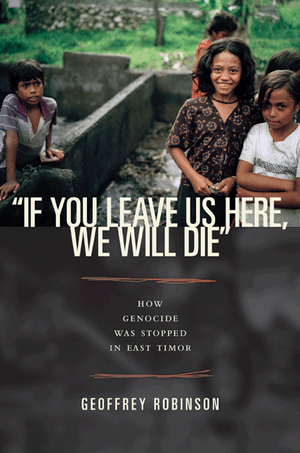
Audio: If you leave us here we will die


A conversation with Geoffrey Robinson - former political affairs officer with the United Nations mission in East Timor (UNAMET) and current history professor at UCLA - talks about his new book with ABC Radio National's Late Night Live host, Phillip Adams. Robinson talks about "the thinking within the UN and the international community at the time," and provides "a vivid personal account of what he witnessed in East Timor. Robinson also addresses the enduring question of how best to seek justice for the crimes of the past."


His new book ""If You Leave Us Here, We Will Die": How Genocide Was Stopped in East Timor" was recently published by Princeton University Press. 

Wednesday, February 3, 2010

TL Groups write UN Security Council on Justice with international support

East Timorese groups, with international support from ETAN and others, have written to the UN Security Council urging the renewed UN mission include the following:
  1. Establish a mechanism during the UNMIT mission which will create an International Tribunal.
  2. Expand the mandate of the Serious Crimes Investigation Team (SCIT) to include some of the most grievous crimes committed prior to 1999, such as the 1975 invasion, 1983 Kraras Massacre, 1991 Santa Cruz Massacre, and others.
  3. Give SCIT the authority and sufficient resources to prepare and publish formal indictments for cases they have investigated. 
 They write
...the current UNMIT mandate only includes investigation processes but not prosecutions, and only covers serious crimes committed in 1999. We are worried that this limited mandate will not end the cycle of impunity in Timor-Leste. We are very concerned that if impunity prevails in Timor-Leste it will nourish impunity in other countries, and all of us who struggle for human rights will not succeed. Therefore, if the United Nations fails to end impunity for past crimes against humanity committed in Timor-Leste, there can be no accountability for ongoing crimes, such as those committed during the 2006 crisis in our country.
 See here for the full letter with signers

Saturday, January 23, 2010

WPAT/ETAN on Naming of Senior Kopassus Officer as Indonesia Military Commander in West Papua

The West Papua Advocacy Team and East Timor and Indonesia Action Network are extremely troubled by the naming of a senior Special Forces (Kopassus) officer as regional commander in West Papua. Kopassus forces have a long and dark history in the region.

 The appointment of Major General Hotma Marbun to the Military Command for the Kodam-XVII Cenderawasih region comes as Papuans continue to seek a dialogue with the Jakarta Government and the demilitarization of their homeland. Their appeals have been resisted by a military that persists in describing Papuans seeking their rights as "separatists" and justifies attacks on peaceful demonstrators as necessary to defending Indonesia's territorial integrity.

 The naming of any Kopassus officer in command of the region raises obvious human rights concerns. In addition, Major General Marbun has a personal record that underscores these concerns. As pointed out by the respected UK human rights organization Tapol, Marbun was involved in operations in Indonesia-occupied East Timor in 1983 and 1986, a particularly bloody period during the occupation. He also participated in military operations in West Papua in 1982 and 1994.
 
General Marbun takes command at a time of growing security force abuse in the region, as recently documented by Human Rights Watch. Indonesian human rights organizations including the Papuan branch of the Indonesian government's official  Human Rights Commission (Komnas Ham) recently voiced public support for the withdrawal of military forces from West Papua to improve prospects for dialogue.

Kopassus actions in West Papua include "sweeping operations" purportedly in pursuit of "separatists" that in fact targeted highland Papuan villagers and the torture/murder of the leading Papuan political figure Theys Eluay. The deeply flawed Indonesian justice system notoriously has chronically failed to hold accountable Kopassus and other Indonesian security forces responsible for criminality and human rights violations.

For decades, the U.S. military provided training and other assistance to Kopassus notwithstanding its widely acknowledged abuses and criminal activity.  Despite the demonstrated failure of international assistance to improve its behavior, the Obama administration is reportedly considering resuming such assistance, terminated under Congressional pressure more than  a decade ago.

Papuans are increasingly marginalized in their homeland, as tensions grow between Papuans and migrants, and Papuan demands for an internationally mediated dialogue with Jakarta and for the demilitarization of West Papua go unanswered In this context, the appointment of a commander from the Indonesian military's hard line Kopassus is profoundly disturbing.

ETAN was formed in 1991 to advocate for self-determination for occupied East Timor. The U.S.-based organization continues to advocate for democracy, justice and human rights for Timor-Leste and Indonesia. For more information, see ETAN's web site: http://www.etan.org. The West Papua Advocacy Team produces the monthly West Papua Report.


GoPetition


Thursday, October 22, 2009

Groups write UN Security Council on Justice

ETAN coordinated this letter to the UN Security Council on justice and accountability for the people of Timor-Leste. More than 65 individuals representing nearly 50 organizations signed on short notice. Some excerpts below, full text here. La'o Hamutuk sent their own letter and memo.
As you meet this week to discuss the situation in Timor-Leste, we remind you that United Nations -- and more specifically Security Council -- pledges and obligations concerning human rights and accountability for serious human rights crimes remain unfulfilled.

Once again we urge the Security Council to implement the recommendations of the 2005 Commission of Experts (CoE) report and Chega! (Enough!), the final report of the Timor-Leste's Reception, Truth and Reconciliation Commission (CAVR). Both reports urge establishing an ad hoc international tribunal should other efforts at justice fail. If anything, recent events confirm that the governments of Timor-Leste and Indonesia are unwilling or able to pursue justice. It is time for the Council to act.


Recent events have highlighted the necessity for international involvement in prosecuting serious crimes committed in Timor-Leste between 1975 and 1999, including the August arrest and extra-judicial release (under Indonesian pressure) of the former militia leader Martenus Bere. He had been arrested under an outstanding indictment for serious crimes committed in 1999 after crossing the border into Timor-Leste. His release not only undermined the rule of law in Timor-Leste, it clearly demonstrated that the government of Indonesia continues to undermine
efforts by the judiciary in Timor-Leste to prosecute Indonesian citizens accused of serious crimes committed in 1999 and before. There was an outcry from broad segments of Timor-Leste society against Bere's release, as shown by letters recently delivered to you from East Timorese.

***

We believe that the United Nations and the Council must live up to its promises to deny impunity to worst perpetrators, if only to reinforce your own credibility. We urge you to act now to implement the UN’s repeated promises by allocating the necessary political, financial and legal resources to end impunity for these crimes against humanity.

We strongly believe that real accountability will reinforce democracy and the rule of law in both Indonesia and Timor-Leste, as well as support genuine reconciliation between the two peoples.

***

A full decade has passed since Indonesia’s violent exit from Timor-Leste. Indonesia has repeatedly demonstrated that it will act to prevent credible prosecution of Indonesian citizens for crimes connected with Indonesia’s occupation of Timor-Leste. We urge Interpol to issue arrest warrants for all those indicted by the Serious Crimes Unit who remain at large, at a minimum to discourage these suspects from traveling internationally. Other sanctions should be considered as well.

***


Sunday, September 13, 2009

Call for Justice - Joint Statement for Crimes Humanity in Timor-Leste

Update: Lao Hamutuk has sponsored a discussion of the Bere case in Dili and issued its own analysis here.

CALL FOR JUSTICE ON EAST TIMOR PAST MASS ATROCITIES

Joint Statement on the Release of Martenus Bere – Indicted for Crimes Against Humanity in Timor-Leste

For the past ten years the disinterest of the international community and active efforts by Indonesia have blocked efforts to end impunity for serious crimes committed during the Indonesian occupation of Timor-Leste. Ignoring the pleas of the East Timorese people, the Timor-Leste leadership continues to dismiss their calls for justice and an end to impunity.

We were deeply distressed by the 30 August speech of Timor-Leste President Jose Ramos-Horta and the actions of the governments of Indonesia and Timor-Leste which led to the release of indicted militia leader Martenus Bere. His extra-judicial release violated international law and treaties and undermined the rule of law and the Constitution of Timor-Leste.

We firmly disagree with President Ramos-Horta that the pursuit of justice is “simplistic.”

Read rest here in English and Bahasa Indonesia

Saturday, August 29, 2009

Conference reaffirms importance of solidarity with Timor-Leste

Klibur Solidaridade Timor-Leste/ Timor-Leste Solidarity Group

Contact:
Xisto dos Santos lanarra.del@gmail.com +670-726-6564
Charles Scheiner charlie@laohamutuk.org +670-734-0965
Manuela Leong Pereira, +670-723-7267

29 August 2009 - On the 10th anniversary of Timor-Leste's historic vote for independence, activists from five continents came together to reaffirm their solidarity with the newly independent country. Meeting in Dili, more than 200 people from solidarity groups in 18 countries discussed the continuing need for justice and accountability. In addition to ending impunity for those who committed crimes against humanity and other human rights violations during Indonesia's illegal occupation, participants developed proposals to address current issues, including economic justice, gender justice and West Papua.

Participants in the three-day conference, "Strengthening Solidarity: The Struggle for Justice Continues," ranged in age from 15 to 85 years. They warmly welcomed long-time supporters of Timor such as Carmel Budiardjo of TAPOL in England and James Dunn, a former Australian diplomat sent to Portuguese Timor 48 years ago. Many young Timorese enthusiastically participated, exchanging ideas with veteran activists from Timor-Leste and abroad.

Attendees both from inside and outside Timor had worked for self-determination for the occupied country. They campaigned together for a decade or more to end the quarter-century of Indonesian occupation and to enable the Timorese to determine their political destiny, which they voted for overwhelmingly on August 30, 1999. Both Timorese and international participants reaffirmed their support for Timor-Leste's development as a new nation based on economic, legal and social justice.

Three Timorese leaders who worked with solidarity activists in exile and later rose to high government positions addressed the conference. President José Ramos-Horta graciously opened the conference, telling stories of his long association with some of the long-time activists present. Mari Alkatiri, Secretary-General of FRETILIN and former Prime Minister, said that "if we don't continue to talk about justice, we shouldn't have thought we could rule ourselves." Agio Pereira, Secretary of State for the Council of Ministers, closed the conference.

Participants enthusiastically endorsed self-determination for West Papua and Western Sahara and ending military rule in Burma and human rights violations in Sri Lanka. They also clearly linked the struggle for justice for Timor-Leste with that for democracy and human rights in Indonesia. Participants felt strongly that others should benefit from the international solidarity extended to Timor-Leste over the decades.

Solidarity activists from Indonesia and Ireland, and two Timorese women, one who worked with the solidarity movement from inside the country and another from Australia, shared their experiences and analysis of their activist campaigns that led up to the referendum. People involved in unfinished human rights and self-determination struggles for Burma, Sri Lanka, Western Sahara and West Papua urged participants to extend their solidarity. Speakers on the second day detailed the consequences of impunity, as well as obstacles to and mechanisms for achieving justice for crimes committed during the brutal Indonesian occupation of Timor-Leste.

Workshops then discussed future solidarity actions on several topics. The justice group reaffirmed the need to end the culture of impunity through the creation of an international tribunal and urged more coordination of international and local campaigns for justice. They called for greater dissemination of Chega!, the report of the Timor-Leste truth and reconciliation commission (CAVR). The group on economic justice called for people-centered development that benefits all Timorese citizens, as well as greater transparency and accountability from government. The gender justice workshop called for improving the judicial system to better support victims of conflicts over the years. The People-to-people/religious solidarity group encouraged religious denominations to get more involved in working for justice and accountability and to provide more information about human rights issues. The Solidarity with West Papua group strongly supported self-determination for the Indonesian-controlled territory.

The conference urged the government of Timor-Leste, the international community and the UN to take principled action against impunity, and demanded an international tribunal for Timor-Leste, saying there cannot be impunity for crimes from 1975-1999. The conference urged attention to the victims of sexual violence from the Japanese occupation as well (1942-1945).

The conference called on Timor-Leste's National Parliament to debate the CAVR and the joint Commission on Truth and Friendship (CTF) recommendations. We urge the Timor-Leste government to implement the CAVR recommendations. Governments of other nations must also implement the CAVR recommendations that are addressed to them. The Timorese government and parliament must attend to the victims of the occupation and intra-Timorese violence, and the UN must establish the solidarity fund to support victims of the occupation. The conference urged cooperation in resolving the cases of stolen children, and investigation into the question of people disappeared. The problem of the East Timorese "refugees" in Indonesia must also not be forgotten; their living condition is growing from bad to worse.

Attendees plan to amplify the voices of the victims of war, violence and occupation and push responsible governments to improve the living conditions of victims. We need to improve data collection on victims (including victims of sexual violence); NGOs need to consolidate the data they have collected (on present and past victims), and use that data to end the cycle of violence.

The conference demanded an end to impunity for the perpetrators of the killings of Papuan political leaders and human rights activists, including Arnold Ap, Opinus Tabuni, Theys Eluay and his driver Aristoteles Masoka,. The participants urged a peaceful dialogue between the government of Indonesia and representatives of the people of Papua. They urged the government of Indonesia to conduct a comprehensive evaluation of the implementation of "Special Autonomy" in West Papua and open its results to public. The conference urged international agencies and governments who support "Special Autonomy" to evaluate and review that support. They also demanded the release of all West Papuan political prisoners wherever they are, including those detained by Indonesian Regional Police of West Papua in Jayapura.

The conference condemned the recent attack by Morocco on Sarawi activists and human rights defenders in Tan Tan, Morocco. The participants extended their solidarity for the implementation of the peace agreement in Aceh, and for the peaceful resolution of the conflict in Mindanao.

Participants came from Aotearoa (New Zealand), Australia, Canada, England, Finland, France, Germany, Indonesia, Ireland, Japan, the Netherlands, the Philippines, Portugal, Sri Lanka, Timor-Leste, the United States, West Papua and Zimbabwe.

Funding was provided by CAFOD, Catholic Relief Services, Caritas Australia, Caritas Aotearoa (New Zealand), Development and Peace, HIVOS, Progressio, and Trocaire.

The conference is part of a series of activities including an exhibition illustrating global solidarity activities over the years now open at Fundação Oriente, Dili, through 5 September. Visiting activists from overseas and Timorese students visited rural communities in Maubisse and Ermera to expand their understanding of people's daily lives and how they are cooperating for mutual benefit.

Klibur Solidaridade Timor-Leste/ Timor-Leste Solidarity Group
Sekretariadu: Oficina Asosiasaun HAK, Farol, Dili, Timor-Leste
Telp. +670-331-3323, email: timorsolidarity@gmail.com, www.laohamutuk.org/solidarity


etanetanetanetanetanetanetanetanetanetanetanetan

ETAN looks forward to your support. Go to http://etan.org/etan/donate.htm to donate. Thank you.

John M. Miller, National Coordinator
East Timor & Indonesia Action Network (ETAN)
PO Box 21873, Brooklyn, NY 11202-1873 USA
PHONE IN DILI (until Sept 9: +670-746-7636)
Phone: (718)596-7668 Mobile phone: (917)690-4391
Email john@etan.org Skype: john.m.miller

Web site: http://www.etan.org
Twitter: http://twitter.com/etan009
Facebook: http://apps.facebook.com/causes/134122?recruiter_id=10193810

Send a blank e-mail message to info@etan.org to find out
how to learn more about East Timor on the Internet

Winners: John Rumbiak Human Rights Defender Award for 2009

etanetanetanetanetanetanetanetanetanetanetanetan

Wednesday, August 26, 2009

More Interesting Reading

From Lao Hamutuk The tenth anniversary of the 1999 referendum that ended 24 years of brutal, illegal Indonesian military occupation of Timor-Leste is an opportunity to assess where the country is now, reflecting on the past and looking to the future. La'o Hamutuk has written several background papers which assess progress over the last decade, look at the current situation, and suggest what still needs to be done.

How much money have international donors spent on and in Timor-Leste?

Justice for Timor-Leste Remains an Unfulfilled International Obligation

Timor Sea Maritime Boundary: Still not settled!

Democracy in Timor-Leste: Information is required

Friday, August 7, 2009

Woolcott and Balibo

Clinton Fernandes responded on the east-timor listserv (archive here, subscribe here) to an article in the Australian which features self-serving remarks by former Australian Ambassador to Indonesia Richard Woolcott. The retired diplomat blames the murdered Balibo 5 journalists and their bosses for the deaths:
"The ABC left, and others left," Mr Woolcott said. "I think proprietors (of the TV stations) bear a heavy responsibility that they've never had to shoulder." ...He said the Indonesians "would have regarded (the reporters) as combatants because of their close association with Fretilin".
He also denies any Australian or personal culpability:
Mr Woolcott said he assumed the [Balibo] film would be "partly fiction, but I don't want to buy into an argument about what the Australian government knew, or didn't know. All my cables have been made public. I have put it all down in my book, and I would not change a word of that chapter. It is simply a tragedy that these young and inexperienced people were there, and their lives were cut short."

Fernandes responds:

1. On 13th October 1975, Woolcott reported in a cable that he had been told by his Indonesian interlocutors that "The main thrust of the operation would begin on 15 October. It would be through Balibo and Maliana/Atsabe".

2. On 14th October, viewers across Australia watched Greg Shackleton's story stating that the Channel 7 team were on their way to the border.

3. On 15th October, Woolcott was once again told by the Indonesians that "Initially an Indonesian force of 800 will advance Batugade-Balibo-Maliana-Atsabe... It is of course clear that the presence of Indonesian forces of this order will become public. The Indonesians acknowledge this. The President's policy will be to deny any reports of the presence of Indonesian forces in Portuguese Timor."

4. On 16th October, the Indonesians attacked Balibo.

5. While there were no mobile phones in those days, Woolcott had immediate access to his Indonesian interlocutors face-to-face.

6. Here's an extract from the proceedings of the Coronial Inquest:

"Every single move by the Indonesians succeeded according to their plans. When informed of the precise Indonesian battle plans, no objection, public or private, was voiced. There were no news broadcasts showing Indonesian involvement in the attack on Balibo. Because senior Australian leaders had been compromised by advance warning of the attack, they were hardly in a position to disclose their true knowledge to the Australian people. When news of the deaths came out, not a single word in public or in private was uttered by the Australian Government or political leaders to suggest involvement or blame on the part of the Indonesians for the deaths of the journalists. Instead, Australian officials in public and in private persisted in what can only be called a bizarre charade of asking the Indonesian Military to use their good offices in seeking information from their Timorese militia allies about the deaths of the journalists... It is apparent that the Indonesian leaders engaged in a masterful power play worthy of an international chess grandmaster using Australian leaders and departmental officers as their pawns."

http://www.unsw.adfa.edu.au/hass/Timor/3/east/index.html

see also: ETAN: Australian Inquest into Balibo Journalists Killings in East Timor Shows Ongoing Need to Pursue Justice and Accountability