Showing posts with label environment. Show all posts

Monday, February 15, 2016

Demand President Jokowi Support Justice for All in San Francisco

Demand President Jokowi Support Justice for All
Location  : The Palace of Fine Art Theatre
Address  :  3301 Lyon Street, San Francisco, CA 94123
Time      :  February 16, 5:30 - 7:30 p.m.

Contact: Peter Phwan, ETAN/ICANet, SF (415) 812-2414
Muhamad Amin, San Francisco (415) 412-6372
John M. Miller, East Timor and Indonesia Action Network (ETAN), +1-917-690-4391
john@etan.org

Facebook: https://www.facebook.com/events/1231440526883481/

Indonesia's President Joko "Jokowi" Widodo is back in the United States for the US-ASEAN Summit Meeting near Palm Springs, CA. On February 16, President Jokowi will meet and address Indonesians in San Francisco before touring Silicon Valley hi-tech companies. 

This trip will be all about business. Jokowi was elected with the promise that his administration would be different. He has yet to fulfill this promises on human right and many other issues. Positive initiatives by President Jokowi have been undermined by his own officials and many important issues, such as justice and accountability for past human rights crimes, have not been seriously addressed. 

Please join us on February 16 as we break the silence and demand that President Jokowi seriously address the following issues:

1. Indonesia must reveal the truth and provide justice for past human rights violations from the mass killings in 1965 on to the illegal invasion and occupation of East Timor
It is 50 years since Suharto's 1965 seizure of power and 40 years after Indonesia's illegal invasion of East Timor (Timor-Leste). During Suharto's decades in power, Indonesian security forces and their proxies killed hundreds of thousands. Indonesia has taken only halting steps to acknowledge these crimes against humanity and has yet to take serious steps to hold those responsible for the crimes committed throughout the archipelago from Aceh to Timor-Leste (East Timor) to West Papua. Many of those responsible maintain powerful positions, including in Widodo's own political party and administration. Refusing to acknowledge the past, the Indonesian military is increasingly re-inserting itself into domestic affairs.

2. End the Persecution of Religious Minorities 

Religious minorities in Indonesia remain under threat. The recent burning of churches in Aceh and bans on Ahmadi worship are among the most recent examples. Followers of minority religions continue to face persecution and to have trouble opening houses of worship, including GKI Yasmin and HKBP Philadelphia churches. Many localities enforce discriminatory regulations in violation of national law.

3. End the Persecution of Lesbian Gay Bisexual Transgender people

Public officials have made a series of troubling anti-gay statements, urging barring LGBT people from universities and other institutions. Recently, the Communication and Information Ministry threatened to ban gay and lesbian emoji or stickers in WhatsApp, Facebook andTwitter.

4. Stop Human Right Violations in West Papua

While Jokowi has promised a new deal for Papua, many of those promises remain unfulfilled. About 40 political prisoners remain in jail and the rules governing media access remain murky. West Papuans advocating for freedom face harassment, arrest or worse. Expanded "development" projects threaten indigenous rights and livelihoods. Indonesia continues to rebuff appeals for direct dialogue with the independence movement.

5. Protect the Environment, Stop Deforestation

Indonesia's forests continue to be stripped to establish palm oil and other plantation agriculture. The rate of deforestation is among the worst in the world. Illegal logging is often facilitated by lax enforcement and corrupt military and police. Haze from the seasonal burning of forests in Indonesia affects the health and well-being of millions in several Southeast Asian countries. Plans to add additional coal-fired electric plants also pose health hazards and will contribute to climate change that already threatens Indonesia's coral and coasts. The massive Benoa Bay Reclamation Project would destroy a large conservation area in Bali for hotels and tourism.

Join ETAN's email listservs on Timor-Leste, Indonesia and West Papuahttps://fs20.formsite.com/jmm555/form2/index.html

Monday, December 24, 2012

ETAN protests at Freeport HQ in Phoenix, AZ

ETAN joined other human rights and environmental groups at protest outside the headquarters of Freeport McMoRan in Phoenix, AZ. Freeport runs one of the largest mines in the world in West Papua. Other groups participating included Sierra Club, IWW and Occupy Phoenix. Thanks to Crazy-Man Docs for the video.


Remarks by ETAN's Chris Lundry at Freeport demo:


Read the monthly West Papua Report

Sunday, December 18, 2011

Freeport and MIFEE in West Papua

Recently published:


Strike at Freeport settled, even as mine’s scars linger- by ETAN's John M. Miller on the end of the strike at Freeport McMoRan's mine and its ongoing impact on West Papua


A few months ago, WIN Magazine published Food vs. Forests, Profits vs. People, by Octo Mote and John M. Miller. The article examines Jarkata's plans for the massive Merauke Integrated Food and Energy Estate (MIFEE) near the Papua New Guinea border. MIFEE's impact will be devastating for people's and environment of the region.


Sunday, October 30, 2011

MIFEE in West Papua

From Food vs. Forests, Profits vs. People by John M. Miller and Octo More in WIN Magazine on the  Merauke Integrated Food and Energy Estate (MIFEE) in West Papua:
"Merauke’s mythic stature will make the Indonesian government all the more sensitive to opposition.Land-grabbing is not new in West Papua; it has happened since colonial times (see sidebar). Every acre of Papuan land that has been claimed for a national project was taken by force. In a sense, there is nothing new about the Indonesian government’s latest project, Merauke Integrated Food and Energy Estate (MIFEE), nor is there anything new about West Papuan resistance."
Read the rest here


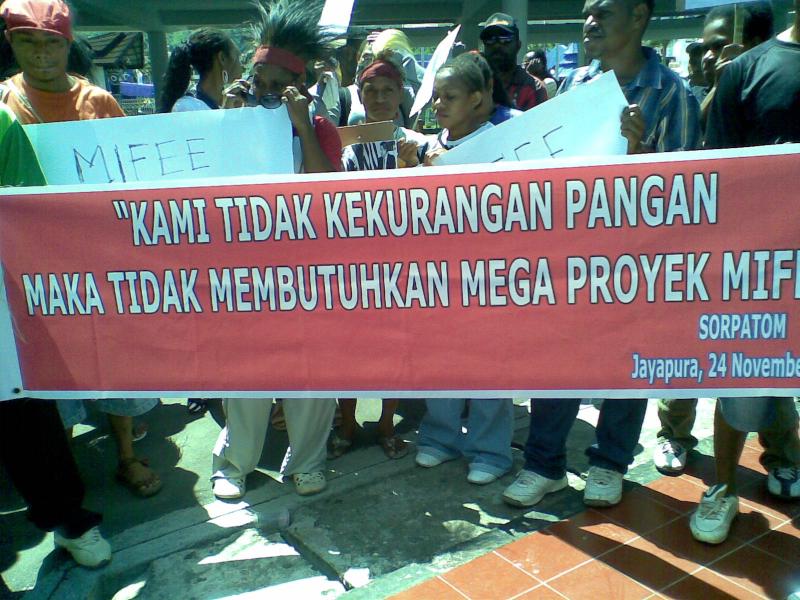
Protest against MIFEE in Jayapura. Photo: SORPATOMNews


Wednesday, February 16, 2011

Help wanted in analyzing proposed environmental law

UPDATE: La'o Hamutuk's analysis of the law can be found here 


La'o Hamutuk is seeking help in analyzing and proposing improvements to Timor-Leste's draft environmental law. On their blog they write:
In late January, Timor-Leste's Secretary of State for Environment circulated a Portuguese-language draft of a basic Environmental Law (also PDF) for limited public consultation.... The Secretary accepted La'o Hamutuk's request to extend the comment period until the end of February. 
La'o Hamutuk has done a preliminary computer-assisted translation of the draft law into English (also PDF), and we are asking people and organizations to make your own submissions or to email us with ideas, suggested changes or other analysis which will help us write ours.
The law has many good aspects, including recognition of the precautionary principle, "polluter pays," the importance of greenhouse gas emissions, public consultation,tara bandu, and community involvement. But it also contains significant loopholes and gaps -- and leaves most specifics for subsequent decree-laws.
La'o Hamutuk plans update its webpage on the law as its receive comments, analysis or new information. 

Friday, October 8, 2010

Call for Climate Justice in Timor-Leste


Timorese plant Mangrove trees on October 10, 2010. Photo by Charles Scheiner

The Movement for Climate Justice in Timor-Leste is joining the global movement to give one hour for the earth. 

On Sunday, 10/10/2010, thousands of actions all over the world will celebrate the international campaign to reduce greenhouse gas emissions to limit global carbon concentration to 350 parts per million to save our planet.

In Timor-Leste, an organizing committee is asking religious, government and other leaders, as well as the entire population of Dili, to take part in this campaign with a concrete action: stop all fossil-fuel-based transport in Dili from 3:00 pm to 4:00 pm Timor-Leste time on Sunday, 10 October 2010.

This concrete action will show the world that Timor-Leste is in solidarity with people worldwide in our common campaign on that day to limit greenhouse gas emissions. Our declaration follows below.

In addition, people will gather at 3:00 pm at the intersection next to Farol Primary School (across from Hasatil) to walk to the mouth of the river in Bidau Santana to plant mangrove trees.


DECLARATION OF THE MOVEMENT FOR CLIMATE JUSTICE

“One Hour for Mother Earth”


Today, the entire world is confronted by the huge impacts of climate change. The world is already at great risks to humanity, ecological disasters, hunger, and island nations disappearing under the sea. These consequences come from the interests of rich people, companies and countries who give importance only to their economic profit, rather than to the lives of people around the world.
Many scientists have already studied our earth and the lives of its inhabitants. They concluded that the conditions that are leading to the destruction of the world cannot be avoided as long as people, companies and industrialized countries continue to increase their emissions into the global atmosphere.
For the world able to survive for many more years with the guarantee that everyone will have the opportunity to live and have children, everyone must realize that the emission of greenhouse gases must be reduced, by changing people’s lifestyles.
Timor-Leste has become an oil-producing nation, and therefore contributes to global emissions. Development inside our country will also lead to environmental damage and pollution.
Today’s reality in Timor-Leste also shows us that we are already at risk from hunger, a threat which will confront humanity and human survival is close to us today. The rainy season doesn’t follow its time, dry days are few, natural disasters happen all the time, agricultural production drops and is destroyed, many springs have dried up, seas are high and rough (eroding the coastal zone), and more.
Everyone must pay attention to these phenomena, we all must be aware of “One world for all of us,” and we must all come together to save the planet for our children and future generations.


Secretary of State Avelinho Coelho prepares to plant Mangrove tree on 10/10/10
Therefore, we from the Timor-Leste Movement for Climate Justice ask and demand of:
·     Industrialized countries should reduce their greenhouse gas emissions by 40-45% in 2020 and 80-85% in 2050, based on the IPCC (Intergovernmental Panel on Climate Change) report.
·     Industrialized countries, especially the United States, European Union, Australia, China, Japan and others should consider all people in the world, and work to normalize greenhouse gases globally at 350 ppm.
·     Industrialized countries should give reparations and compensation equal to the environmental destruction they have caused so far.
·     Industrialized countries should mobilize and expand their use of environmentally-friendly renewable energy, including changing current environmentally-destructive lifestyles .
·     The United Nations, which facilitates Conventions on Climate Change, should be more pro-active in giving pressure to highlight solutions to this global emergency. They should resolve to stop and immediately cut environmentally destructive technology and development practices.
·     The United Nations, especially the Security Council, should issue a resolution against countries which gravely pollute at the subregional or regional level, as a crime against humanity.
·     The Government of Timor-Leste must also think about its own people, and follow a development path which is sustainable, renewable, and friendly to the environment.
·     The Government of Timor-Leste, which has already signed the Kyoto Protocol, should implement the clauses of this protocol.
·     Peoples across the globe must understand that we must reduce emissions and change lifestyles to save our planet.
·     The Government of Timor-Leste should cancel the expensive heavy oil project, which destroys land and the environment, and reallocate its budget to develop and promote environmentally friendly energy sources like wind, hydroelectric, solar, biogas and other renewable energy.


The Struggle Continues.

Movement for Climate Justice
Haburas Foundation, La’o Hamutuk, Permatil, Hasatil (list in formation) and other activists and individuals.
Contact: Demetrio (Haburas) +670-723-1881 or Maxi (La'o Hamutuk)  +670-733-6307

see Tetum version of the announcement and call here

UPDATE: posted a revised version of Declaration. Copy-editing changes only.  Added photos from 10.10.10 action

Thursday, June 3, 2010

West Papua Report - June 2010

This is the 73rd in a series of monthly reports that focus on developments affecting Papuans. This series is produced by the non-profit West Papua Advocacy Team (WPAT) drawing on media accounts, other NGO assessments, and analysis and reporting from sources within West Papua. This report is co-published with the East Timor and Indonesia Action Network (ETAN) Back issues are posted online at http://etan.org/issues/wpapua/default.htm

Summary
The West Papua Advocacy Team editorially notes that Papuans are welcoming the June visit of President Obama to Indonesia with the hope that the administration will seek to build a new U.S.-Indonesian relationship not based on military and commercial interests but rather founded on common respect for human rights and democracy. That hope fuels Papuan beliefs that such a transformation in the U.S. perspective could bring about fundamental change in their plight, an increasingly desperate situation in which the U.S. is historically complicit. 


A military ultimatum to a rebel leader in the Papuan central highlands and thus far small scale military operations there are raising fears of a massive "sweeping operation" when the ultimatum expires in June. Initial reports indicate that operations may have begun ramping up at the end of May. In the past such operations have uprooted thousands of civilians and led to many civilian deaths.


Leading U.S. legislators have strongly cautioned the U.S. administration against resuming training and other assistance to the Indonesian Special Forces (Kopassus). Those forces are among the most prominent violators of human rights, especially in West Papua. Also in the U.S. Congress, Congressman Patrick Kennedy has launched a resolution in the U.S. Congress which expresses the sense of the House of Representatives regarding the human crisis facing Papuans. The resolution, now gaining support in the U.S. House of Representatives, calls on the Government of Indonesia to address human rights concerns, including the abuse of detainees.


An editorial by a senior official in Human Rights Watch has again called attention to extraordinary abuse of prisoners in West Papua and decried the unaccountability of the abusers. Indonesian authorities have again prevented international journalists from documenting peaceful civil dissent in West Papua. An Amnesty International report is strongly critical of the Indonesian government's continued repression of dissent noting in particular the use of torture against peaceful demonstrators. The Indonesian government is moving forward with plans for a massive "food estate" in the Merauke area of West Papua. The plan has drawn strong criticism from Papuan and international observers concerned that the government-organized in-migration of very large numbers of non-Papuans to work in the estate will further marginalize Papuans, amounting to what could be described as creeping genocide. Environmentalists have also voiced concern about the destruction of vast stretches of forest and peatland which will significantly increase carbon emissions.


Full report here

Sunday, March 28, 2010

La'o Hamutuk call for rejection of the Copenhagen climate accord

La'o Hamutuk has written to Prime Minister Xanana Gusmão urging that Timor-Leste to reject the Copenhagen Accord on climate change. The group offers 7 arguments including:
The Copenhagen Accord contradicts some basic principles of the UNFCCC [United Nations Framework Convention on Climate Change], including the principle of common but differentiated responsibilities. It also contradicts the Kyoto Protocol because it leaves it up to the developed countries to reduce their emissions, with no legally binding targets. It is not a democratic agreement because it was decided only by a small group of countries, not by all countries in COP. This is against the principle of consensus in the UNFCCC. If Timor-Leste associates to this Accord, we are going against some principles in UNFCCC and Kyoto Protocol that we have ratified.
La'o Hamutkuk writes that "a small group who don't want to take responsibility for their actions which have destroyed the global climate" negotiated The Copenhagen Accord.

Read the full letter here.

Friday, March 19, 2010

Tough week for Sinar Mas

from Ayu Oktaviani

Sinar Mas, Indonesia’s largest oil palm company which has come under considerable criticism for its palm oil operations in recent years, was handed two significant defeats this week.

Food giant Nestlé found itself on the defensive, with the release of a report from Greenpeace criticizing the company for buying palm oil from Sinar Mas. This comes three months after the largest buyer of palm oil, Unilever, announced that it would no longer be purchasing palm oil from Sinar Mas, followed a month later by a similar announcement from Kraft Foods. Nestlé’s immediate response that Sinar Mas palm oil was only used in products sold on the domestic market, a practice that they would discontinue, showed how controversial Sinar Mas has become. Western consumers are becoming increasingly concerned about palm oil plantations that have been clearing forests across the archipelago, destroying local habitats, particularly in Sumatera, Borneo and Papua where most of the remaining rainforests are located in Indonesia.  

A much less reported victory for local resistance against oil palm happened on March 18 in West Kalimantan (Indonesian Borneo). Two local indigenous leaders, Japin and Vitalis Andi, were released from custody after spending more than three weeks in a Ketapang jail for opposing a Sinar Mas oil palm plantation which is destroying indigenous lands. 

The case began in April 2008, when PT. Bangun Nusa Mandiri (PT. BNM), a subsidiary of Sinar Mas, began clearing land for an oil palm plantation in the Marau Subdistrict of Ketapang, West Kalimantan. By September 2009, the company had destroyed 250 hectares of land traditionally held by the Jalai Dayak people in Silat Hulu village.

From the start, the community refused to hand over their fields to the company, and made various attempts to negotiate with the company directly and through the local government, but to no effect. On September 28, 2009, Mr. Japin from Silat Hulu reported the company to the local Marau police office on behalf of his community. The next day, about 60 people from Silat Hulu collectively confiscated two bulldozers and a theodolite from PT. BNM in an effort to stop the clearing. The community soon gave the theodolite over to the police, but continued to hold the heavy equipment as evidence in their case against PT. BNM. 

The community also applied traditional justice mechanisms to the company, demanding financial compensation for trees and other vegetation that had been cleared as well as refusing the company further entry to their lands. The company ignored these demands and the traditional legal system. The community continued to look for justice, and on October 26, 2009, Luhai Hartanto, B, Ritung and Japin, on behalf of the indigenous people of Silat Hulu, brought the case to the West Kalimantan delegate for the Indonesian National Commission on Human Rights (Komnas HAM), and to the provincial police department of West Kalimantan. 

On October 15, fully-armed local police came to Silat Hulu, to secure the peace and negotiate a settlement between the villagers and the Sinar Mas subsidiary. The police did not flatly reject the community-imposed penalty, but attempted to renegotiate the compensation amount for plots destroyed by PT. BNM. The community agreed to reduce the monetary compensation from 1.3 billion Rupiah to 510 million Rupiah (US$ 140,000 to US$55,000), in the hope of a quick resolution, with assurances that the police would push for PT BNM to resolve the case. 

Friday, January 22, 2010

Heavy Oil Construction Begins at Hera, Timor-Leste


From La'o Hamutuk:


On 15 January 2010, the Prime Minister, President of the Republic, Minister of Infrastructure and President of Parliament, together with a few ambassadors, laid the cornerstone for the Hera generating project, attended by more than 100 Government officials and a few others, although virtually nobody from civil society, international agencies or the political opposition was present. This is the first element of a $360 million system of two power plants which will be powered by heavy fuel and 800 km of high-voltage power lines. It is intended to power 12 districts within two years.

A contract was signed in October 2008 with Chinese Nuclear Industry Construction Company #22, with promises to electrify the nation by the end of 2009. However, work at the Hera site was suspended in mid-2009, and major technical changes were made in the project design. It will no longer use second-hand generators, can be adapted in the future to other fuels, and will have a more reliable closed-loop grid design.

Speakers at the Hera ceremony were defensive, attacking those who suggested improvements to the project. Photographs, complete Tetum audio recordings and unofficial English and Tetum transcripts by La'o Hamutuk are available at http://www.laohamutuk.org/Oil/Power/cornerstone/10PowerHeraCornerstone.htm .


Betano is in Manufahi district, not in Covalima as shown on the banner behind the Prime Minister Xanana Gusmao. Photos from La'o Hamutuk,

For information on heavy oil project developments during 2010, see http://www.laohamutuk.org/Oil/Power/10PowerPlant.htm
For information on heavy oil project developments during 2008-2009, see http://www.laohamutuk.org/Oil/Power/08PowerPlant.htm

Abridged excerpts from the speeches which preceded the laying of the cornerstone follow below.

-- La'o Hamutuk, 22 January 2010

Monday, December 14, 2009

A Joint Statement, Copenhagen: SE Asian Leaders - Go for Solution Not Delusion!

Southeast Asian Leaders - Go for Solution Not Delusion!
A Joint Statement, Copenhagen, Denmark, December 14, 2009


Copenhagen - 14 December 2009:

We, members of Oilwatch Southeast Asia [i] and Indonesian Civil Society Forum for Climate Justice (CSF) declare our common position and demands on the current climate negotiation in COP 15 UNFCCC Copenhagen. We have witnessed the lack of leadership among industrial countries to significantly cut carbon emission let alone show their responsibility to support developing countries to tackle the impacts of climate change.

Southeast Asia is considered as one of the most vulnerable regions in the world to impacts of climate crisis. Most of the Southeast Asian countries are poor and majority of the population in the region live in deep poverty resulting to a very low capacity to adapt to climate change impacts. The location of the region poses high risk for disasters such as typhoons, droughts, earthquakes, and flooding.

We are disappointed that the negotiations in COP15 UNFCCC do not take into account the reality in the ground that fossil fuel exploitation by industrial countries have been going from strength to strength. Oil and gas projects of transnational corporations are mushrooming and demand for coal is increasing [ii].

Big foreign and private corporations such as Royal Dutch Shell, BHP Biliton, CNUOC, Chevron Texaco, Amarada Hess, Conoco Phillips and Bumi Resources, are the same actors who plunder natural resources and pollute the environment [iii]. These big corporations control and exploit the rich natural resources of the region particularly fossil resources like oil, gas and coal. Also these entities with the support of international financial institutions like International Monetary Fund, World Bank and Asian Development Bank, are the owners and suppliers of fossil-based technologies and products that the people of Southeast Asian are forced to be dependent with.

Given the fact that burning and consumption of fossil fuels especially oil and coal is the leading cause of global carbon emission, we demand the national governments in Southeast Asia
  • To agree on a common position to push for more than 40% carbon reduction from ANNEX I countries by 2020 from the level of 1990.
  • To demand from ANNEX I countries to compensate Third World countries from ecological debt and fund their mitigation and adaptation initiatives
  • To declare an immediate moratorium on new exploration and commercial operation of oil, gas and coal by big transnational companies in the region.
  • To define a concrete timeline and comprehensive plan on eventual phase out of fossil fuel extraction and usage in the region.
In this regard there should be a significant investment on research and fast development of technologies that harness alternative and renewable resources of energy that are cheap, safe and clean. This is needed to make the economy and energy needs of Southeast Asia to veer away from relying on the production and consumption of fossil fuels. Majority of the income and revenues from the existing extraction of fossil fuel in the regions should be automatically appropriated for funding public services

We oppose the false solutions being implemented and pushed for by ANNEX I countries and their transnational corporations such as carbon trading, clean development mechanism, the proposed REDD and 'clean' coal technologies. These market-based and profit-oriented solutions put the interest of private corporations and ruling elite above anything else.

We push for the leaders of Southeast Asia countries to unite for truly address the issue of climate change and curb global warming. There should be a reversal of the orientation and framework of economic development and production in the region. In this regard, climate solutions should be based on human security, rectification of ecological debt, land rights, the change of production and consumption pattern, to realize social justice and people's sovereignty.

These principles ensure in the heart of climate solutions are the welfare and interest of the people and the environment.

The Oilwatch Southeast Asia, CSF, PACC, La'o Hamutuk and TCJ remain committed not only in pushing for genuine climate solutions but also in steadfastly fight along with grassroots communities against agreement, policies, program and projects that will further aggravate climate change and endanger our communities.

Media contacts:
  • Clemente Bautista, People's Action on Climate Change (PACC), email: entengi2@yahoo.com.ph; cell phone:  +45.2639.2749
  • Ines  Martius, Timor-Leste Institute for Development Monitoring and Analysis, email: ines@laohamutuk.org; cell phone:  +45 5274 8769 
  • Siti Maemunah, CSF Indonesia, email: mai@jatam.org;  cell phone +45 5049 956
  • Penchom Saetang, Thai Working Group for Climate Justice (TCJ), email: toxiccampaign.earth@gmail.com cell phone: +45 2862 7267

[i] Oilwatch SEA is a regional alliance of fossil fuels-affected communities and support organizations from Arakan Oil Watch from  Burma;  Indonesian Civil Society Forum on Climate Justice (CSF) and JATAM from Indonesia; Friends of the Earth from Malaysia; People's Action on Climate Change (PACC), Kalikasan People's Network for the Environment (Kalikasan-PNE) and Central Visayas Fisherfolk Development Center Inc. from Philippines, Timor-Leste Institute for Development Monitoring and Analysis (La'o hamutuk) from Timor Leste; and Thai Working for Climate Justice (TCJ) and Ecological Alert and Recovery

[ii] Almost half of Indonesia coal production, - around 100 million tons - , was extracted by Bumi Resources mostly for export.  The company Climate Justice and Ecological Alert and Recovery  --Thailand from Thailand.

[iii] Today 80% of 216 million tons total coal product from Indonesia is aimed for export and the demand has been increasing over the year.

Thursday, December 3, 2009

from Haburas - save Timor's forests, buy bio-briquettes and fuel efficient stoves

from Haburas in Dili

Dear Santa Claus,

This Christmas what I really want is to help to promote primary industry in Timor Leste whilst saving Timor's forests and natural resources. I have heard that through using bio-briquettes and fuel efficient stoves instead of burning wood I can have a direct effect on the future of Timor Leste's forests and natural resources. I have heard that through using bio-briquettes and fuel efficient stoves instead of burning wood I can have a direct effect on the future of Timor Leste's environmental health and at the same time support local unemployed men, women and youth in Dili.

Please please please can you bring me a Manatuto made Fuel-Efficient, Briquette-Specific Stove for Christmas, they are available at The Haburas Foundation in Farol.

With this stove I can reduce the amount of money my family spends on cooking fuel and even reduce the amount of smoke my family and I inhale when cooking. I have also heard that it is very easy to use and very easy to change from cooking with wood to using bio-briquettes once I have the stove.


Thank you, and Merry Christmas

The Starter Pack of a FEBS Stove, a large bag of Briquettes and an instruction leaflet costs $10. They would make an ideal present for your household, friends or your local staff. Briquettes and stoves will continue to be available from Haburas and other sale locations in the New Year.

The BRIQUETTE PROJECT is a Haburas initiative funded through an AusAid development grant.

UPDATE: Added photo from WhatisMatt. See also IRIN: High hopes for bio-briquettes.
More photos are here.

Monday, November 23, 2009

Satellite imaging of environmental damage near Freeport mine in West Papua and in Timor-Leste


Dr. Chris Lavers writes

There is considerable international concern at the rapid growth of the Freeport mine at Grasberg, operated by Rio Tinto Zinc (RTZ) in West Papua (Irian Jaya) over failures to address human rights and environmental protection issues. For the Amungme tribe, reduction of the beautiful Mount Grasberg, one of the largest Sudirman range peaks, to a vast hole in the ground, has been devastating.
Read the rest here
 
Figure 4 Central view of the mine (Tambang Terbuka).

see also the ETAN/WPAT: Statement on the operations of the Freeport McMoran Mine in West Papua, Indonesia

The blog Return to Rai Ketak posted several NASA satellite images showing fires throughout Timor-Leste during the height of the dry season.